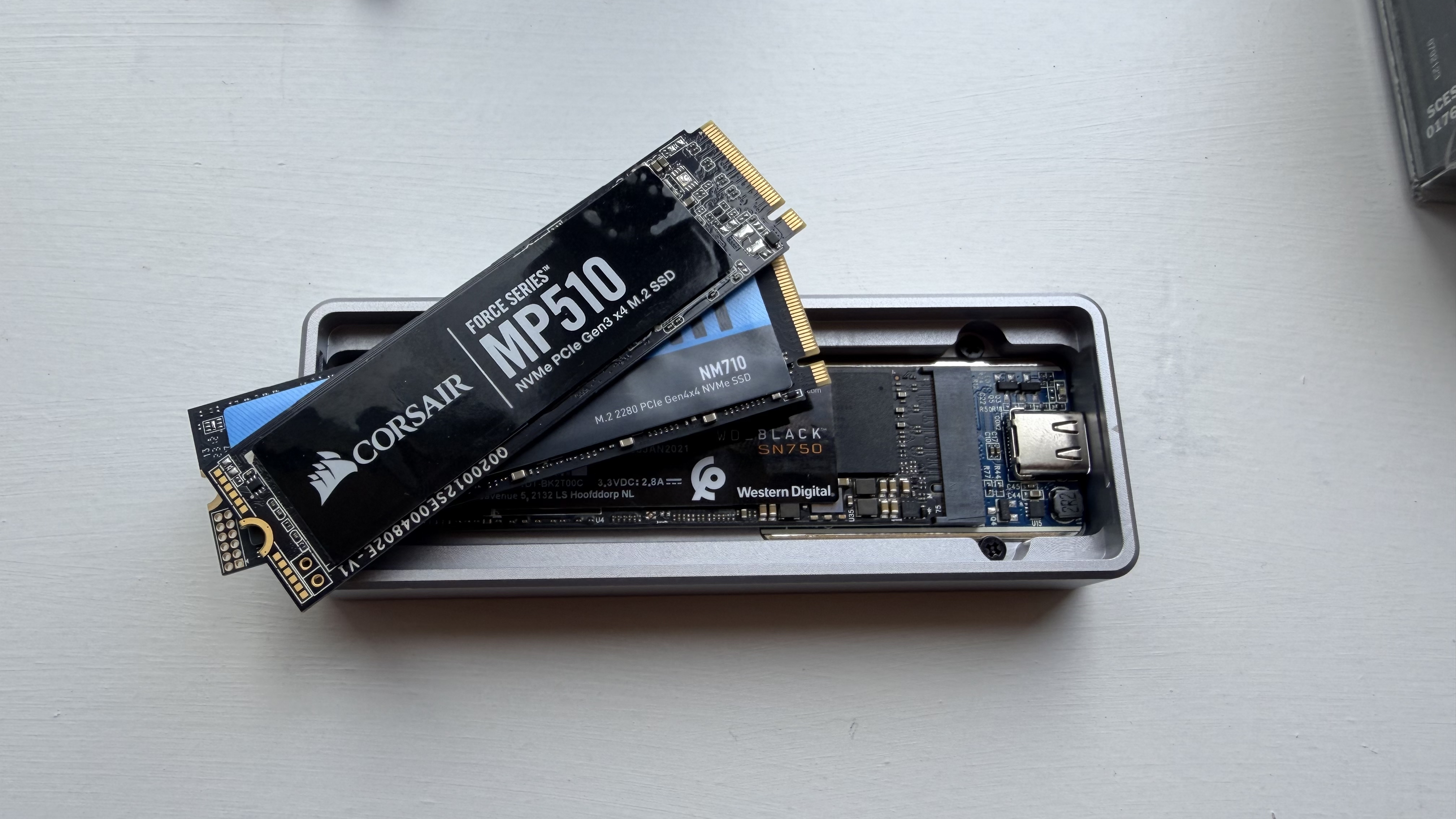
SSD price increases 2026 are hitting the DIY PC market in the part of the build that used to be boring: storage. Tom’s Hardware, comparing current retail listings with prices from Amazon Prime Day 2025, found some mainstream drives now cost two to four times as much as they did a year ago.
The pain is broad because SSDs are not one tidy category. PC builders may be shopping for M.2 NVMe drives, older SATA SSDs, external storage, PCIe Gen 4 options, or faster Gen 5 models. Tom’s Hardware says the price spike has cut across those choices, even though performance and use cases vary widely.
Why are SSD prices so high in 2026?
Tom’s Hardware attributes the current market to the same AI-driven component crunch affecting memory, along with SSD shortages and Micron’s decision to wind down Crucial as a consumer brand. SSDs use NAND flash, and when supply tightens or manufacturers redirect capacity toward enterprise customers, retail buyers tend to see fewer bargains and uglier shelf prices.
Micron announced in December that it was closing its consumer Crucial operation to focus on enterprise. Tom’s Hardware notes that Crucial’s exit may be less damaging for SSD competition than for RAM, because the SSD market has more vendors and product lines. Still, removing a known consumer brand takes one more pricing pressure point out of the market.
How much have SSD prices changed?
The cleanest example is Samsung’s 990 Evo Plus 2TB. Tom’s Hardware recommended that drive for a 1440p gaming PC during Amazon Prime Day 2025, when it was discounted to $113 from $176. The same drive is now listed on Amazon at $363.49 after a 36% discount, according to Tom’s Hardware, a 221.5% increase from last year’s deal price.
The listed full price is even stranger: $579.99. Tom’s Hardware says the highest actual price it has seen for that model was $465 in May, still more than four times the 2025 sale price. That spread also shows why retail “discounts” are a bad map right now. A large percentage markdown can still leave the buyer with a bad deal.
Higher-capacity drives have lost much of their old value, too. Tom’s Hardware says 4TB M.2 SSDs such as the WD Blue SN5000 and Silicon Power UD90 could be found just over a year ago for $214 and $209, respectively, near 5 cents per gigabyte. The WD Blue SN5000 is now $449.99, or 11.2 cents per gigabyte.
Are SATA SSDs cheaper now?
Falling back to SATA does not automatically fix the problem. Tom’s Hardware has been tracking Samsung’s 870 Evo 2TB on Amazon and says it once sold for $80 and was no more than about $150 a year ago. Amazon is now showing it at $399 after a 62% discount, with a listed price of $1,039.
That does not mean a 2TB SATA SSD has suddenly become a four-figure product in any sane sense. It means current list prices and discount badges are noisy enough that shoppers have to compare real historical prices, not the number crossed out on a product page.
What counts as a baseline SSD price now?
Tom’s Hardware says that, excluding PCIe Gen 3 drives, the low end for M.2 SSDs is now about 11 cents per gigabyte. It points to the Silicon Power UD90 as one of the better current values: $439 for 4TB, around $150 for 1TB, and $244 for 2TB.
Faster Gen 5 drives cost more. Crucial’s P510 is listed at $180 for 1TB and $340 for 2TB, while Samsung’s 9100 Pro is priced at $250 for 1TB, $400 for 2TB, and $900 for 4TB, according to Tom’s Hardware.
Prebuilt PCs may hide some of the sticker shock, but Tom’s Hardware warns that vendors can obscure SSD quality more easily than RAM capacity. A spec sheet can advertise storage without making the drive’s generation, speed, or capacity tradeoff obvious. That is where the old boring part of a PC build has become worth reading twice.
This story draws on original reporting from Tom's Hardware.