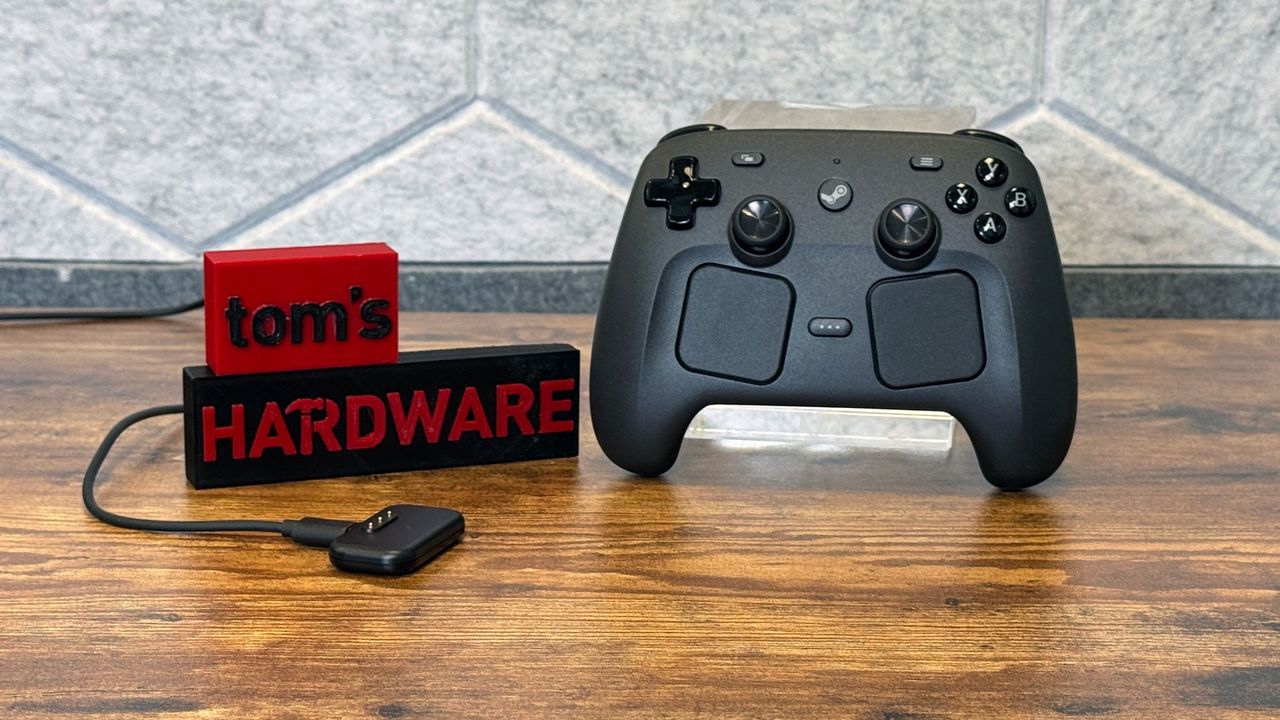
Steam Haptics Player, a project published by developer Pixel1011, sends audio files to the haptic hardware in Valve’s 2026 Steam Controller, making vibrations audible as music. The controller has no conventional speaker, and this is not a Valve feature. It is a reverse-engineered experiment that treats the motors behind its controls as a very unusual audio output.
The project’s repository says it streams stereo audio from a file to the controller’s haptics and supports the Steam Controller (2026), not other controllers. The result is a controller doing a job its hardware was not publicly sold to do.
How does Steam Haptics Player make a controller play audio?
According to Tom’s Hardware and HWBusters, Pixel1011 found low-level Human Interface Device, or HID, commands that can pass raw audio data to the controller’s haptic system. Steam Haptics Player uses FFmpeg to decode or transcode an audio file, prepares a PCM audio stream, then sends packets through those commands instead of routing them through higher-level input software such as Steam Input.
The controller firmware drives the haptics with that data. Because vibration can move air, the motors produce audible sound. HWBusters reports that the tool splits the wired signal across two main motors, producing its stereo effect. That does not turn the device into a purpose-built stereo speaker, obviously. It is still audio made by components intended for tactile feedback.
What quality does wired and wireless playback support?
Over a wired connection, the reported format is 16-bit, 8 kHz PCM. The 8 kHz sample rate is a key constraint alongside the 16-bit depth: this is low-bandwidth audio, not a claim of full-range music playback. Tom’s Hardware described the wired demonstration as comparatively loud and balanced in its listening assessment. HWBusters separately reported that wired playback should normally be cleaner.
Wireless operation through Valve’s Puck is more constrained. Reports say the tool uses 8-bit μ-law audio at 8 kHz, a compact encoding that reduces the amount of data sent. Tom’s Hardware reported crackling, popping and gaps in wireless playback, attributing them to limited bandwidth; HWBusters also cited packet loss over the air. The Puck was not designed as an audio transport, and it behaves accordingly.
Can owners use it safely?
Pixel1011’s repository identifies the project as file-based audio playback, and reporting says FFmpeg is needed to handle decoding or transcoding. That establishes a basic setup requirement, not an endorsement from Valve.
The longer-term tradeoff is unresolved. HWBusters reports that the project documentation warns there is no established assurance about sustained use of undocumented HID commands on the haptic motors. Tom’s Hardware also reported that the battery-life effect is unknown. For now, Steam Haptics Player is a documented hack with a working demo, not evidence that a controller’s haptics are built for hours of audio duty.
This story draws on original reporting from Tom's Hardware.