A Subway menu PCs gaming experiment by TechTuber Garkus turned three retired sandwich-shop signage machines into tiny game boxes, with results that landed about where the silicon says they should: GTA V at roughly 15 fps and Minecraft around 25 fps.
Garkus said the three systems had spent about a decade driving Subway menu displays above counters and were kept out of the scrap pile along with matching LG digital signage TVs. The machines booted into Windows and kiosk mode, where they showed the restaurant menu rather than a normal desktop.
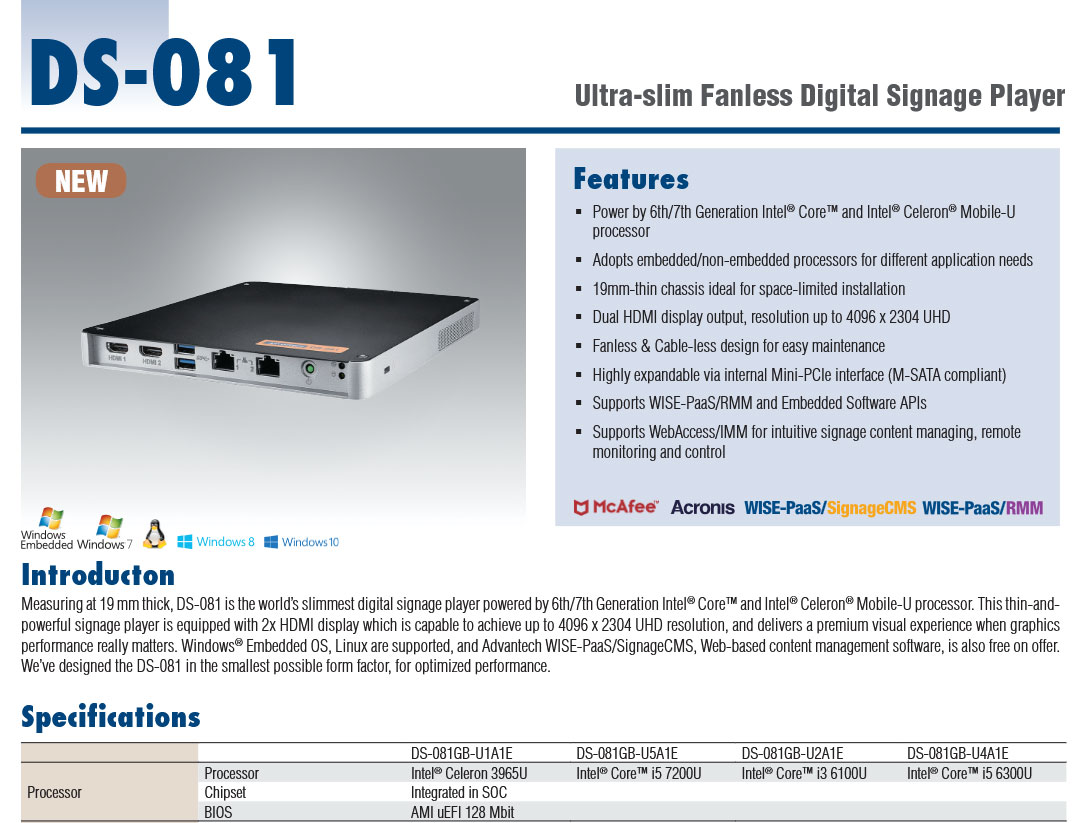
The hardware was identified from its labels as Advantech DS-081 digital signage PCs. Advantech’s data sheet lists the relevant Core i3-6100U version as the DS-081GB-U21A1E, a slim, passive-cooled unit built to run displays rather than chase frame times.
A digital signage PC is a small computer used to drive screens in stores, transit hubs, restaurants and other public spaces. It usually prioritizes quiet operation, low power draw and long unattended uptime, which explains the fanless design here and also explains why the gaming numbers were not kind.
Can Subway menu PCs run games?
They can run some games, according to Garkus’s test, but the retired Subway boxes are far better suited to light titles and older-console emulation than modern mainstream PC gaming.
The processor inside the tested units is an x86 Intel Core i3-6100U, a Skylake-era dual-core, four-thread mobile chip running at 2.3 GHz. The chip is configured for a 7.5 W to 15 W power envelope, which is sensible for a sealed box mounted behind a menu board and less sensible for heavyweight games.
Graphics are handled by Intel HD Graphics 520, integrated into the processor with 24 execution units and a maximum clock of 1.00 GHz, according to the specifications cited by Garkus. Because it is integrated graphics, it shares system memory instead of using dedicated video memory, so memory capacity and bandwidth matter more than they would on a machine with a discrete GPU.
The units were not completely barren. The DS-081 has two HDMI 1.4 outputs, two Ethernet ports, four USB 3 ports, audio input and output, and an RS-232 serial port. Inside, Advantech’s design supports two DDR4-2133 SODIMM slots for up to 32GB of RAM, a SATA III drive, and an mSATA connector. Garkus’s machines arrived with 4GB of RAM in one slot and a 64GB SATA SSD.
For the test, Garkus added another 4GB DDR4 module, bringing a machine to 8GB of RAM. He then split the three PCs across operating systems: one stayed on Windows 10, one received Bazzite Linux after SteamOS objected to the SATA-only storage setup, and another was configured as a Hackintosh running macOS Monterey.
The easy win was Peggle, a lightweight 2D puzzle game that ran without trouble. GTA V was a much rougher fit. Garkus reported about 15 fps, though the game had defaulted to high settings, took a long time to prepare on Bazzite, and crashed when exiting.
Minecraft fared better but still not well. Garkus saw uneven performance around 25 fps, and the video did not provide resolution or quality settings for that run. He also tried Mario Kart Wii emulation while GTA V was still compiling shaders, which makes the result more tinkering session than controlled benchmark.
Garkus concluded that the former kiosk PCs make more sense for emulating older systems up to the PlayStation 2 and original Xbox era. Even there, the hardware points toward lighter games and reduced settings rather than a miracle resurrection of restaurant display gear.
This story draws on original reporting from Tom's Hardware.