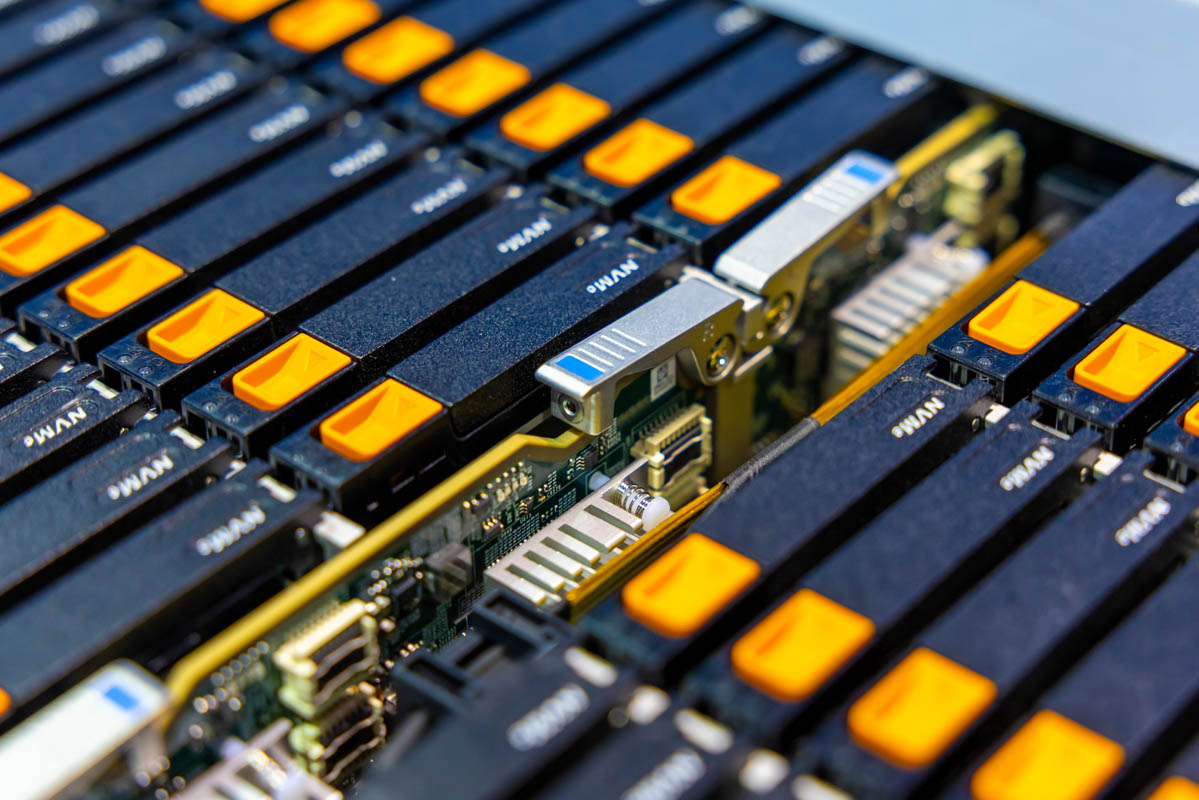
The Supermicro ASG-4116S-NU160R, a 4U storage server built around 160 hot-swappable 2.5-inch NVMe bays, was shown at FMS 2026, according to ServeTheHome. The machine is aimed at buyers who need to cram an awkward number of flash drives into four rack units, then have the software and power budget to live with the result.
The headline count needs a little decoding. Supermicro's datasheet lists 160 top-loading U.2 NVMe bays, each connected over PCIe 4.0 x1, plus four front-accessible E1.S NVMe bays running PCIe 5.0 x4. That makes 164 listed hot-swap drive bays in the default configuration. It also lists two M.2 NVMe slots. The additional four bays are not U.2, and the 160 U.2 bays are not PCIe 5.0, distinctions that disappear quickly once a product page starts waving around large numbers.
What hardware does the Supermicro ASG-4116S-NU160R use?
Supermicro specifies a single AMD EPYC 9005-series processor, with support for chips rated up to 360W under air cooling. The company lists a maximum of 96 CPU cores and 192 threads, along with 12 DDR5 RDIMM slots supporting up to 6TB of ECC DDR5-6400 memory at one DIMM per channel.
For expansion, the datasheet lists a PCIe switch and three PCIe 5.0 x16 full-height, half-length slots in the default configuration. Networking consists of two 10GbE RJ45 ports using a Broadcom BCM57416 controller, alongside a separate 1GbE management port. Supermicro also lists IPMI 2.0, virtual media and KVM-over-LAN, which gives administrators remote console access rather than requiring a trip to the rack for every bad boot.
The vendor names high-performance computing, research, AI training, analytics, drug discovery, weather modelling and finance among intended uses. Those are application categories, not performance results. Neither Supermicro's specifications nor the FMS report excerpt establishes capacity, throughput, latency or a price for a populated system.
What must operators plan for?
This is not a short chassis. Supermicro lists the rackmount enclosure at 6.9 inches high, 17.65 inches wide and 33.2 inches deep, with a net weight of 203 pounds. Its power table specifies two hot-plug, redundant 2,600W titanium-level supplies, rated at 96% efficiency. A rear-view text fragment in the datasheet instead says 2,000W, conflicting with both the power table and the headline features. Capacity planners should verify the shipping configuration rather than trust that stray diagram label.
The drive count creates a mundane but consequential Linux problem. Supermicro says the kernel assigns names such as /dev/nvme0n1 in the order controllers are detected during boot, which can change between reboots. The BMC, by contrast, keeps drives ordered by physical PCIe slot. Supermicro recommends mounting and identifying drives by UUID, while using the slot number to match the operating system's device with the BMC's physical-bay view. On a system with 164 hot-swap bays, treating an ephemeral device name as a stable identity would be a fairly expensive form of optimism.
This story draws on original reporting from ServeTheHome.