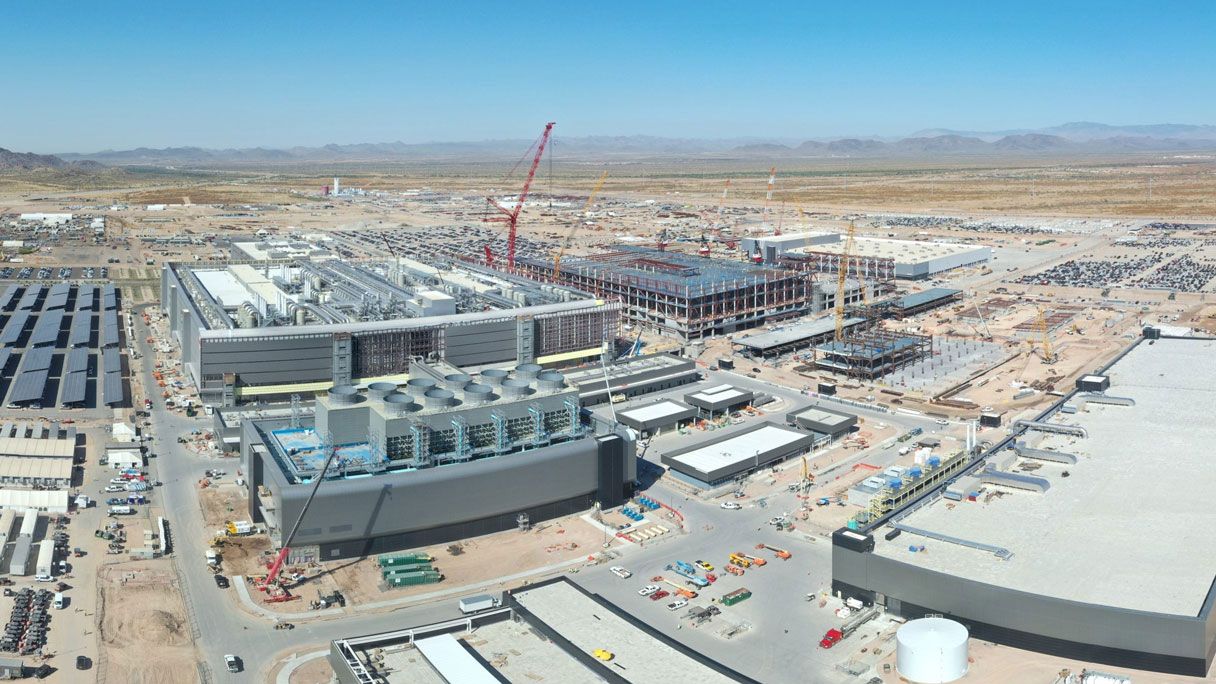
TSMC chief executive C.C. Wei said the company will put another $100 billion into its U.S. manufacturing buildout, adding at least four more chip fabs and advanced packaging facilities in Arizona. The new plants are intended for 2-nanometer chips and later process nodes, the company told investors during its second-quarter earnings conference in Taipei on Thursday.
The commitment brings TSMC’s announced U.S. investment to $265 billion. Wei did not give a construction schedule. He said the company will pace the work according to customer demand, which is the polite semiconductor-industry way of saying the press release is not the same thing as a purchase order for concrete, tools, water and workers.
Wei said the money will support additional logic wafer fabs for 2nm and smaller technologies, plus advanced packaging plants aimed at long-term demand from TSMC’s major U.S. customers. Bloomberg, citing a U.S. official, reported that the plan would bring TSMC’s U.S. footprint to 10 fabs and two advanced packaging facilities.
The packaging part is not decorative. For AI accelerators, wafer production is only one piece of the supply chain. Capacity for TSMC’s CoWoS advanced packaging has been a constraint for companies that need high-end processors assembled into usable accelerator packages. If TSMC builds that capability in Arizona alongside wafer fabs, U.S. customers would get a more complete domestic path from wafer start to packaged chip.
Record profits fund a larger buildout
The Arizona announcement landed with another record quarter for TSMC. The company reported net income of NT$706.56 billion, or $22.35 billion, for April through June, up 77.4% from a year earlier. Revenue rose 36% to NT$1.27 trillion, and gross margin reached 67.7%. TSMC said high-performance computing made up 66% of revenue by platform.
TSMC now expects third-quarter revenue between $44.6 billion and $45.8 billion. At the midpoint, that would be a 12% sequential increase. The company also lifted its full-year revenue growth forecast to slightly above 40% in U.S. dollar terms, compared with its earlier guidance of roughly 30% in June.
Chief financial officer Wendell Huang said 2026 capital spending is now expected to reach $60 billion to $64 billion, up from a previous plan of $52 billion to $56 billion. Huang said 70% to 80% of that budget will go toward advanced process technologies.
TSMC’s equipment suppliers are describing the same demand curve. ASML raised its 2026 outlook on Wednesday, and Applied Materials chief executive Gary Dickerson told Nikkei Asia that the industry is headed for years of capacity expansion.
No fixed clock for Arizona
The extra U.S. pledge follows a U.S.-Taiwan trade agreement that cut tariffs on Taiwanese goods to 15% in exchange for $250 billion in planned Taiwanese investment in the United States. It also came roughly two weeks after President Donald Trump said TSMC was doubling the size of its Arizona operations.
A demand-based commitment gives TSMC room to satisfy the political deal without promising a fixed spending calendar. Wei said he expects demand to stay very strong through 2029 or 2030, while adding that he was unsure whether there would be a dip before then.
Wei also said TSMC plans 13 leading-edge and advanced packaging fabs in Taiwan over the next several years, a point aimed at concerns that U.S. expansion could drain investment from Taiwan. Arizona still has practical problems to solve, including labor, water and visa constraints. Those may shape the buildout as much as customer demand does.
This story draws on original reporting from Tom's Hardware.