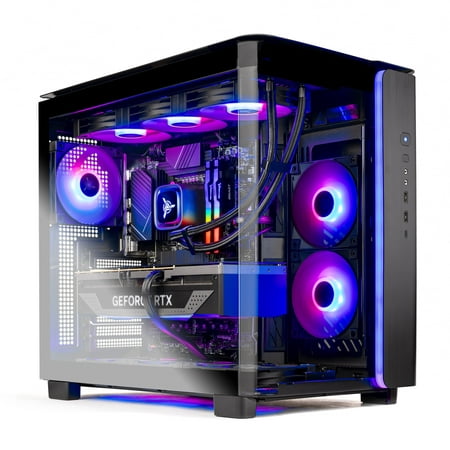
Walmart has listed the Skytech Gaming King 95 desktop gaming PC at $1,399, down from a stated $1,999.99 list price. That puts the advertised discount at $600.99 for a prebuilt machine built around AMD’s Ryzen 7 7800X3D and Nvidia’s RTX 5060 Ti 16GB.
For buyers pricing out a gaming desktop while component costs keep acting feral, the pitch is straightforward: this is a full Windows 11 system with the CPU, graphics card, memory, storage, cooling, and power supply already installed. Tom’s Hardware, which flagged the deal, says the total package would be difficult to match by buying the parts individually at the listed sale price.
What Walmart says is inside
According to Walmart’s product listing, the Skytech Gaming King 95 configuration includes:
- AMD Ryzen 7 7800X3D processor
- Nvidia RTX 5060 Ti graphics card with 16GB of VRAM
- 32GB of DDR5 memory
- 1TB NVMe SSD
- 850W Gold-rated ATX 3 power supply
- 360mm ARGB all-in-one liquid CPU cooler
- Windows 11
The Ryzen 7 7800X3D is an AM5 desktop chip with eight cores and AMD’s stacked 3D V-Cache. Tom’s Hardware describes it as the previous-generation gaming leader before the Ryzen 7 9800X3D arrived. The cache matters because games often benefit when the CPU can keep more data close to the cores instead of reaching out to slower system memory. Less waiting on RAM can mean smoother and more consistent frame delivery, depending on the game and the rest of the system.
Tom’s Hardware says the 7800X3D remains close to current X3D chips in its CPU gaming benchmark hierarchy. That is a benchmark claim, not a guarantee that every game will scale the same way, because resolution, graphics settings, engine behavior, and GPU load all get a vote.
The GPU and the catch
The listing pairs that CPU with an RTX 5060 Ti carrying 16GB of VRAM. Tom’s Hardware says the system should be suited to 1080p and 1440p gaming, with 4K possible when settings are chosen appropriately. It also points to the 16GB frame buffer and Nvidia DLSS 4 as factors that can help with frame rates and heavier texture or shader workloads.
The obvious compromise, according to Tom’s Hardware, is memory speed. The system has 32GB of DDR5, which is a sensible capacity for a modern gaming PC, but the memory is listed at DDR5-5200 MT/s. Tom’s Hardware calls that somewhat slow and says it should not severely damage the machine’s overall performance.
That caveat is still worth spelling out because RAM pricing has made casual upgrades less appealing than they used to be. The machine’s strongest parts are the CPU, the 16GB graphics card, and the overall prebuilt price. The memory speed is the bit that keeps the deal from looking cleaner than it is.
This story draws on original reporting from Tom's Hardware.