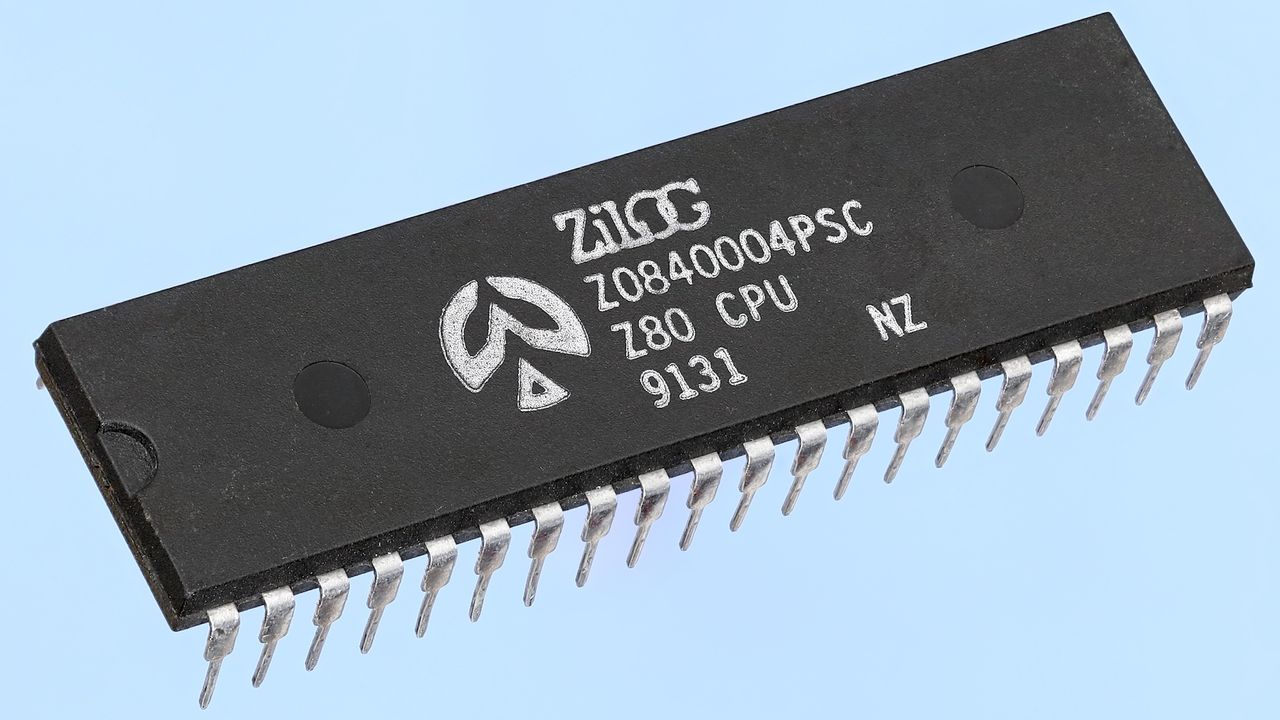
Zilog’s Z80 has reached its 50th year with an odd kind of afterlife: the original part is gone from Zilog’s order book, while an open-source replacement is working its way through real chip fabrication.
The 8-bit processor first went on sale in July 1976 and remained in production until 2024. Zilog, now owned by Littelfuse, told customers in an April 15, 2024 end-of-life notice that its wafer foundry would stop supporting the Z84C00 family. The company closed last-time-buy orders in June 2024.
That would normally be the boring end of a long-running component: distributors sell down stock, repair benches hoard parts, and old machines get a little harder to keep alive. The Z80 is getting a less tidy ending because Renaldas Zioma’s FOSS Z80 project is trying to build a drop-in replacement for the original 40-pin DIP package.
According to the project’s GitHub repository, the first silicon version of the design works. That chip was fabricated through Tiny Tapeout 7 on SkyWater’s 130 nm process and used a die area of 0.064 square millimeters. A later QFN64 version exposed all 40 Z80 pins through an Efabless CI2406 shuttle. Two more fabrication runs used IHP’s 130 nm process, and the current run targets the old DIP40 format through chip-on-board assembly on GlobalFoundries’ 180 nm GF180MCU process via Wafer.Space.
The goal is compatibility with machines and kits that expect a Z80 in the socket, including the ZX Spectrum and RC2014 systems. That is the useful bit for hobbyists and repairers: a modern board that asks old hardware to make fewer compromises.
The design uses Guy Hutchison’s TV80 Verilog core. The project’s Tiny Tapeout page says its 130 nm CMOS implementation should reach clocks up to 50 MHz. The original NMOS Z80 commonly ran at 4 MHz in that comparison, while the early commercial chip typically ran at 2.5 MHz. Later CMOS versions reached 20 MHz.
The original Z80 worked because Zilog made it convenient, not because nostalgia later declared it sacred. It was binary-compatible with Intel’s 8080, so it could run existing CP/M software. It also included a DRAM refresh counter on the chip, reducing the external support logic system builders needed. The Computer History Museum says working prototypes cost about $400,000 to develop, backed by $500,000 in funding from Exxon.
The part then spread everywhere 8-bit computing had a budget. It appeared in the ZX Spectrum, TRS-80, MSX computers, Sega’s Master System, the Pac-Man arcade cabinet, Texas Instruments graphing calculators, and other systems. Industrial controllers kept using it long after home computers moved to newer processors.
Zilog has also started trimming the Z80’s official successor family. In an October product change notice, the company put the eZ80L92 and several Z8F-series microcontrollers on end-of-life, citing “little to no demand.” Orders closed on January 20, with shipments scheduled through April 20 on non-cancelable, non-returnable terms. The notice named only the eZ80L92 among eZ80 parts, and the broader eZ80 architecture remains in Zilog’s catalog.
The Z80 is still getting dragged into new stunts, too. Earlier this year, a developer ran a small conversational AI program on a Z80 system with 64KB of RAM. That does not make the chip modern. It does explain why people are still bothering to fab replacements.
This story draws on original reporting from Tom's Hardware.