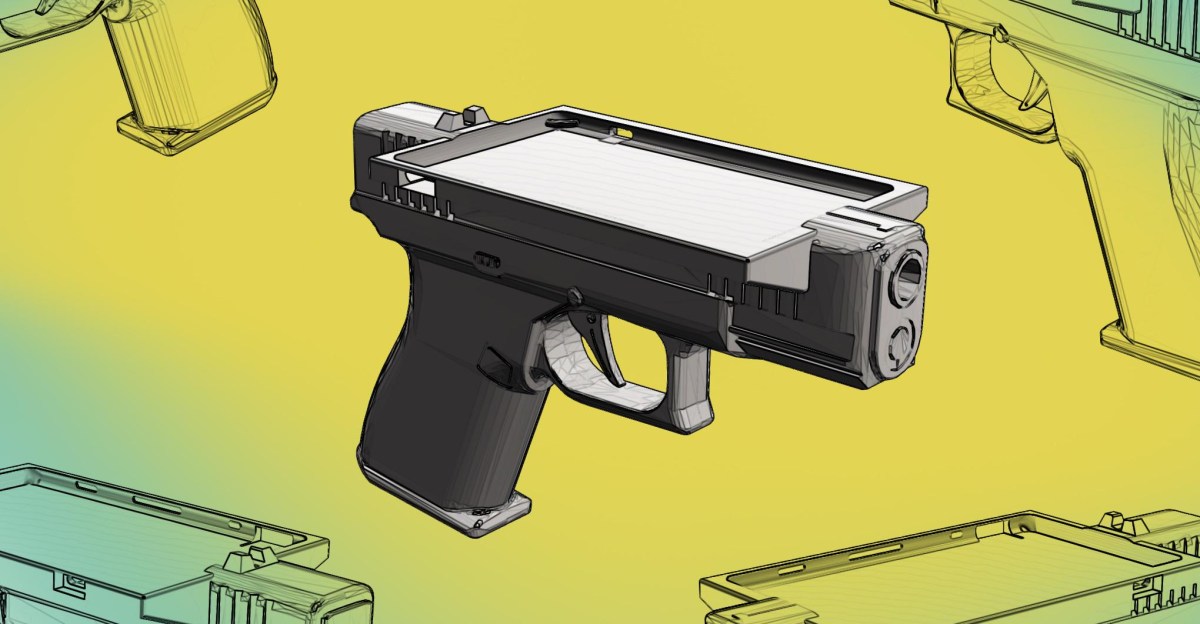
3D printer gun blocking laws now have an awkward mascot: the Gundle, a pistol-shaped case for the Xteink X4 e-reader made by Louisville creator Luke Blackford, who goes by Luke The Maker. The plastic accessory looks like a handgun because Blackford modeled its shell from a gun design, but it does not fire and its trigger does nothing.
Blackford showed the case last month in social videos, including one where he reads on the device and puts it in a car center console. The gag is obvious. The policy problem is less funny: software that tries to stop gun files before printing may have to decide whether a gun-shaped book gadget is a firearm part, a prop, or just one more cursed object from the desktop fabrication internet.
How would 3D printer gun blocking work?
The proposed systems would inspect a digital model before a printer makes it. If the software decides the file is a gun or gun component, it blocks the job. New York has already enacted a law requiring this kind of approach, while a California bill has passed the state Assembly, according to public records cited by The Verge. Both states are relying on expert panels to assess technical feasibility and implementation details.
New York Gov. Kathy Hochul’s office did not answer The Verge’s questions about Blackford’s case or false positives. Spokesperson Jess D’Amelia said Hochul is focused on public safety and that the law uses technical experts to address ghost guns and illegally made weapons.
Critics say the hard part is not stating the goal. It is getting code to distinguish illegal gun files from harmless objects that happen to share the same silhouette. Cliff Braun, associate director of technology policy and research at the Electronic Frontier Foundation, told The Verge that the Gundle is the sort of print the law is not meant to stop, while also showing why the problem is hard.
Why could an e-reader case get flagged?
One detection method compares files against hashes, or known digital fingerprints, of banned models. Braun and Dartmouth engineering professor Solomon Diamond told The Verge that this approach could miss modified files because small design changes can defeat exact matching. Another approach uses computer vision or AI to judge whether a shape resembles a gun. That could catch more variants, but it also risks blocking props, toys, tools, or oddball art projects.
Diamond said visual similarity is where false positives become likely, because a fake firearm and a functional firearm can look alike. He also described a third method, geometric identification, that could be tuned for exact geometry and would not be fooled by the e-reader case, though he said that approach is still new for print-blocking systems.
Handguns make the classification messier. The Bureau of Alcohol, Tobacco, Firearms and Explosives clarified in 2022 that the serialized part is the one housing the primary fire-control component. For AR-15-style guns, Braun said receivers are comparatively distinctive. For pistols, the serialized frame can resemble other objects more easily, from toy guns to power tools.
Blackford told The Verge he did not build the Gundle to test the laws, but he distrusts mandated scanning and favors open software. He made the case in less than a day by finding a free gun model, editing it in Fusion 360, adding the Xteink X4 fit, and printing it on a Bambu Lab H2D.
He later posted the files on his own site, while avoiding larger 3D model marketplaces because he did not want the design spreading too widely. Blackford said he has not taken it into public, and would print it in a clearly different color if he did. That caution is not cosplay. The Verge noted federal rules for look-alike firearms and cited the 2014 police killing of Tamir Rice, as well as a Washington Post report estimating that police killed 86 people over two years while they held realistic-looking toy weapons, pellet guns, or airsoft guns.
This story draws on original reporting from The Verge.


