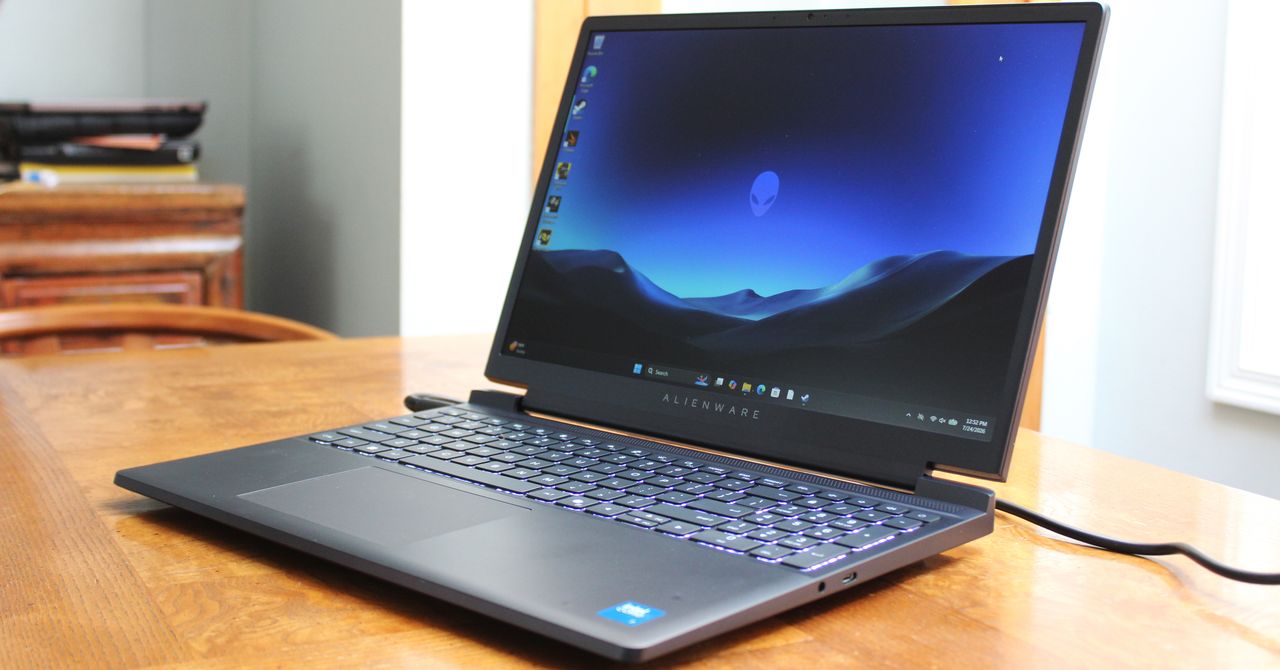
A new Alienware 15 review from WIRED gives Dell’s entry-level gaming laptop a 7/10, with reviewer Luke Larsen finding enough RTX 5050 performance to justify the price, while flagging the display as the machine’s obvious corner cut.
The laptop starts at $999 with an Nvidia RTX 4050, but Larsen said that configuration is hard to recommend because the GPU is more than three years old and has 6 GB of VRAM. In practice, he treated the $1,200 RTX 5050 model, with 8 GB of VRAM, as the realistic starting point. Dell also sells an RTX 5060 version for $1,350, a $150 step up from the tested model.
WIRED’s review describes the Alienware 15 as restrained by gaming-laptop standards. There is no aggressive lighting overload, and Larsen said the design borrows from Alienware’s Aurora laptops, including the keyboard look and chassis materials. The laptop is 0.9 inches thick, with much of that bulk in the lid. He found some flex in the lid and keyboard deck, but not enough to be a serious problem.
Ports are one of the stronger parts of the package. The Alienware 15 includes two USB-A ports, two USB-C ports, HDMI 2.1 and Ethernet. Both USB-A ports support up to 5 GBps, while the USB-C ports support up to 10 GBps. The left-side USB-C port can charge at up to 100 watts, useful for topping up the battery, though not enough for gaming under load.
Is the Alienware 15 worth buying?
WIRED’s answer is conditional: the RTX 5050 version performs well enough, but the screen and competing laptops make the value argument messy. Larsen said the Lenovo LOQ 15 remains the better buy while it is still available at $1,200 with an RTX 5060, because it offers faster gaming performance and a better display at the same price as the Alienware 15 RTX 5050 model.
The tested Alienware 15 uses a 15.3-inch, 1920 x 1200 display with a 165-Hz refresh rate. That refresh rate fits the hardware, but Larsen’s colorimeter measured only 63 percent coverage of the sRGB color space. A screen with low sRGB coverage cannot reproduce as many standard web and game colors, which is why images can look flat or off even when resolution and refresh rate look fine on a spec sheet.
The Alienware 15 also ships with Wi-Fi 6, which Larsen noted is two generations behind Wi-Fi 7. That does not mean the laptop has bad wireless networking, but buyers with a newer router will not get the latest wireless features from this machine. For a plain-language refresher, Kernel has an explainer on how Wi-Fi moves data without wires.
Performance was the review’s strongest argument for the laptop. With the RTX 5050 and Intel Core Ultra 7 240H, the system combines for 115 watts of performance. The CPU is from Intel’s previous generation, but Larsen said sticking with it appears sensible because newer Intel Series 3 laptops are currently expensive and the gaming difference is not large.
- Cyberpunk 2077: 65 fps at 1080p Ultra, 82 fps at 1080p Medium.
- Marvel Rivals: 38 fps at 1080p Ultra, 63 fps at 1080p Medium.
- Black Myth: Wukong: 30 fps at 1080p Ultra, 59 fps at 1080p Medium.
Larsen said the laptop can run demanding modern games around or above 60 fps after some settings changes, without wrecking image quality. He also reported that the RTX 5050 system was 77 percent faster in games than Intel’s best integrated graphics as tested in Dell’s latest XPS 14.
Battery life is less flattering. WIRED estimated the Alienware 15 is unlikely to exceed six hours under a light load, and would last only a few hours with heavier multitasking. That is not unusual for gaming laptops, but it is one more reminder that the Alienware 15 is a compromise machine, not a budget miracle.
This story draws on original reporting from WIRED.


