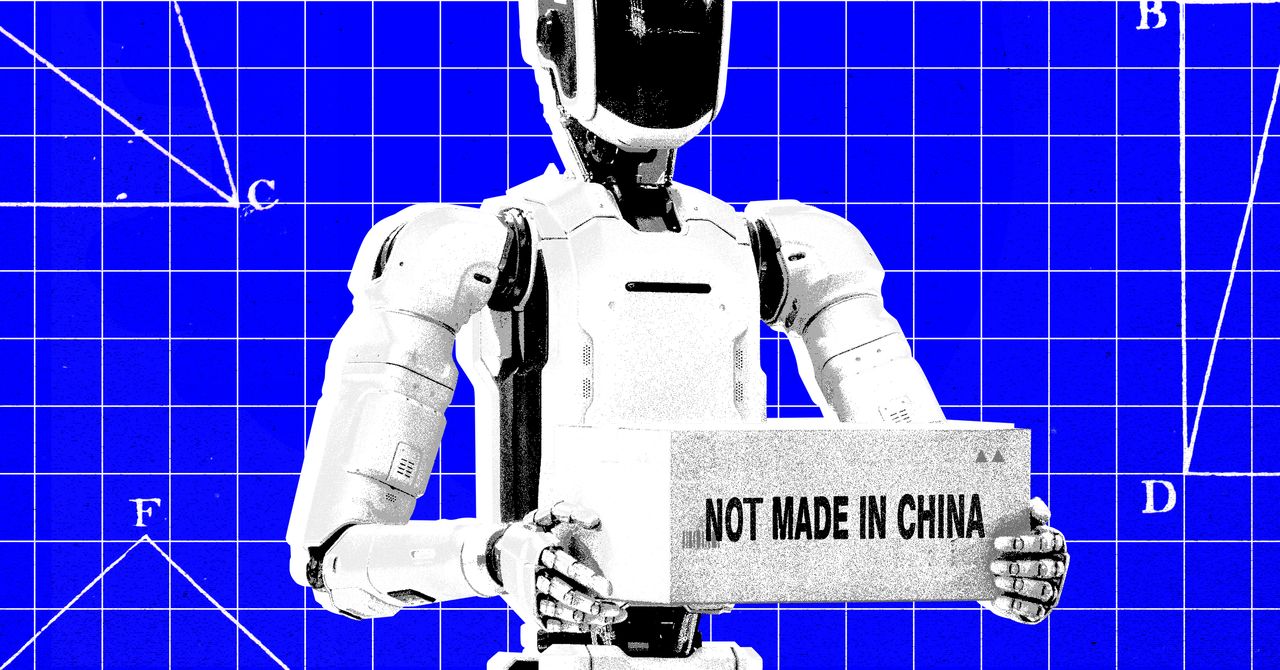
Ati Robotics’ China-free robot claim depends on which machine is under discussion. The company assembles robots in India, but founder Saurabh Chandra told WIRED that its 10,000-pound tugger still uses battery cells from China. Its pallet mover and planned humanoid have more direct Chinese component dependencies. That distinction has gained relevance after the Federal Communications Commission decision described by WIRED as barring new models of humanoids and other advanced devices from China.
Ati’s approach is a sourcing exercise, not a magic passport stamp. Chandra said the company’s Bangalore research and development operation helped control labor costs and let it adapt suppliers and components developed for India’s electric two- and three-wheeler market. He said the firm worked with vendors to modify some of those parts for robots. Automotive components, he said, are reliable, produced at scale and cost-efficient.
The company was founded in 2017 to develop motors for self-driving cars, according to WIRED. It later moved into industrial robots, including tuggers that pull wheeled loads and pallet movers that transport materials in large facilities. Chandra said choosing to develop its own hardware also reduced the company’s reliance on Chinese suppliers.
Which Ati robots still use Chinese components?
- 10,000-pound tugger: Chandra called it effectively China-free, while also identifying Chinese battery cells as its remaining Chinese-sourced component. The tugger uses lidar from Ouster, which Chandra described as a US-based supplier.
- Pallet mover: Chandra estimated that Chinese parts account for less than 5% of this model. He identified a Chinese solid-state lidar as a dependency and said Ati had no non-Chinese alternative for it.
- Humanoid: This machine is less insulated. Chandra said the full arm and actuator are made in Bangalore, but its harmonic drive, frameless motor and battery cells come from China, at least for now.
The motor choice illustrates the engineering cost of reducing a supplier dependency. Chandra said Ati uses induction motors rather than brushless motors containing magnets. The induction motors are somewhat less efficient, he said, but the company can compensate by using more battery capacity. The choice also means the magnet in Ati’s motor is not sourced from China, according to Chandra.
That is why “China-free” needs an asterisk large enough to read from the warehouse floor. A robot can be assembled in India, use locally adapted components and still rely on a Chinese battery, sensor or drivetrain part. Chandra said battery cells could instead be obtained from South Korea or Japan, but that was an assertion about potential sourcing, not a reported switch in production.
Chandra told WIRED that Ati had several hundred robots working in warehouses and factories, with more than 50 customers. He also said its first humanoid, designed to move heavy bins, was expected to enter service later that year. Those deployment, customer and timing figures are company statements, and the key test will be whether Ati can maintain its stated sourcing profile as its product range expands.
This story draws on original reporting from WIRED.