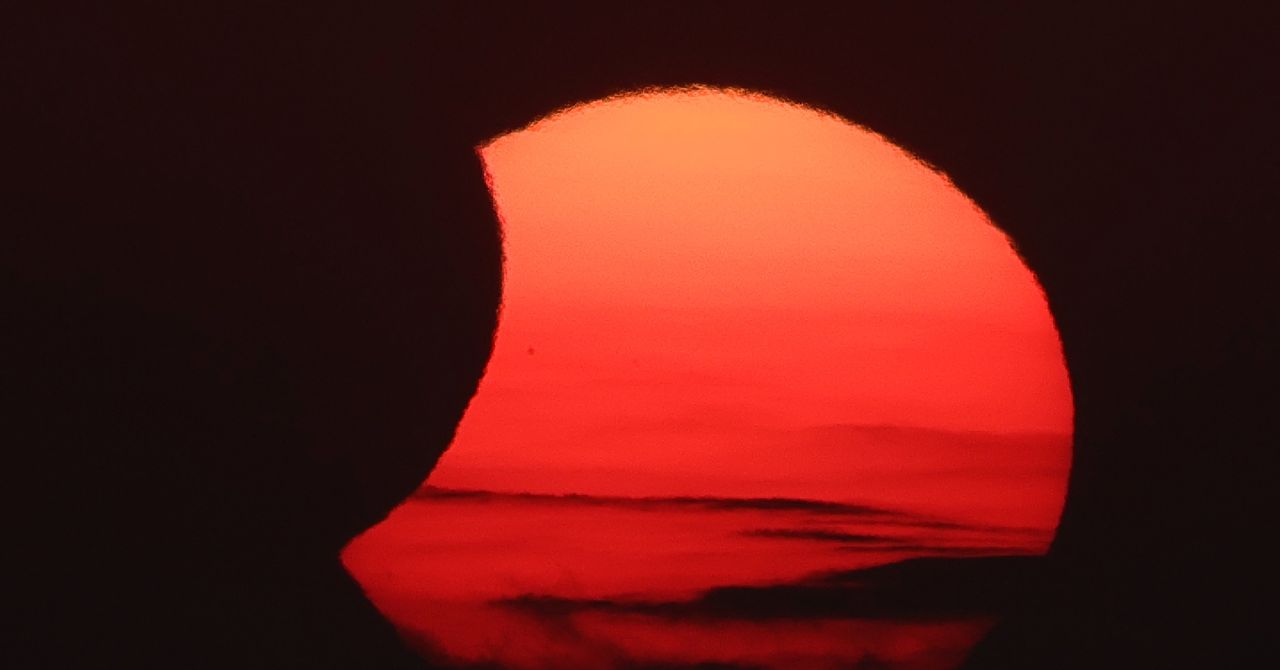
The August 2026 solar eclipse photos from Spain record a short window of totality, with the Sun low enough to share the frame with beaches, ports and city crowds. The August 12 eclipse crossed the Northern Hemisphere, and the path of totality passed over Iceland and Spain, according to NASA’s Scientific Visualization Studio.
WIRED’s Spain-focused gallery, using Getty Images photographs, documents both the astronomical event and the people who stopped to watch it. The selection is a set of credited scenes, not a scientific ranking of the day’s images. Any publisher reusing such photographs would need to secure its own rights.
Where did the August 12, 2026 eclipse path of totality run?
NASA says the path began in far northern Siberia near the North Pole, traveled through the Arctic and North Atlantic, and crossed Iceland and Spain. The rest of Europe and parts of North America and Africa experienced a partial eclipse.
That geography explains the gallery’s focus. Jaime Reina photographed the solar corona over Arenal Beach in Llucmajor, Mallorca, while Ander Gillenea captured the corona from San Asensio in La Rioja. The corona is the Sun’s outermost atmosphere; NASA says it can be seen during a total solar eclipse.
The sky show and the people under it
The photographs do not stick to a telescope-like view of the Sun. Pierre-Philippe Marcou’s image shows people gathered at El Cerro del Tío Pío Park in Madrid. Reina also photographed a family and other observers on Mallorca. At the port of Tarragona, Josep Lago photographed spectators watching the eclipse.
Other frames locate the event across Spain: Leon Neal photographed the eclipse from Palencia, Eric Alonso from Segur de Calafell, and Thomas Coex captured the period after totality from La Zurriola Beach in San Sebastián. Jose Jordan’s photograph over Valencia’s Albufera lagoon places a flock of birds in the scene after totality.
Those wider views have their own value. EarthSky, citing NASA’s Goddard Space Flight Center, notes that eclipse photographs can capture the changing environment and the people watching, rather than only a close image of the Sun.
How do photographers safely photograph a solar eclipse?
During partial phases, NASA Eclipse Data says a certified solar filter must cover a camera lens used to photograph the Sun. Viewers should not look directly at the Sun without specialized solar-viewing protection.
During the brief total phase, the filter must be removed to photograph the much fainter corona, NASA says. The same guidance recommends rehearsing camera settings and bracketing exposures, since one exposure cannot capture the corona’s full brightness range. Once totality ends, the filter goes back on.
The result is a gallery that makes the eclipse legible at human scale: a technical celestial alignment, certainly, but also an evening interruption at a beach, a stadium, a harbor and a city park.
This story draws on original reporting from WIRED.