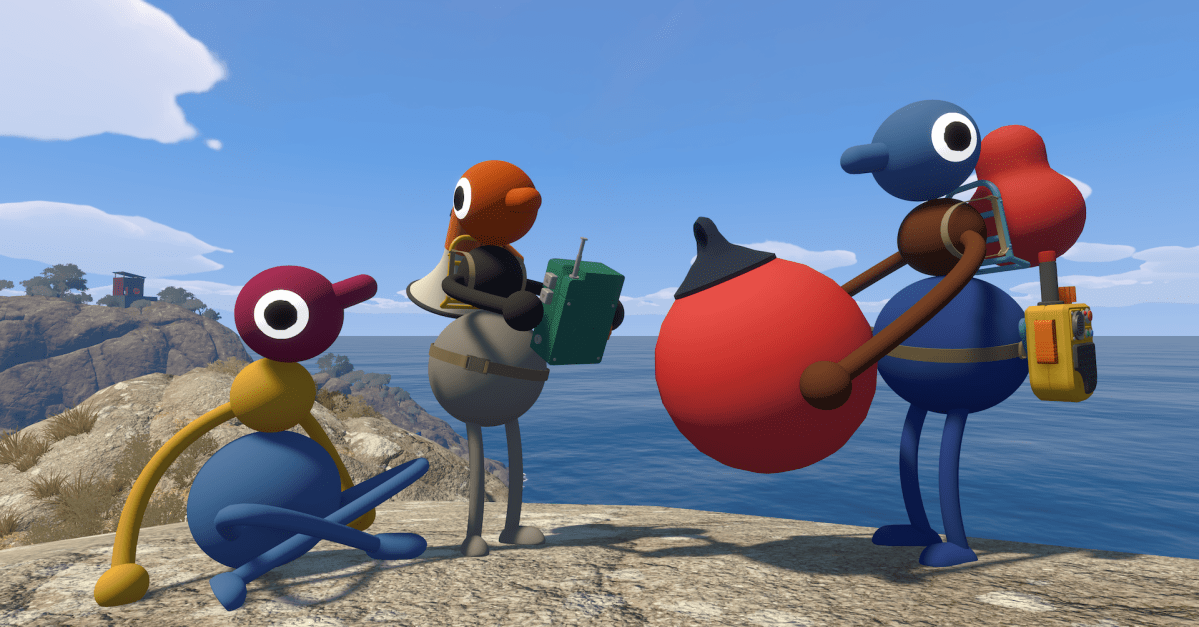
Big Walk Breath of the Wild is a useful comparison only up to a point. House House’s new multiplayer game shares the landmark-led, lightly guided exploration that made wandering feel rewarding in Nintendo’s adventure, according to reviews from The Verge and Nintendo Life. Its central trick is different: players must coordinate to solve puzzles, often when the game has made talking to one another inconvenient.
House House, the developer behind Untitled Goose Game, puts groups on a large island without much instruction beyond basic control signage, The Verge reports. Players investigate conspicuous buildings, trails and other distant sights rather than following a map menu, quest markers or a prescribed route. The Verge reports no directional arrows.
That creates the part of Big Walk that resembles Breath of the Wild: visual cues pull players toward possible discoveries and the route is theirs to choose. Nintendo Life likewise compared the game’s sightlines and landmark-based exploration to Breath of the Wild. Those are reviewers’ comparisons, not a statement from House House. The supplied reporting does not identify Breath of the Wild as an official template or influence.
Is Big Walk like co-op Breath of the Wild?
In its approach to discovery, partly. In how players make progress, no. Big Walk is a cooperative exploration-and-puzzle game for two to 12 players, according to GameSpot. The Verge says its puzzles scale for groups of two to four, while a session can hold up to 12 people. The group can roam together, or split into smaller teams when a problem permits it.
Communication is the machinery under the hood. Players use proximity voice chat or a proximity text system, The Verge reports, but distance can reduce or eliminate their ability to hear one another. Some puzzles deliberately separate participants or give different players different pieces of information. Nintendo Life says the game also supports gestures including pointing, arm movements, sitting, jumping, spinning and head-shaking, leaving groups to build their own vocabulary when speech fails.
GameSpot reports that players can pick up, carry and kick objects, operate buttons and use hand signals. The game’s puzzles then turn those limited actions and fragmented information into the job. A group might need to describe a symbol one member can see, relay instructions through a barrier, or use improvised tools found on the island. The mechanics are doing the social engineering, which is more interesting than another checklist of errands.
What should players know before starting Big Walk?
The same design has practical costs. The Verge’s reviewer found that players need at least one partner to do much of anything, and said slow travel, getting lost and difficult puzzles can make a session feel like work. Darkness also matters: without lanterns or other light sources, navigation becomes hard and staying together becomes more important.
GameSpot reported that Big Walk was due to launch August 4 for PC, PlayStation 5 and Switch 2, with a stated 12-to-20-hour route to its ending. The Verge reviewer had played more than 13 hours as a pair without finishing, a reminder that the actual time will depend on how quickly a group can agree on what that strange object is called, let alone what to do with it.
This story draws on original reporting from The Verge.


