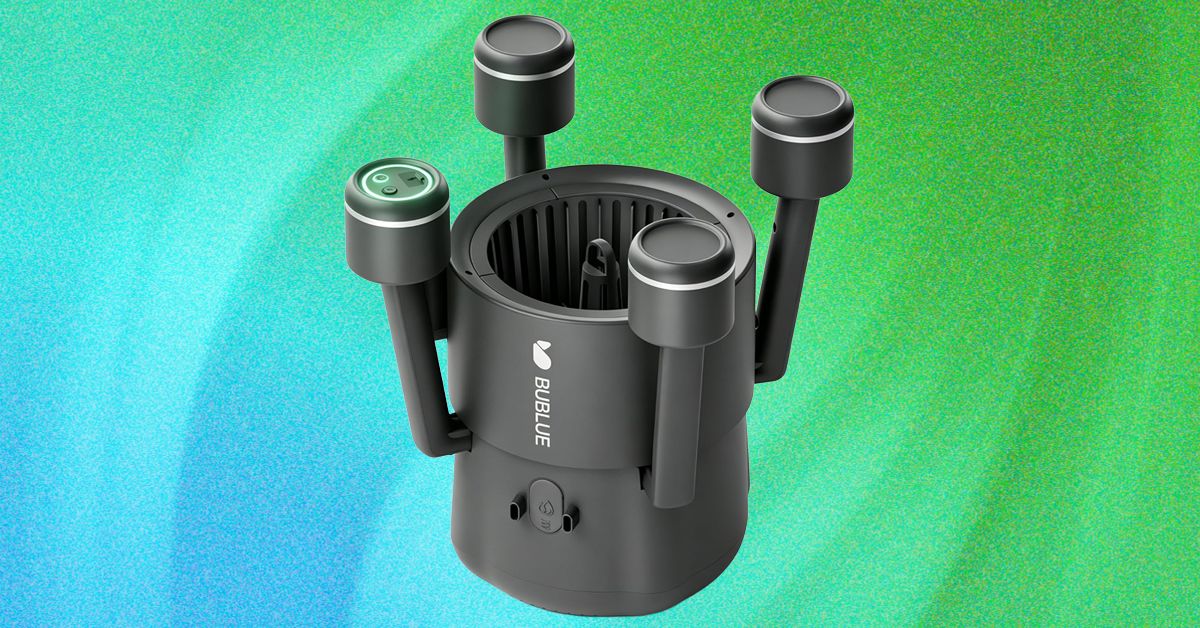
Bublue’s BuVortex V5 pool skimmer has a clever idea and a practical problem: it can pull leaves into a small water vortex, but WIRED reviewer Christopher Null found that it does not run long enough to replace the boring solar skimmers already doing this job.
Null rated the device 5 out of 10 after testing it for a week in his own pool with ordinary organic debris and artificial leaves. His verdict was blunt by implication: the BuVortex V5 is fun to watch and can work for a few hours, but pool-surface cleaning is a job that punishes anything requiring frequent charging, retrieval, disassembly and redeployment.
A different way to skim
Most robotic pool skimmers use a floating, twin-hull design and push debris into a basket between propeller-driven pontoons. Bublue markets the BuVortex V5 as “the world’s first active absorption skimmer,” according to WIRED. The useful translation is less mystical: the robot creates a small whirlpool that drags nearby debris downward into an underwater basket, where netting helps keep it from escaping.
The hardware is built around a central cylinder about a foot wide, with four surrounding arms for flotation and balance. One arm carries the charging port, power button and a Bluetooth pairing button for the Bublue mobile app. The robot weighs 11.5 pounds and needs about 1.5 feet of water depth to operate, according to Null’s review.
The app gives users two operating modes and an exit command that sends the robot to the pool edge for pickup, assuming the battery has not already died. Null said Bluetooth setup initially failed repeatedly, though the connection worked normally a day later.
The battery is the catch
The BuVortex V5 uses a 7,800 mAh battery. Bublue specifies a four-hour charge time and three hours of runtime, while Null said his test unit ran close to four hours. The larger omission is solar charging, which WIRED said is common on conventional skimmer robots.
That changes the maintenance model. A solar skimmer can stay in the pool, shut down overnight and resume when sunlight returns. The BuVortex V5 has to be pulled out, charged and put back in. During heavy leaf fall, Null argued, a few hours of coverage leaves too much time for debris to sink or drift into a wall skimmer.
In WIRED’s test, the robot moved around the pool at up to 33 feet per minute. A corner-boost mode kept it closer to pool edges, though Null said most leaves in his pool stayed nearer the middle. By the end of a run, the BuVortex collected about 70 percent of test leaves, sank about 20 percent and left roughly 10 percent floating. Null said standard skimmers usually cleared his pool surface within about 90 minutes, with leaves either collected or sunk.
Cleanup adds more work
The robot breaks down into five pieces for cleaning. Null described the process as manageable but time-consuming, with the mesh filter especially annoying because debris clung to it and the filter was difficult to reseat in its circular frame.
WIRED listed the positives as a novel design, decent short-term performance, compact size, quiet operation and a relatively low price. The review cited a current sale price of $260, with retailer listings at $270 from Amazon and Walmart.
The tradeoff is the part pool owners will notice: the BuVortex V5 asks for attention exactly where a skimmer is supposed to remove it. Null concluded it may suit smaller pools or occasional debris, but for a larger pool with steady leaf load, a net may sometimes feel like the more efficient machine. Grim, but technically persuasive.
This story draws on original reporting from WIRED.