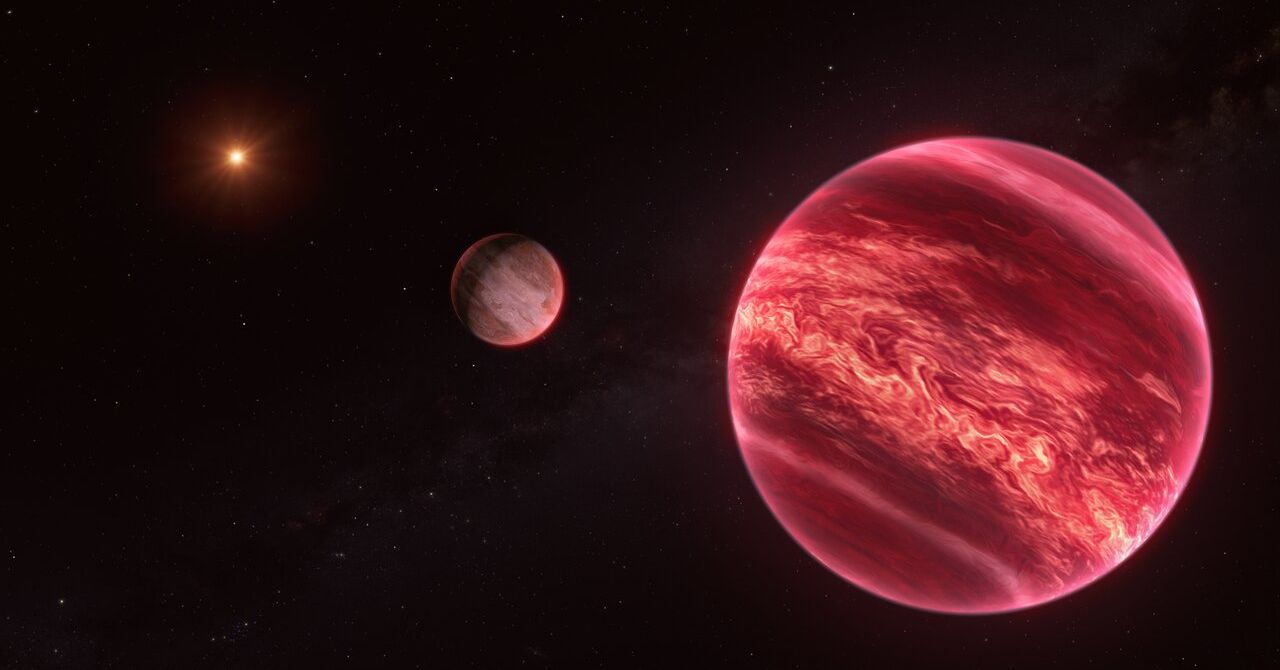
Astronomers say they have found evidence for a CD-35 2722 exomoon, a moonlike body orbiting a brown dwarf 73 light-years from Earth. The claim, published in Nature, is the strongest reported detection yet of a satellite outside the solar system, though the naming is messier than the headline version suggests.
Researchers have cataloged more than 6,000 exoplanets, but moons around them have remained stubbornly hard to confirm. The new candidate orbits CD-35 2722 B, a brown dwarf in the CD-35 2722 system. A brown dwarf sits between planet and star: too massive to be an ordinary planet, but not massive enough to ignite as a star.
CD-35 2722 B is about 37 times as massive as Jupiter. It orbits a star with about 40 percent of the sun’s mass, separated from it by an apparent distance of about 2.8 arc seconds.
How did astronomers detect the CD-35 2722 exomoon?
The team watched CD-35 2722 B for 23 nights from October 2023 through February 2026 using CRIRES+, an infrared spectrograph on the European Southern Observatory’s Very Large Telescope. They used the Doppler method, which looks for tiny shifts in a body’s spectrum as it moves toward and away from Earth.
That wobble can reveal the gravitational pull of another nearby object. Astronomers used the same broad technique in 1995 to find the first exoplanet orbiting a sunlike star. In this case, CD-35 2722 B is far enough from its host star that the team could read its spectrum directly with little contamination from starlight.
The Nature paper reports a strong periodic signal consistent with a large satellite circling the brown dwarf roughly every 170 days. The inferred object has a mass of at least 0.9 times Jupiter’s mass.
That is not a polite little moon by solar system standards. The candidate is about 2.5 percent of the mass of the brown dwarf it orbits. For comparison, Earth and the moon have a mass ratio of about 1.2 percent, the highest planet-moon ratio in our solar system. The moon systems of Jupiter and Saturn are much smaller by that measure.
The researchers checked several ways the signal could have been faked, including errors in correcting for Earth’s orbital motion, seasonal changes in Earth’s atmosphere, and rotation of the brown dwarf itself. They also calculated the Roche limit and Hill radius, which describe whether tidal forces would rip a satellite apart and whether it can remain gravitationally bound. Their conclusion: the proposed orbit sits in a physically stable region.
Is CD-35 2722 B's companion really an exomoon?
That depends on definitions, and astronomy has not finished writing them. ESO says there is no officially recognized definition of an exomoon, and the researchers call the object an exosatellite rather than forcing it into the same category as Earth’s moon.
ESO quoted Alice Zurlo, an astrophysicist at Diego Portales University, saying that the solar system makes the distinction between planets, moons, and the sun look tidy. In CD-35 2722, she said, those boundaries blur.
The paper also says the object may or may not satisfy future criteria for being called a moon. A separate team had earlier reported clues of a possible satellite in the HD 206893 system using the VLT Interferometer, but that work had not produced a definitive detection.
If the CD-35 2722 signal holds up, it gives theorists a difficult object to explain and observers a better target class to hunt. The study also points to a broader possibility: smaller rocky satellites around brown dwarfs could experience tidal heating, which might allow warmer environments far from ordinary stellar habitable zones. ESO says the coming Extremely Large Telescope, with its 39-meter primary mirror, could make smaller exomoons easier to find.
This story draws on original reporting from WIRED.