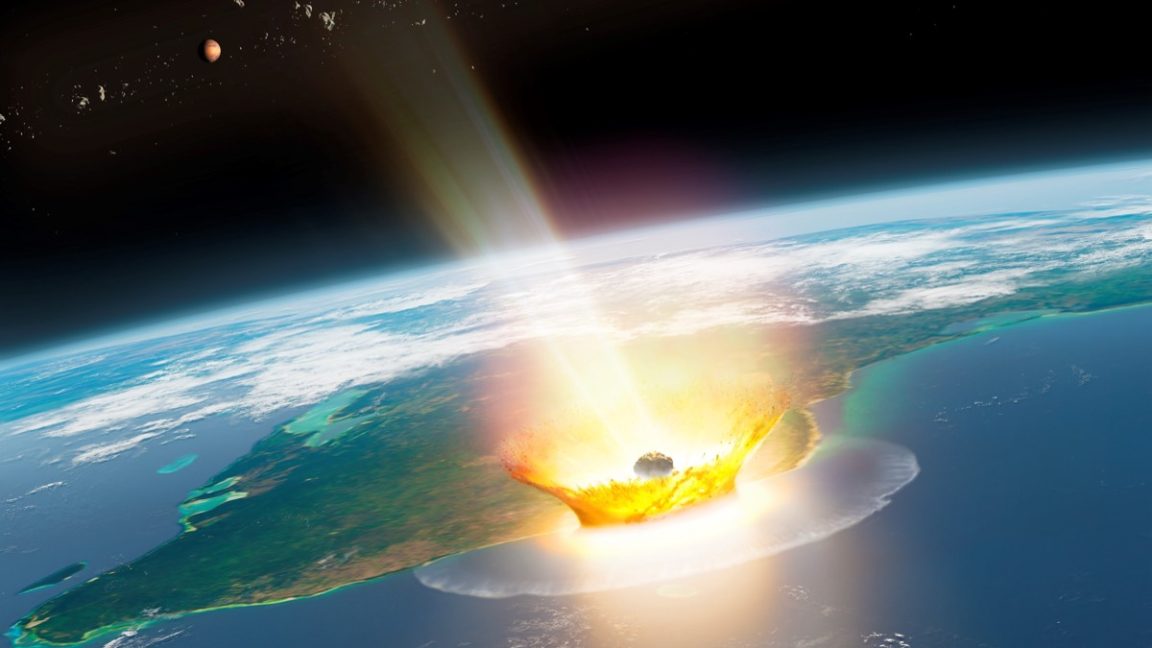
A new study of the Chicxulub impact and dinosaurs puts heat, not just darkness, near the center of the extinction story. In a paper published in the Journal of Geophysical Research: Biogeosciences, researchers argue that debris lofted by the impact would have formed a vast dust cloud that heated the upper atmosphere enough to kill exposed organisms and set off broad wildfire activity.
The finding addresses a stubborn problem in one of Earth science’s best-known disasters: scientists broadly accept that a space rock hit Earth about 66 million years ago, but the exact chain of events that turned the impact into a global extinction has remained disputed. The extinction eliminated about three-quarters of plant and animal species, with dinosaurs as its best-known victims.
How did the Chicxulub impact kill dinosaurs?
According to the new paper, the impact sent dust high into the atmosphere. That material would have absorbed and redistributed energy in a way that made the upper air extremely hot, effectively broiling organisms that could not get underground, underwater, or otherwise shielded from the heat.
The same process, the authors report, would also have helped ignite widespread fires. That matters because it ties the immediate aftermath of the impact to a physical killing mechanism: exposed animals and plants would not have needed to wait for longer-term climate effects to face lethal conditions.
The broader impact hypothesis traces back to 1980, when physicist Luis Alvarez and geologist Walter Alvarez proposed that an asteroid or comet caused the end-Cretaceous extinction. Their argument rested on sediment layers at the Cretaceous-Paleogene boundary found around the world, which contained unusually high levels of iridium. Iridium is more common in asteroids than in Earth’s crust, making it a useful fingerprint for extraterrestrial material. Dutch geophysicist Jan Smit reached a similar conclusion in the same year.
Researchers later identified the likely impact site at Chicxulub on Mexico’s Yucatan Peninsula. Geophysicists first found the large crater in the late 1970s. The object that made it has been estimated at between 11 and 81 kilometers across, or roughly 7 to 50 miles.
That size helps explain why the event was not a local catastrophe. The impact was powerful enough to melt, shock, and eject granite from deep within Earth. It probably generated a megatsunami and hurled vaporized rock and sulfates into the atmosphere. Estimates cited in the research history put the released energy at more than a billion times that of the atomic bombs dropped on Hiroshima and Nagasaki in 1945.
The new paper does not erase other proposed consequences of the Chicxulub impact. It adds a sharper account of the early thermal violence: dust in the sky, heat in the upper atmosphere, and little mercy for anything caught in the open.
This story draws on original reporting from Ars Technica.


