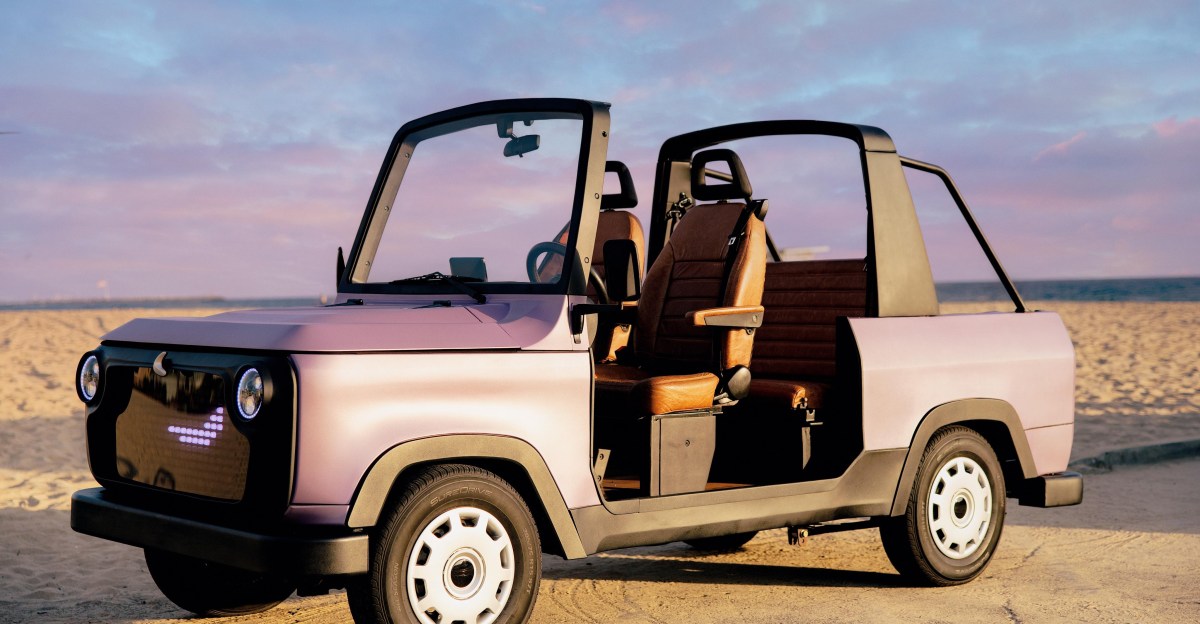
Chip Motors, a Miami startup led by CEO Jameson Detweiler, has introduced a small open-air electric vehicle aimed at the awkward space between golf carts and cars. The company is selling the four-seat version for $15,000 and a six-seat version for $18,000, with $250 reservations open now and deliveries planned for 2027.
The vehicle is called Chip, because of course it is. Chip Motors describes it as a “life utility vehicle,” though under US rules it fits the more useful category of a low-speed vehicle. Its top speed is 25 mph, which means it is limited to roads posted at 35 mph or lower. That makes it a neighborhood machine: grocery runs, school pickups, and short second-car trips, assuming your neighborhood has streets where a 25 mph box does not become rolling road furniture.
Chip Motors says the vehicle uses in-wheel motors and a 15 kWh lithium iron phosphate battery mounted flat in the floor. The company claims an estimated 100 miles of range. It also says the battery can charge overnight from a standard 110-volt household outlet, or in about four hours on a Level 2 240-volt charger through a NACS port. The company’s own site says those charging figures are illustrative while final specifications are still pending, so treat the numbers as targets rather than lab scripture.
A golf cart with a remote operator
The feature meant to separate Chip from a dressed-up resort cart is called “Chip Go,” a remote driving system that Detweiler told The Verge will let owners summon the vehicle, have it park itself, or send it on errands without a person sitting behind the wheel. The company’s long-term goal is Level 4 autonomous driving, but the first version depends on teleoperation, with a human operator controlling the vehicle remotely.
That mechanism matters. Chip is not claiming that a production vehicle will initially drive itself through town using onboard autonomy alone. Detweiler said cellular networks can handle latency spikes by managing connections, and argued that remote operation is easier at sub-25 mph neighborhood speeds than at highway speeds. He did not provide detailed technical information about the teleoperation stack, according to The Verge. Chip Motors also says it plans to accept legal responsibility while its vehicles are under remote operation.
The vehicle has a roll bar, a front LED display that acts as a digital face, and voice-command features. Detweiler told The Verge the launch video’s chatty behavior reflects the company’s intended software direction: a vehicle connected to family group chats, calendars, and traffic information, with reminders about when to leave. That is the pitch. The production reality is still somewhere between a reservation page and a 2027 delivery promise.
The bet: Americans will downsize, selectively
Detweiler argues Chip is aimed at families who already started using golf carts as local transport after the pandemic, especially in warm-weather markets. He told The Verge that golf cart sales have grown since that period and said Chip Motors’ research indicates the broader small-vehicle segment has grown roughly 50 percent annually since 2021.
The obvious problem is price. Some small conventional cars can be driven on highways, exceed 25 mph, and sell in the same general range. Detweiler’s counterargument is that many compact European-style cars are not designed around US roads dominated by large pickups and SUVs. Chip, he says, is being engineered for American conditions while keeping ownership costs lower through electric operation and cheaper insurance.
Chip Motors is also looking beyond the first open-air model, including more weatherproof versions for colder places and more highway-capable variants. For now, its first product is a tiny EV with provisional specs, a remote-operator parking promise, and a business plan built on the idea that the second car in many households is already overqualified for the job.
This story draws on original reporting from The Verge.


