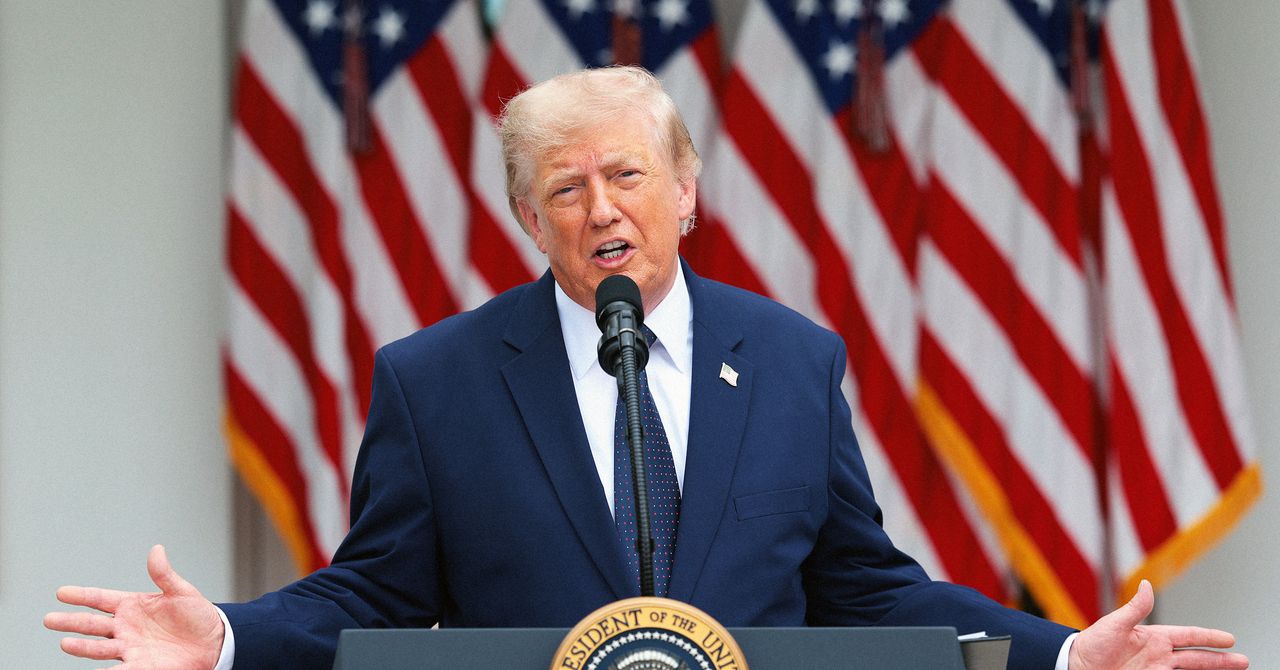
President Donald Trump used a Thursday night White House speech to revive claims about foreign interference in the 2020 election, and the election-denial ecosystem immediately treated it as something more useful than evidence: a permission structure.
Trump alleged interference by China, accused the “deep state” of cover-ups, and repeated disproven claims that noncitizens voted in U.S. elections. He pointed viewers to files posted on the White House website. Those materials did not substantiate his central claims.
That evidentiary gap did little to slow his supporters. Patrick Byrne, a prominent election denier, told conspiracy broadcaster Alex Jones after the speech that Trump had delivered “a grand slam” and claimed it was more significant than the release of records related to John F. Kennedy’s assassination. The Trump administration released JFK files last year.
Jones responded by saying the “deep state” was panicking, using cruder wording on air.
The Insurrection Act enters the chat
Across Telegram and X, election conspiracists argued that Trump’s speech could help justify invoking the Insurrection Act. The law can permit a president to deploy military forces domestically in some circumstances. The Brennan Center for Justice has said the statute could be invoked in ways that put troops near polling places, though the legal limits on what federal forces could do around elections remain disputed.
Lara Logan, a former CBS News correspondent who has become a prominent figure among election deniers, called Trump’s remarks “a reckoning” on X and described them as the first move in a larger plan.
Others filled in the plan themselves. A member of the Sarasota Patriots, an election-denial group, wrote on Telegram that Trump now had the “optics” to do what he considered necessary to secure the 2026 midterms, including using the Insurrection Act to place military and federal law enforcement at polling locations.
Jacob Creech, the conspiracy theorist who posts as WarClandestine, wrote on X that Trump would first show he had exhausted other options, then invoke the Insurrection Act. Arizona state Sen. Wendy Rogers shared Creech’s post and said he was describing Trump “laying the predicate.”
Michael Flynn, Trump’s former national security adviser and a major figure in election-denial circles, went further. He called on X for the immediate arrest of the CIA and NSA directors from Trump’s first term for treason, citing Trump’s claims rather than new evidence.
Officials and experts reject the claims
Alexandra Chandler, director of impact programs at Protect Democracy and a former intelligence community official, said the White House had used “cherry-picked intelligence” and discredited raw reports to create a pretext for unlawful action. Chandler said the point was to mobilize supporters who could be asked to reject the 2026 results if Trump’s side loses.
Election officials were blunter. Nevada Secretary of State Cisco Aguilar said in an emailed statement to WIRED, “This is all bullshit.” Rep. Jamie Raskin of Maryland told Zeteo the speech was “gibberish,” “drivel,” and “almost self-debunking.”
The awkward part for Trump came from John Solomon, a conservative journalist recently appointed to a White House role reviewing election-interference documents. Cleta Mitchell, a former Trump adviser who runs the Election Integrity Project, praised Solomon on X for helping make public what she described as evidence of a Chinese Communist Party attack on the 2020 election.
A 2021 assessment by the Office of the Director of National Intelligence reached the opposite conclusion on China, saying Beijing did not deploy interference efforts and considered but did not deploy influence efforts intended to change the presidential election result.
Speaking to reporters after Trump’s speech, Solomon did not validate Trump’s allegation that foreign interference changed votes. “I only know the intelligence community has zero evidence that a foreign power flipped a vote in 2020, 2022 or 2024,” Solomon said. Asked whether the 2020 result was accurate, he said he was “still researching.” Solomon did not immediately respond to a request for comment.
This story draws on original reporting from WIRED.