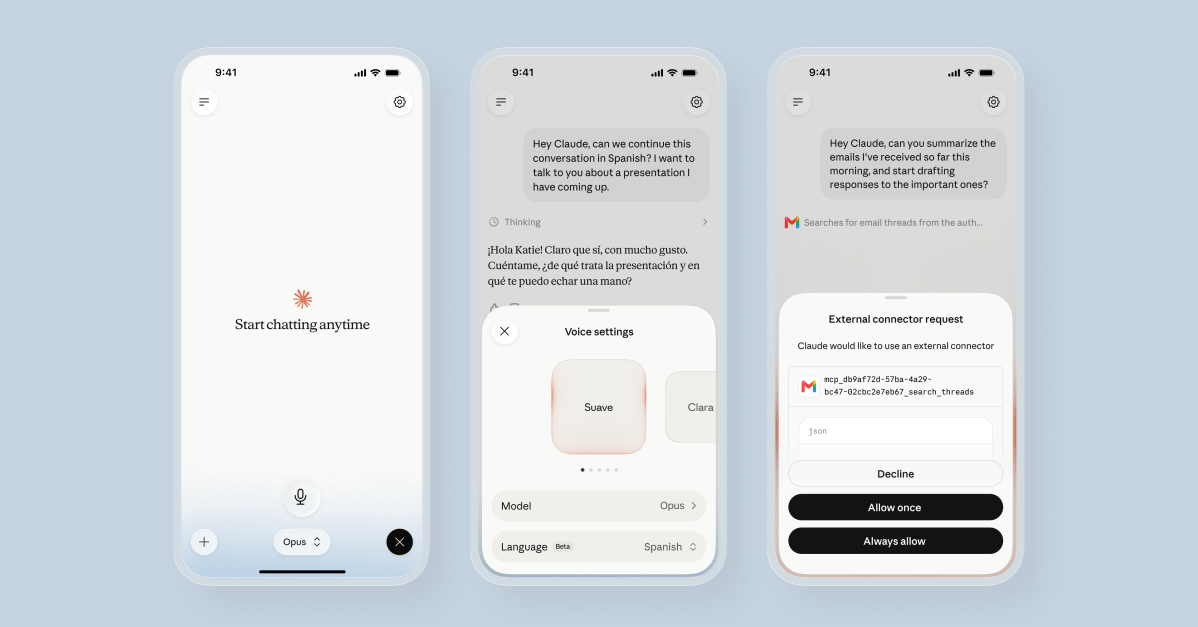
Anthropic is bringing Claude voice mode to its Opus and Sonnet models, moving the spoken interface beyond Haiku, the faster and less capable model that previously handled it. The Claude voice mode Opus Sonnet rollout also expands voice access into apps including Gmail, Slack, and Canva, according to Anthropic.
The change matters for people using Claude as a work tool rather than a talking FAQ. Voice mode began as a low-latency way to ask quick questions aloud and get spoken answers back. Anthropic now says users pushed it into heavier work, including business problems that required more reasoning than Haiku was built to provide.
What changed in Claude voice mode?
Claude users can now choose Sonnet or Opus while using voice mode, not just Haiku. Anthropic describes Sonnet and Opus as models made for tougher problem-solving, with more complex responses and analysis than Haiku.
The company says voice conversations can also lead into actions. Examples Anthropic gave include turning a spoken discussion into a one-page pitch or rearranging calendar appointments when a train delay throws off a schedule. That is the obvious direction for voice assistants: less “answer my question,” more “do the boring follow-up work.” It is also where the permissions and app connections start to matter.
Anthropic is widening those connections to services such as Gmail, Slack, and Canva. The company did not frame this as a separate app launch; it is an expansion of what Claude can reach while users are talking to it. As usual with AI assistants inside work tools, the useful bit is also the sensitive bit: email, messages, documents, and calendars are where actual business context lives.
Why Anthropic is moving beyond Haiku
Anthropic said in a blog post that voice mode’s early use did not stay confined to casual prompts. People used it to work through more substantial tasks, and Haiku’s speed-first design meant it could keep the exchange moving but did not always provide enough depth.
Haiku remains the model for quick interactions. The new setup lets users switch between voice and text during the same conversation and change models along the way. A user could start with Haiku for a short spoken prompt, then move to Opus if the thread turns into a more demanding project.
That model switching is the practical part of the announcement. Voice is convenient for dumping context quickly, but heavier reasoning can be expensive, slower, or unnecessary depending on the task. Anthropic is making the model choice part of the conversation flow rather than forcing users to decide at the start and live with it.
Which languages support Claude voice mode now?
Anthropic is also taking several non-English voice mode options out of beta. The company says voice mode now supports French, German, Spanish, Hindi, Indonesian, Italian, Japanese, Korean, and Portuguese, in addition to English.
The language expansion makes the feature less like a demo for English-speaking early adopters and more like a core interface for Claude. The bigger test will be whether the more powerful models make spoken sessions useful for real work without turning every conversation into another place users have to audit an AI assistant’s guesses.
This story draws on original reporting from The Verge.


