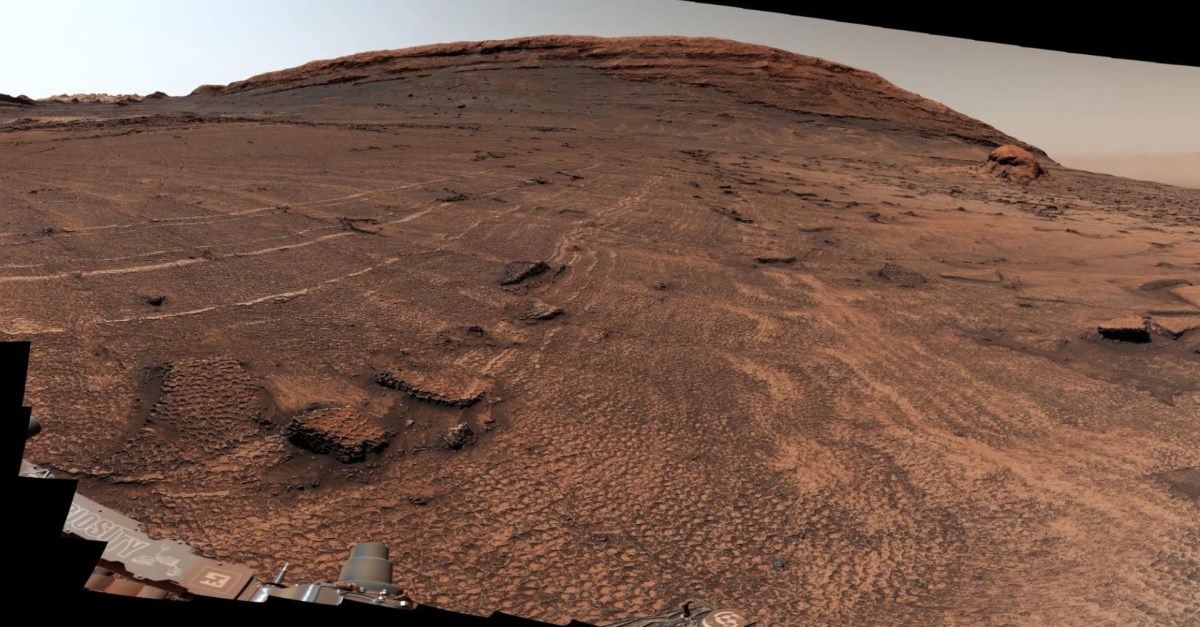
NASA says the Curiosity rover Mars polygons photographed in Valle Grande form the largest field of honeycomb-like ground texture the rover has found so far. The find matters because these small fracture patterns can preserve evidence about how Martian sediment changed, including whether water once helped shape the valley.
The terrain sits in Valle Grande, a Martian valley explored by Curiosity during its long climb of Mount Sharp. NASA described the feature as a broad field of polygonal fractures, with individual shapes measuring about 1.5 to 3 inches across. Curiosity has seen this kind of pattern before, but NASA said earlier finds were limited to much smaller patches.
Curiosity photographed the area on June 19 and June 20, corresponding to Martian sols 4,930 and 4,931 for the mission. NASA said the rover produced a 360-degree panorama showing the texture extending around it, which is how a little oddity in the dirt becomes a dataset rather than just a nice postcard from a very expensive robot.
What are the Mars polygons Curiosity found?
The polygons are fracture patterns in the Martian surface that look like a honeycomb. NASA calls them polygonal fractures, and the agency says their size, shape and chemistry may help scientists work out what physical process made them.
Ashwin Vasavada, Curiosity’s project scientist, said NASA’s team has measured the features’ geometry and chemical makeup and is looking for clues in the data about their origin. That is the careful version of the story: a striking pattern has been found, but the mechanism still has to survive the measurements.
NASA said the discovery could point to water having existed in Valle Grande in the past, based on similar polygon patches Curiosity has examined before. Some earlier polygons seen by the mission were clearly mud cracks, according to NASA. Mud cracks are the boring Earth analogy that becomes interesting on Mars, because they can record wet sediment drying out.
Water is not the only possible explanation NASA gave for the honeycomb texture. The agency said similar patterns can also result from temperature swings between warm and cold conditions, or from compression that forced water out of sediment while the material was buried. In other words, the polygons are evidence of geological processing, but they are not a one-line proof of a lakebed.
Why Valle Grande matters
NASA said that billions of years ago, lakes and streams marked the lower foothills of Mount Sharp, the 3-mile-tall, or 5-kilometer-tall, mountain Curiosity has been climbing since 2014. Valle Grande is part of that broader Martian terrain record, where the rover is reading layers and textures instead of headlines.
The new panorama gives the Curiosity science team a larger exposure of the polygon texture than it previously had. A wider field lets researchers compare patterns across the valley floor and test whether the same process appears to have shaped the whole area, or whether several processes left similar-looking cracks. NASA has not announced a final answer yet.
This story draws on original reporting from The Verge.


