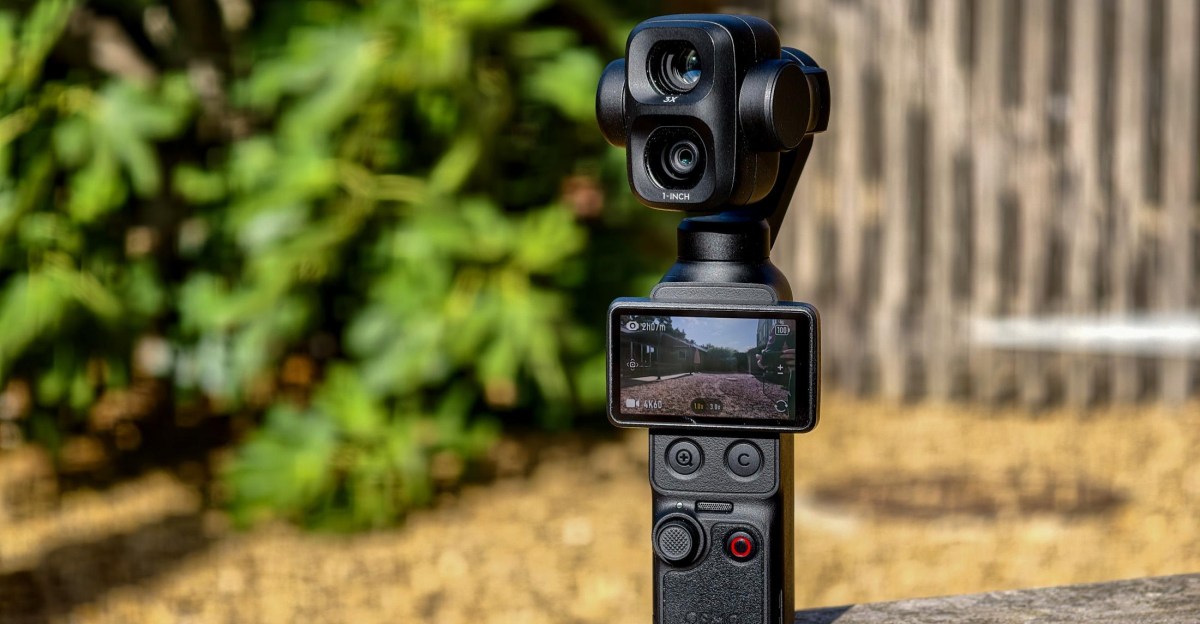
DJI’s new Osmo Pocket 4P is a larger, dual-lens version of the Osmo Pocket 4, according to a DJI Osmo Pocket 4P review by The Verge’s Dominic Preston. The useful bit for creators is plain: DJI added a 3x telephoto camera to its tiny stabilized video rig, then kept most of the Pocket 4’s controls, software, storage and shooting modes intact.
The catch is availability. Preston reports that DJI will not release the Pocket 4P in the US, continuing the company’s recent trouble getting some products onto the American market. In Europe, the Standard Combo costs £529 or €599, about $680, and includes a fill light, carry pouch and a handle with a tripod thread. A Vlog Combo costs £605 or €689, about $785, and adds a larger case, compact tripod, DJI Mic Mini 2 and DJI’s FrameTap remote.
Is the DJI Osmo Pocket 4P available in the US?
No. According to The Verge, DJI is launching the Osmo Pocket 4P in other markets but not in the United States. Preston also notes that Xtra, a company selling DJI-like products after DJI’s US ban, has delisted its Muse 2 Pro, stopped taking preorders and refunded deposits while the FCC works against alleged DJI front companies.
The camera itself is close to the Pocket 4 with a thicker head. The second lens is a 60mm-equivalent 3x telephoto positioned above the main camera. It uses a 1/1.28-inch-type sensor, smaller than the main camera’s 1-inch sensor, but has a brighter f/1.8 aperture compared with f/2.0. Preston says it supports 4K landscape video, 3K portrait video, low-light capture, slow motion and timelapse. It does not work for panoramas.
In testing, Preston found the telephoto footage sharp and the gimbal stabilization strong, including during recording from a small boat on a windy day. The Pocket 4P can record 4K video up to 12x zoom, but The Verge says quality starts falling after 6x, with 12x footage looking softer and text losing clarity.
The telephoto lens also changes the camera’s look at close range. Preston says the f/1.8 aperture produces stronger background blur, making it useful for product shots, portraits and pets. Switching lenses while recording can cause a short judder, and The Verge noticed occasional color shifts between the cameras.
What changed from the Pocket 4?
The main camera has also been updated, according to Preston. It keeps the same size, resolution and aperture as the Pocket 4’s main camera, but uses a new sensor with up to 17 stops of dynamic range and DJI’s 10-bit D Log 2 color profile. The improvements are more visible in difficult lighting, though The Verge says low-light shooting still has limits.
The new hardware costs some portability. The Pocket 4P weighs 230 grams, about 40 grams more than the Pocket 4, and its gimbal and lens assembly is roughly twice as large. The device remains compact, but Preston says it feels less pocketable. He also raises a durability concern: when powered off, the lenses face forward and are exposed. DJI no longer includes a gimbal clamp, and the recessed lenses can collect dust.
DJI rates battery life at 210 minutes, 30 minutes less than the Pocket 4. Charging remains a claimed 32 minutes for a full charge. Built-in storage is still 107GB, with support for microSD cards up to 1TB.
Software is mostly familiar: three buttons, a joystick and a 2-inch flip-out touchscreen. A new multi-person tracking mode can detect several subjects while following the person in the center. The Pocket 4P also supports DJI’s FrameTap, a small wireless touchscreen remote that can start recording, control the gimbal and zoom, access playback and handle some settings. Preston says it cannot change resolution or frame rate.
The obvious rival is Insta360’s Luna Ultra, another dual-camera stabilized pocket camera. The Verge says Insta360 offers 8K recording from its main camera and is available in the US for $769.99. DJI’s counterpunch is lower European pricing, longer battery life, wider dynamic range, better slow motion and twice the built-in storage, according to Preston’s comparison.
This story draws on original reporting from The Verge.


