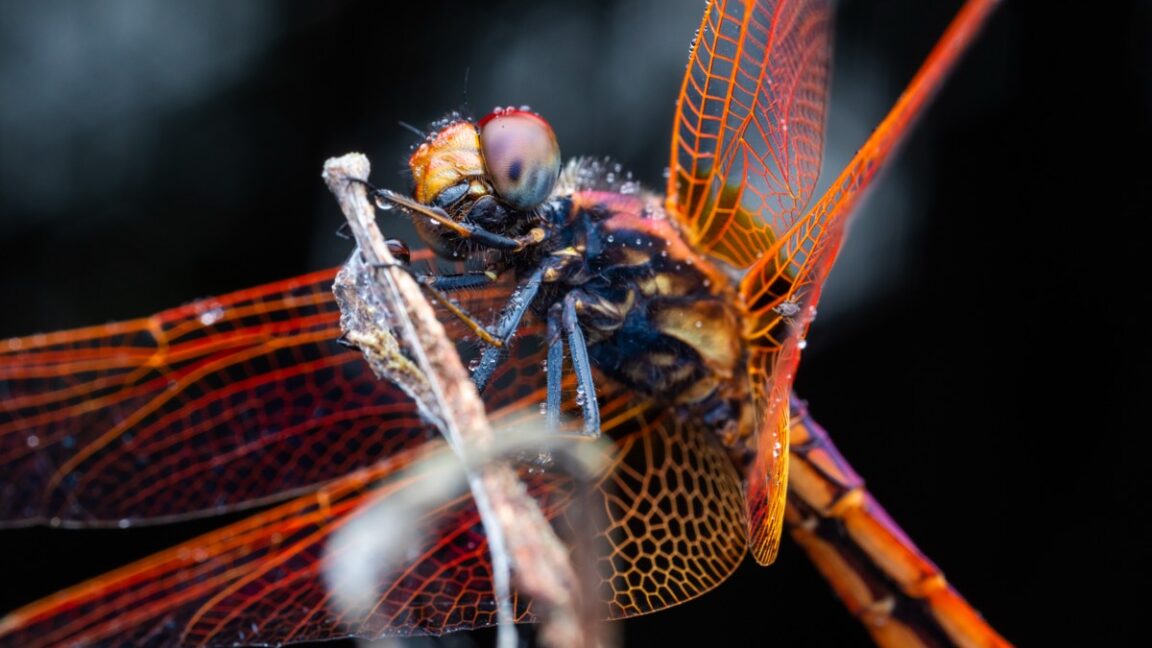
Male dragonflies defending pond territory do something closer to air combat than a straight chase, according to a study published in the Journal of the Royal Society Interface. The researchers found that the insects appear to follow relatively simple rules to hold a tactical position behind a rival, a pattern that resembles the way fighter pilots try to get on an opponent’s tail.
The work matters beyond bug trivia. The authors argue that dragonflies may offer a useful model for drones that need to fly by vision-based guidance without hauling around heavy computation. Nature, as usual, has already shipped a compact control system and declined to include a glossy white paper.
The team studied male Trithemis aurora, a crimson dragonfly species whose males are described by the authors as fiercely territorial. Multiple males often gather around ponds, each defending a perch and trying to keep competitors out of prime breeding space.
Earlier work on dragonfly interactions often leaned on visual observation or single-camera footage. For this study, the researchers used a portable stereovideo setup with two shutter-synchronized cameras, recording in color and monochrome. From that field rig, they reconstructed 102 paired male-versus-male flight paths in three dimensions. They also reconstructed nine flights in which dragonflies intercepted prey, giving them a comparison between hunting and territorial combat.
Territory fights are not prey chases
The difference between hunting and fighting showed up clearly in the flight data. When dragonflies hunted, they generally approached prey from below, which often placed the target against the sky. That is convenient if your visual system is trying to pick a small moving object out of the world.
Male-on-male encounters were messier. The territorial flights followed more tangled paths, and the rival dragonflies were more often seen against foliage or the ground. The insects were not merely closing distance to intercept a target. According to the study, each male tried to gain a better tactical position, especially behind the other dragonfly.
That tail-chasing behavior is the obvious comparison to fighter tactics. Human pilots also try to get behind an opponent, where weapons and sensors give them an advantage. The authors suggest a mechanical reason for the similarity: fighter aircraft often rely on forward-facing radar and weapons, while dragonflies have vision biased toward targets in front of them.
The study also found maneuvers that would look familiar in an air-combat briefing, if the briefing had six legs and compound eyes. Dogfighting dragonflies used loops, spirals and downward vertical turns. Their roles as pursuer and pursued shifted repeatedly during a fight, rather than remaining fixed as in a predator-prey chase.
The insects could pull turns of up to 6 Gs, according to the researchers. They usually did not trade everything for maximum speed, instead favoring maneuverability. Even during intense territorial fights, they glided at least one-third of the time. The authors suggest that gliding may save energy or make visual tracking easier. Sharp turns, by contrast, depended on flapping.
One fighter-pilot habit did not carry over. The authors write that pilots treat altitude as stored energy, since a dive can turn height into speed. Dragonflies did not appear to use height that way. The study found that they tended to position themselves slightly below an opponent, which may help with visual tracking rather than energy advantage.
The result is a tidy lesson for engineers: sophisticated flight behavior does not necessarily require a complicated rulebook. For these dragonflies, territorial combat appears to emerge from a small set of visual and positional priorities, executed very quickly in three-dimensional space.
This story draws on original reporting from Ars Technica.