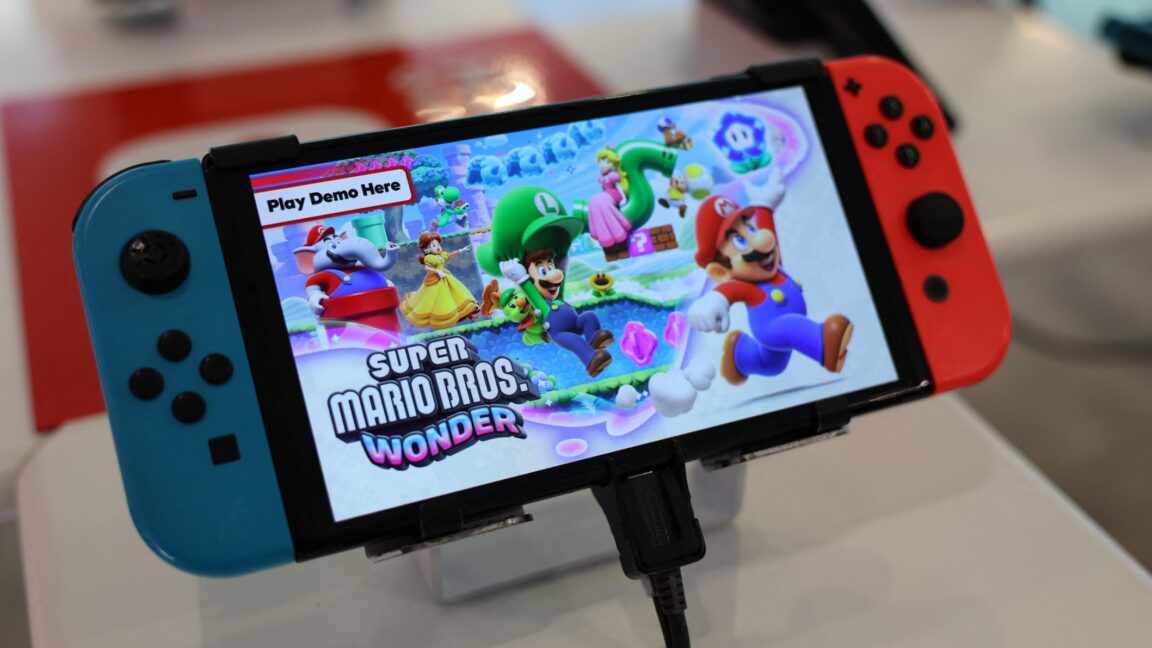
Nintendo plans to stop selling the original Switch in Europe next February, the company said Monday, choosing retirement over a compliance retrofit for hardware that is now nine years old.
The decision is tied to incoming European rules that will require easily replaceable batteries in many consumer electronics. Nintendo is revising the Switch 2 for those requirements, according to its support notice, but it is not doing the same work across the older Switch line. Outside Europe, the regulation does not directly change Switch availability.
The European cutoff does not mean Nintendo is done with the original Switch everywhere. An Ars Technica analysis of Nintendo’s annual earnings releases argues the machine is fading far more slowly than most Nintendo hardware at the same age, especially on software sales. That matters for players and developers because a console with a still-active buyer base can remain a viable target even after its successor arrives.
A very old console that still sells games
The Switch’s hardware sales peaked in Nintendo’s 2021 fiscal year, which ended in March 2021, at nearly 29 million units shipped worldwide, according to Ars’ reading of Nintendo’s financial data. Switch software peaked the following fiscal year at more than 235 million units.
Those numbers have fallen for years, as expected for aging hardware. The unusual part is the slope. Ars found that the Switch was still at about 13 percent of its peak annual hardware sales in its ninth full fiscal year, with 3.8 million units shipped. By comparison, the Wii was below 1 percent of its peak annual hardware rate at a similar point.
Software looks healthier. Nintendo sold nearly 137 million Switch games in the last fiscal year, or about 58 percent of the platform’s best annual software result, according to Ars. At comparable ages, the Nintendo DS, 3DS, and Wii were each below 5 percent of their peak annual software sales.
The Switch also peaked later than several earlier Nintendo systems. Ars notes that the 3DS and Wii hit their best hardware years in their second full fiscal years, while the Switch did so in its fourth. Among recent Nintendo portables, only the DS posted higher peak hardware sales than the Switch.
Switch 2 does not kill the old market by itself
Nintendo hardware usually lingers for one to four fiscal years after a replacement reaches stores, Ars found. The Switch 2’s launch makes the original Switch’s end easier to see, but not easy to date.
On one side, demand for the new machine appears strong. Ars says the Switch 2 sold nearly 20 million units in its first partial fiscal year, compared with nearly 4 million units for the original Switch over its latest full fiscal year. That suggests many buyers wanted more capable hardware and moved quickly.
On the other side, Switch software is still outselling Switch 2 software by nearly three to one, according to Ars. Backward compatibility changes the usual handoff. A game built for the original Switch can also be sold to Switch 2 owners, while Switch 2-only games cannot run on the older console.
That gives developers a blunt commercial reason to keep supporting the older system when their games do not need the newer hardware. Ars points to Nintendo’s own recent Rhythm Heaven Groove for Switch as an example. Price also helps the old console: Ars notes that the Switch 2, listed at $500 and due to get pricier, will soon cost about 63 percent more than the $340 base Switch.
Ars’ conclusion is cautious: the Switch is past its peak, but its software base and lower price could keep new hardware sales meaningful for several more years. Its projection says new Switch units may still be selling into 2029 or 2030, even as Nintendo’s attention shifts to the Switch 2.
This story draws on original reporting from Ars Technica.