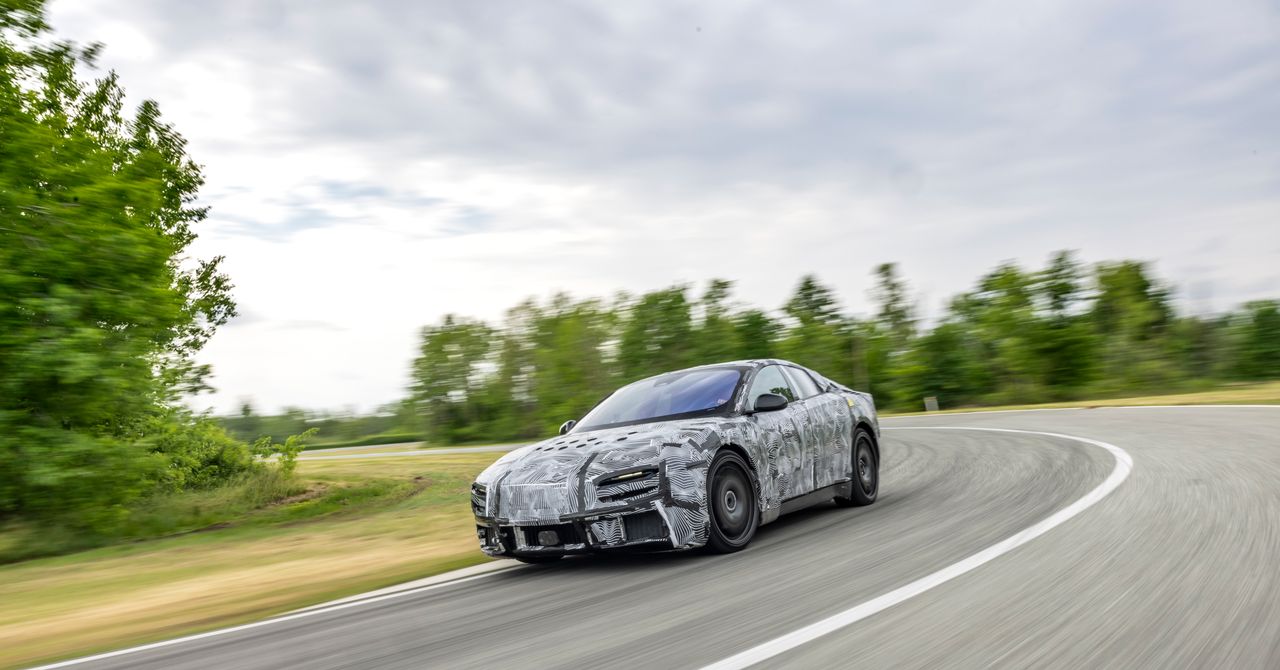
The Ferrari Luce first drive puts Ferrari’s most awkward new question on pavement: can an electric, four-door, five-seat car still feel like it came from Maranello rather than a luxury tech lab with better tailoring? WIRED drove a preproduction Luce at a northern Italian test track before the car’s May reveal in Rome, with camouflage still hiding the final design.
The Luce is Ferrari’s first fully electric car. Ferrari engineered it in Maranello, while LoveFrom, the California design firm founded by former Apple design chief Jony Ive, handled the design. Benedetto Vigna, Ferrari’s chief executive since 2021, arrived from the semiconductor industry rather than the usual car-company ladder, a useful bit of context for a car built around electronics, sensors and software as much as aluminum and tires.
That mix has not made the Luce an easy sell to Ferrari loyalists. WIRED reported that parts of Ferrari’s fan base objected to an EV on principle, while the design also drew hostility because it breaks sharply from the brand’s familiar visual grammar. Without the badge, the Luce does little to imitate Ferrari’s historic shapes.
What is the Ferrari Luce EV?
The Luce is a four-door electric Ferrari with a 122-kWh battery, four electric motors and an 800-volt architecture built into a new chassis. Its layout gives it space for five seats and a rear cabin WIRED described as unusually roomy for a Ferrari, while the battery placement means the driver sits higher and closer to the front axle than in the brand’s lower sports cars.
Ferrari says the chassis uses hollow castings, extrusions and aluminum sheets to cut weight and manage loads. The company says the battery sits as low as possible in the floorpan, giving the Luce a center of gravity 95 mm lower than the Purosangue and a yaw moment of inertia 15 percent lower than that car. In plain English: Ferrari is trying to make a heavy EV turn in more willingly than its size suggests.
The numbers are not shy. The two front motors produce 282 bhp, while the rear motors produce 831 bhp, taking total output beyond 1,000 bhp. Ferrari lists rear-wheel torque at 5,900 pound-feet, or about 8,000 Newton-meters. The front motors can spin up to 30,000 rpm and reach maximum speed in under a second.
How does the Ferrari Luce drive?
WIRED’s first drive described the Luce as approachable by Ferrari standards, with light, carefully tuned throttle and brake responses. The car uses a vehicle control unit that manages power delivery and energy recovery, updating target metrics 200 times per second. Ferrari chief test driver Raffaele de Simone told WIRED that rear-wheel steering, active suspension and four-motor torque vectoring work together when the driver asks for more rotation in a corner.
A new “e-manettino” on the steering wheel changes the EV’s behavior. In Range mode, output is capped at 429 bhp and the car mainly drives the rear wheels. Tour mode raises available power to 608 bhp and adds all-wheel-drive capability. Performance mode lifts output to 958 bhp and allows a 190 mph top speed.
Ferrari also built a Torque Shift Engagement system to add more driver control than the usual EV torque surge. The right paddle selects five power and torque levels, while the left paddle selects five levels of regenerative braking. WIRED said the system is meant to mimic some of the interaction of a combustion car with a conventional transmission and engine braking.
The Luce uses Ferrari’s third-generation 48-volt active suspension and rides on 23- and 24-inch wheels. The body and chassis are made from 75 percent recycled aluminum, and Ferrari fitted a separate rear subframe connected by elastomeric bushes to reduce noise and vibration.
Ferrari did not fake a V-12 soundtrack. Antonio Palermo, who led the sound work, told WIRED the team used an accelerometer and equalized naturally occurring frequencies from the rear inverter, filtering out unwanted noises such as gear whine. The result, according to WIRED’s drive, is mostly quiet until Performance mode brings out a synthetic-leaning but real electric timbre.
The Luce is still a provocation for people who define Ferrari by combustion noise and familiar proportions. Ferrari’s bet is that software, power electronics and chassis control can carry the badge into EV territory without turning the car into a silent spreadsheet. On WIRED’s early drive, the hardware at least made a serious case.
This story draws on original reporting from WIRED.


