Firefighting drones got two real field tests this summer, one in California and one in Alaska, aimed at a narrow but consequential job: hitting small wildfires fast enough that they do not grow into the kind of incident that needs tankers, helicopters, and weeks of crew time.
The machines are not replacements for crewed aircraft. Their payloads and range are much smaller than airtankers that can haul large amounts of water or retardant to remote fires. The bet from drone makers, fire agencies, and the organizers of the $11 million XPRIZE Wildfire competition is more specific. If drones can be staged near high-risk areas, launched quickly, and refilled quickly, they may buy firefighters time during a fire season that climate change has pushed closer to a year-round threat in much of the United States.
CAL FIRE tries a small swarm
The California Department of Forestry and Fire Protection, known as CAL FIRE, tested five autonomous drones on July 15, according to Fresno television station KMPH. The demonstration, organized with nonprofit FireWERX and California company Seneca, had the drones work together to dispense a combined 500 to 1,000 gallons of firefighting foam.
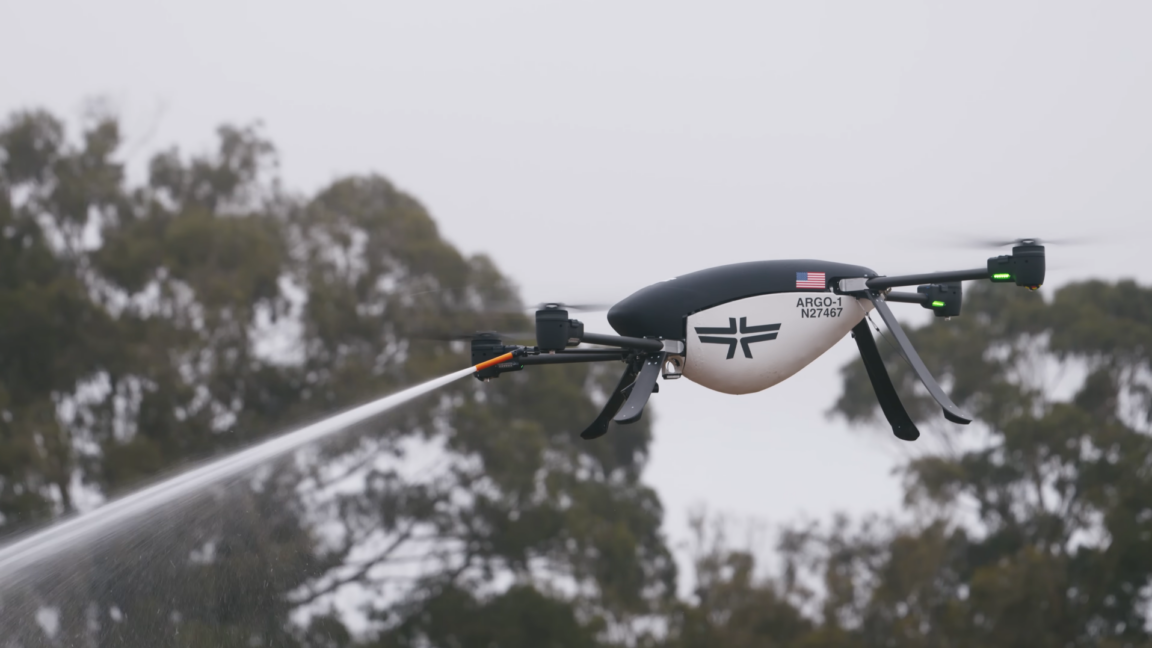
Seneca plans to make the drones commercially available in 2026. Its Argo-1 aircraft can carry about 100 pounds of water or retardant, and the company says the system is designed to fly in groups of four to six drones.
The autonomy is bounded, which is the sane version of autonomy in a fire zone. A human operator gives the drones a GPS waypoint. The aircraft then fly toward the target, use onboard sensors to detect the fire’s heat signature, choose a hovering height, and line up to spray one after another, according to HeliOps Magazine.
The constraints are just as clear. HeliOps reported that a fully loaded Argo-1 has a 10-mile round-trip range and averages about 30 mph. That means the drones would need to be parked close to likely ignition areas or hauled in by vehicle. Seneca’s pitch is that the aircraft are small enough to fit in the bed of a pickup truck with the tailgate down, and that two people can carry an empty drone.
Seneca told HeliOps it wants firefighters to be able to refill a returning drone and swap in a fresh battery in about two minutes. The company previously showed the system to San Bernardino County Fire in December 2025.
Alaska test pairs sensors with suppression
A separate XPRIZE Wildfire finals test near Fairbanks, Alaska, in June 2026 used a system from German company Dryad Networks. Dryad’s Silvaguard setup combines its Silvanet detection network with observation and suppression drones across a 1,000-square-kilometer test area, according to XPRIZE and Dryad.
Dryad’s detection layer uses solar-powered sensors mounted on trees to detect smoke from a smoldering fire. When one triggers, the alert moves through a wireless mesh network to an Internet-connected border gateway. A prepositioned observation drone then launches to confirm the fire, locate it, and reduce false alarms using infrared and optical imaging.
If the system confirms a fire, a Silvaguard suppression drone can launch and drop up to 26 gallons of suppressant. Dryad says the drones can sit ready inside solar-powered spherical hangar pods.
Actual adoption will decide whether these systems remain clever demos or become tools firefighters trust. Aspen Fire Protection District in Colorado has already committed to a five-year, $5 million contract for five Seneca drones, according to Seneca and Aspen Public Radio.
CAL FIRE has not bought firefighting drones. It would be a serious customer if that changes: the agency says it operates more than 70 crewed fixed-wing aircraft and helicopters, calls the fleet the world’s largest aerial firefighting fleet, and already uses AI-assisted camera networks while supporting the FireSat satellite system intended to detect wildfires from space.
This story draws on original reporting from Ars Technica.