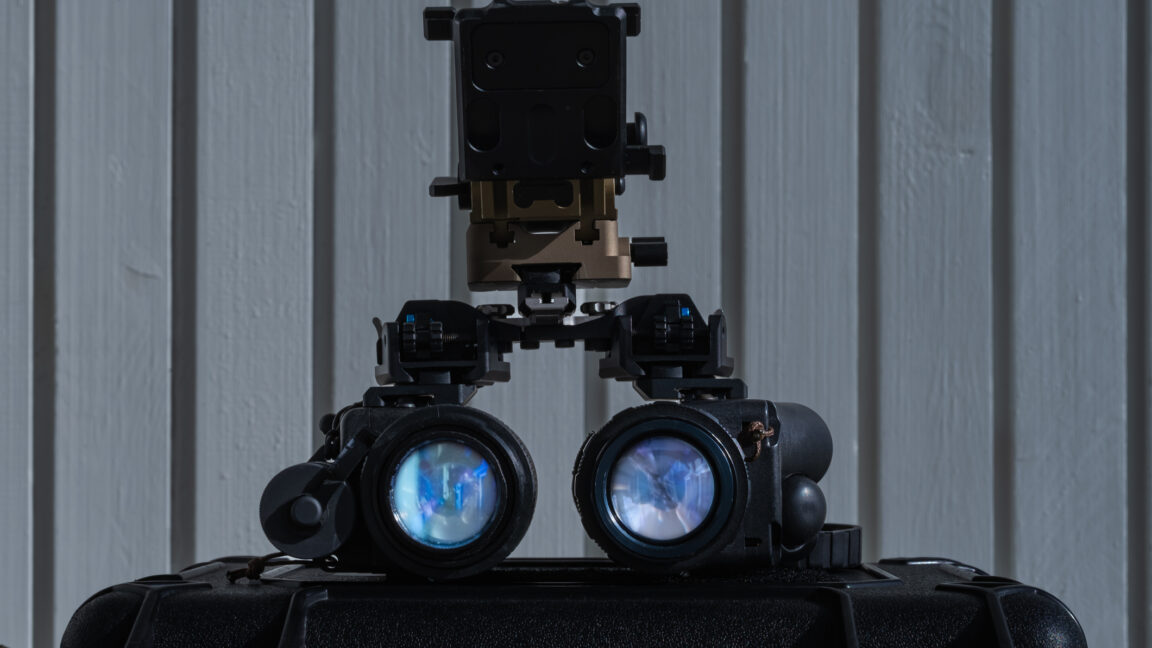
Researchers in China have built a lab prototype for full-color night vision goggles that converts infrared light into visible color, according to a study published in Science Advances. The device, developed by a Beijing Institute of Technology team led by Xin Tang and Ge Mu, uses mercury telluride quantum dots and a two-layer OLED to turn incoming infrared radiation into images the human eye can see.
Human vision misses infrared because those photons do not carry enough energy to trigger the molecular machinery in retinal cells. Conventional night-vision systems work around that by detecting infrared and displaying it as visible brightness, often in green. That preserves some scene information, but it collapses many infrared differences into one color channel.
Tang and Mu’s team tried a different approach: make the output color change with the infrared signal itself. The study says the system can encode both infrared wavelength and intensity, giving viewers more information than a brightness-only display.
How do full-color night vision goggles work?
The detector layer uses mercury telluride colloidal quantum dots, each roughly 4 nanometers across. Because they are so small, their electronic energy levels become discrete rather than continuous, so different infrared wavelengths can trigger different electronic transitions inside the dots.
At longer infrared wavelengths, around 2 micrometers in the team’s tests, photons generate a modest number of mobile charge carriers. Shorter-wavelength infrared photons carry more energy and can open additional carrier-generation pathways. In some cases, one photon can help produce more than one electron-hole pair, according to the study.
The OLED then turns those differences into visible color. The researchers built it with two emissive layers: one red-emitting layer closer to the incoming holes and one cyan-emitting layer farther away. Between them sits an energy barrier of about 0.82 electron volts.
Weak or long-wavelength infrared signals produce fewer holes, which get captured in the red layer. Stronger or shorter-wavelength signals produce more holes, saturating the barrier and allowing some carriers to reach the cyan layer. The result is a changing mix of red and cyan light, rather than a single-color brightness scale.
The team’s calculations suggest that this color-shifting design could let users distinguish infrared power differences about 200 times smaller than a comparable monochrome system would allow.
What did the researchers actually build?
The researchers made a semi-transparent eyeglass weighing 23 grams, with an active viewing area of about 3.57 square centimeters. In controlled tests using shortwave infrared illumination, it displayed color-coded test patterns and moving objects that a standard camera could record. The structure also allowed visible light through, so the authors say it could work either as an infrared overlay or, with filtering, as an infrared-only viewer.
The team also tested whether the converted light could stimulate biological visual systems. In cells engineered to produce channelrhodopsin-2, a blue-light-sensitive protein, infrared illumination through the upconverter produced photocurrents. In mice, infrared pulses viewed through an LED screen produced electroencephalogram responses. In human volunteers, the same setup produced electroretinogram responses. The infrared pulses alone produced no measurable response in those tests.
The paper describes the work as a step toward next-generation visual prosthetics, but that claim should stay in the lab notebook for now. The eyeglass tests used calibrated sources and simple high-contrast shapes, not messy real rooms or streets filled with overlapping infrared signals. The OLED also needs external power.
There is another unglamorous problem: mercury telluride is a heavy-metal compound. The study does not establish long-term safety for skin contact, much less for an implant inside an eye. For now, the work shows that infrared can be converted into richer visible signals. It does not yet show a deployable night-vision product or an implantable retinal device.
The study was published in Science Advances under DOI 10.1126/sciadv.aed0245.
This story draws on original reporting from Ars Technica.