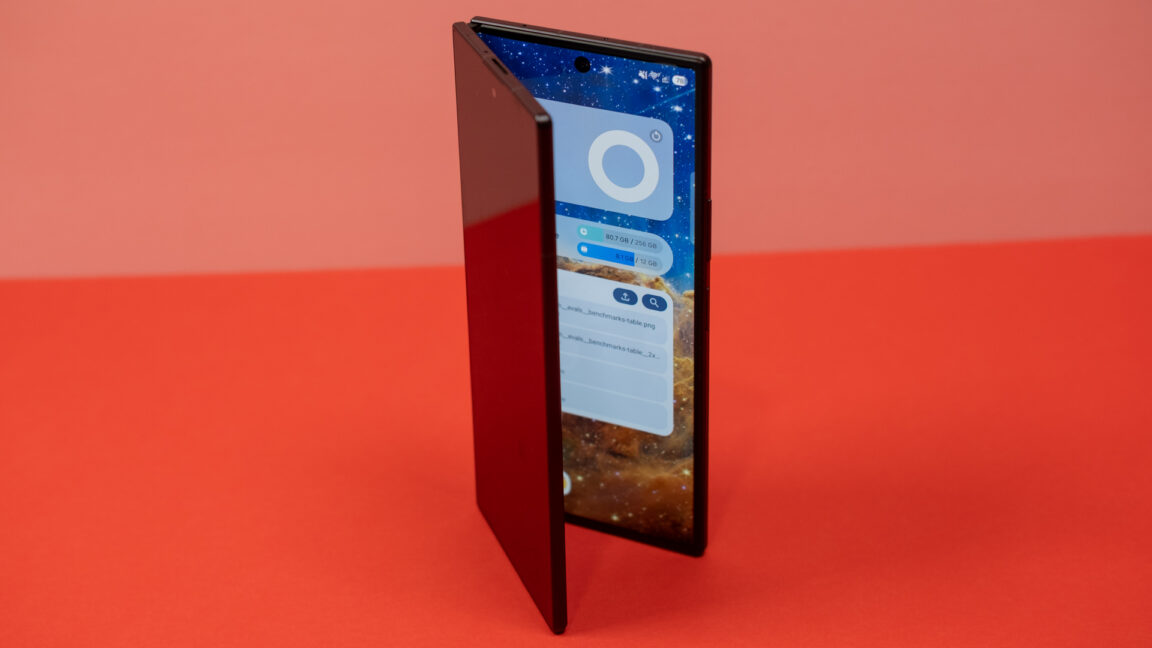
This Galaxy Z Fold 8 Ultra review lands on a familiar conclusion: Samsung has removed many of the old annoyances of book-style foldables, then attached a $2,099.99 starting price that demands a very specific kind of owner. The company’s top 2026 folding phone is a conventional tall-and-narrow handset when shut and an 8-inch tablet when opened. That is useful hardware, not magic. It earns its keep only if the tablet screen gets regular use for reading, browsing or doing several things at once.
Samsung lists the Fold 8 Ultra at 215g, 8.9mm thick folded and 4.1mm open. It has a 6.5-inch cover display, an 8-inch inner display, Qualcomm’s Snapdragon 8 Elite Gen 5 for Galaxy chip, a 5,000mAh battery, and rear cameras comprising a 200MP wide sensor, 50MP ultrawide and 10MP 3x telephoto. Samsung’s product page puts the US price at $2,099.99 before trade-in.
Is the Galaxy Z Fold 8 Ultra worth $2,100?
For people who treat a phone as a pocketable work and reading screen, the case is credible. Ars Technica found the phone closes without a gap, opens flat, and feels close to a normal phone in a pocket. The Guardian likewise found the external display practical for calls, messages and maps, while the internal panel suited books, websites and side-by-side applications.
The inner OLED has a 120Hz refresh rate and an anti-reflective treatment. Ars Technica said the treatment reduces reflections rather than erasing them, while The Guardian found it made the panel easier to read in direct sunlight. Samsung says a titanium layer below the display strengthens it. Ars Technica found the crease effectively imperceptible in ordinary use, but The Guardian could still see it with the screen off and feel it under a finger. That is progress, not a repeal of flexible-display physics.
Samsung’s One UI 9, based on Android 17, is the hardware’s strongest supporting act. The phone can keep three apps active in a split-screen grid and add floating windows, according to Ars Technica and The Guardian. That is materially more useful than a large screen used as an expensive video player, especially since widescreen video carries black bars on the squarer inner panel. Ars Technica also criticized Samsung’s duplicate and preloaded apps, including Facebook and LinkedIn, and found the Now Brief AI feature offered little practical value.
Where does the Fold 8 Ultra still compromise?
The camera assembly protrudes far enough to make the phone wobble on a table and can catch while pocketing, Ars Technica reported. The Guardian also cautioned that the inner screen’s softer material attracts fingerprints and needs more care than hardened glass on a conventional phone.
Battery life is strong, but it does not rescue the value argument for buyers who do not need a fold. CNN Underscored measured nearly 23 hours in a looping 4K-video test, about 90 minutes ahead of the Z Fold 7. In its testing, Samsung’s Galaxy S26 phones ran three to five hours longer. The Guardian reported about two days of mixed use, while noting games and other demanding tasks drain the battery faster.
The standard Z Fold 8 starts $200 lower at comparable storage tiers, according to Mark Ellis Reviews, and has the same storage options. The Ultra offers the more familiar tall phone shape and an additional rear camera, but the premium is not subtle. Pay for it if three-app multitasking and an 8-inch canvas are part of the weekly routine. Otherwise, a conventional flagship, or Samsung’s cheaper Fold 8, leaves a lot less money folded into the hinge.
This story draws on original reporting from Ars Technica.


