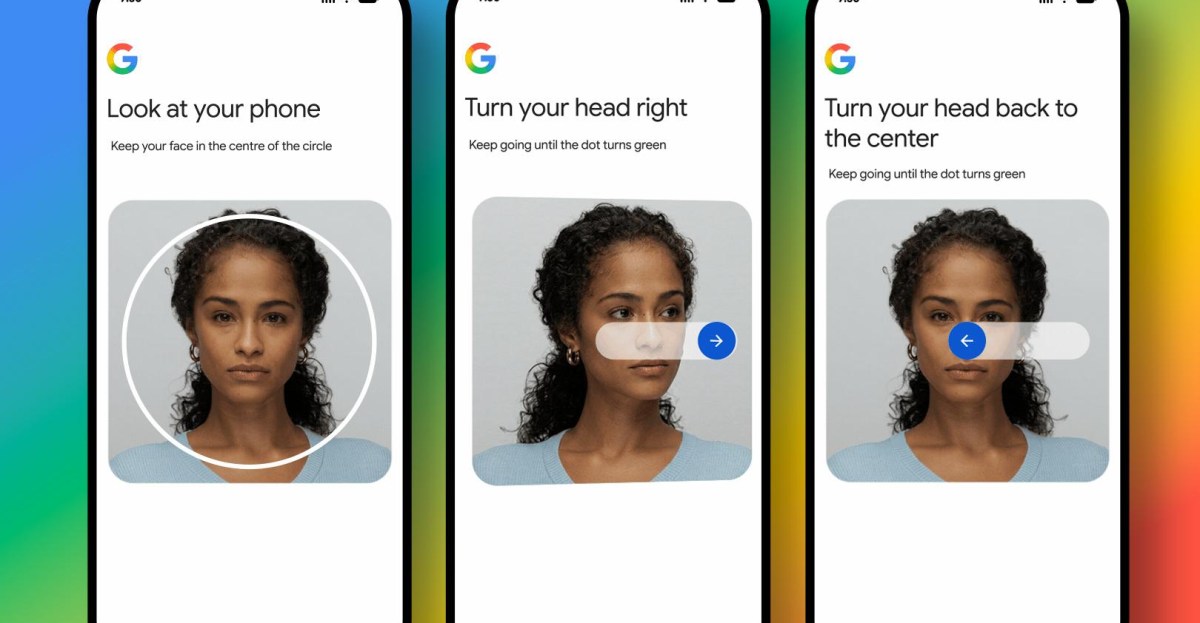
Google is adding a biometric recovery option for people who cannot get into their accounts with the usual password, device, or two-factor authentication route: record your face and move your head on command.
The company says its new selfie video sign-in method lets a user capture a short video on a phone, computer, or other device with a camera. Google then checks that clip against a previously saved reference video to decide whether the person trying to sign in is the account owner.
That makes the feature another fallback path for a very common failure mode: the account is yours, but the phone with your authenticator app is gone, the computer you normally use is unavailable, or the password has been forgotten. Google is pitching the system as proof of identity when the other signals are missing.
How the check works
To enroll, Google says users look into the device camera and follow on-screen instructions that ask for basic head movements. The point is to capture the face from more than one angle, not just a flat image suitable for a badge printer or a lazy phishing kit.
When the user later signs in with this method, Google asks for another short video. The movement prompts serve two jobs: they help Google compare the new recording to the saved reference clip, and they are meant to show that the camera is recording a live person rather than a static picture.
The setup resembles the enrollment flow for face-based unlock systems such as Apple’s Face ID, though Google says this version does not require extra infrared lighting hardware. In practice, that makes it available through ordinary cameras on mobile devices and PCs, assuming Google offers the option during account access.
Google keeps the reference video in the cloud
The privacy tradeoff is not subtle. Google says the reference selfie video is recorded and stored securely in its cloud using encryption. That means the clip is not tied only to the device where it was made, which is useful if the whole point is recovering access when a trusted device is missing.
It also means the recovery credential is a stored biometric-style record under a Google account, not a local-only face template. Google says users can remove the saved video from their account at any time.
According to Google, the stored selfie video is used by default to help with sign-in. The company also says users may choose to share it for other purposes, though Google’s announcement frames that as optional.
The company has not described this as a replacement for passwords, passkeys, or two-factor authentication. Based on Google’s own explanation, selfie video is an additional way to prove account ownership when the standard tools are unavailable. That is helpful, assuming the matching works as claimed and users are comfortable giving Google another cloud-stored identity artifact to guard.
This story draws on original reporting from The Verge.