Have glueballs been discovered? The careful answer is that the BESIII Collaboration has made its strongest case yet, not that particle physics has closed the file. In a preprint posted July 22, the collaboration argues that X(2370) is a particle with a dominant component of the lightest predicted glueball. The result adds a new flavor measurement to evidence accumulated over years, but it remains a preprint without independent experimental confirmation documented here.
That distinction is doing real work. BESIII is not reporting a pristine ball of gluons sitting alone on a detector readout. Its conclusion is that X(2370) is likely a mixed state dominated by a glueball component, with other interpretations currently disfavored. The collaboration says no single measurement can uniquely separate a glueball from every other kind of hadron.
What did BESIII actually find?
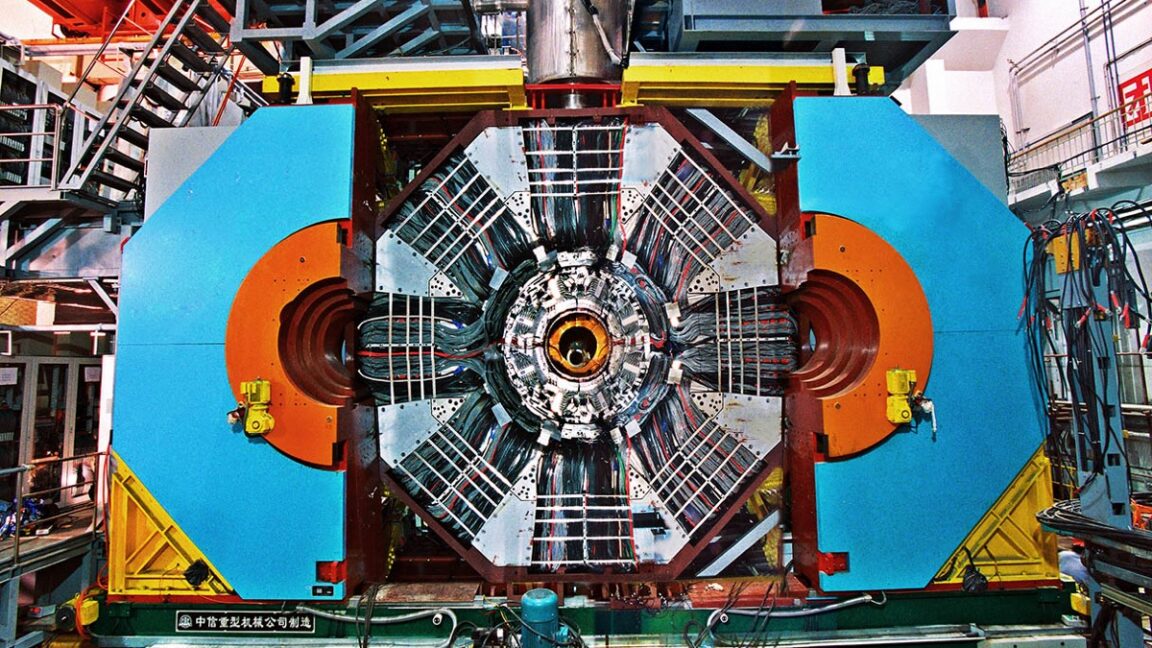
The Beijing experiment examined 10 billion decays of the J/psi particle, a productive place to look because its radiative decays create a gluon-rich environment. Researchers searched for X(2370) decaying into a K*(892) particle and an antikaon, including the charge-conjugate process, through a final state containing two neutral kaons and a neutral pion.
They found no evidence for that decay channel. The BESIII preprint sets a 90% confidence-level upper limit of 2.7 × 10⁻⁶ on the specified product branching fraction. The team interprets that suppression as evidence that X(2370) is a flavor-singlet state, meaning it is not associated with a particular quark flavor. BESIII treats that result as additional evidence for its predominantly gluonic interpretation.
What is a glueball?
Gluons carry the strong force that binds quarks inside protons, neutrons and other hadrons. Quantum chromodynamics, or QCD, says gluons can also interact with one another. That self-interaction permits bound states made from gluons, called glueballs. Finding one would test a basic but stubbornly hard-to-observe consequence of QCD.
X(2370) has been a candidate since BESIII first observed it in 2011. The collaboration says its measured mass fits the lattice-QCD prediction of 2.3 to 3.0 GeV/c² for the lightest pseudoscalar, or 0-+, glueball. It also cites X(2370)'s measured 0-+ spin-parity, production in radiative J/psi decays, decay patterns, and suppressed radiative decays involving omega and phi mesons as parts of the broader case.
Why the claim is still not final
The evidence is cumulative, which is both the point and the caveat. BESIII argues that the combined pattern requires a dominant glueball component to explain X(2370) naturally. Its own paper also says individual signatures do not unambiguously identify a glueball.
Colin Morningstar, a Carnegie Mellon particle physicist not involved in the work, told Ars Technica that the result is the strongest evidence so far that glueball-dominated particles can occur in nature. Independent groups still need to test the result. Until then, “glueball-dominant candidate” is the accurate label, however much the headline writers may want to declare victory.
This story draws on original reporting from Ars Technica.