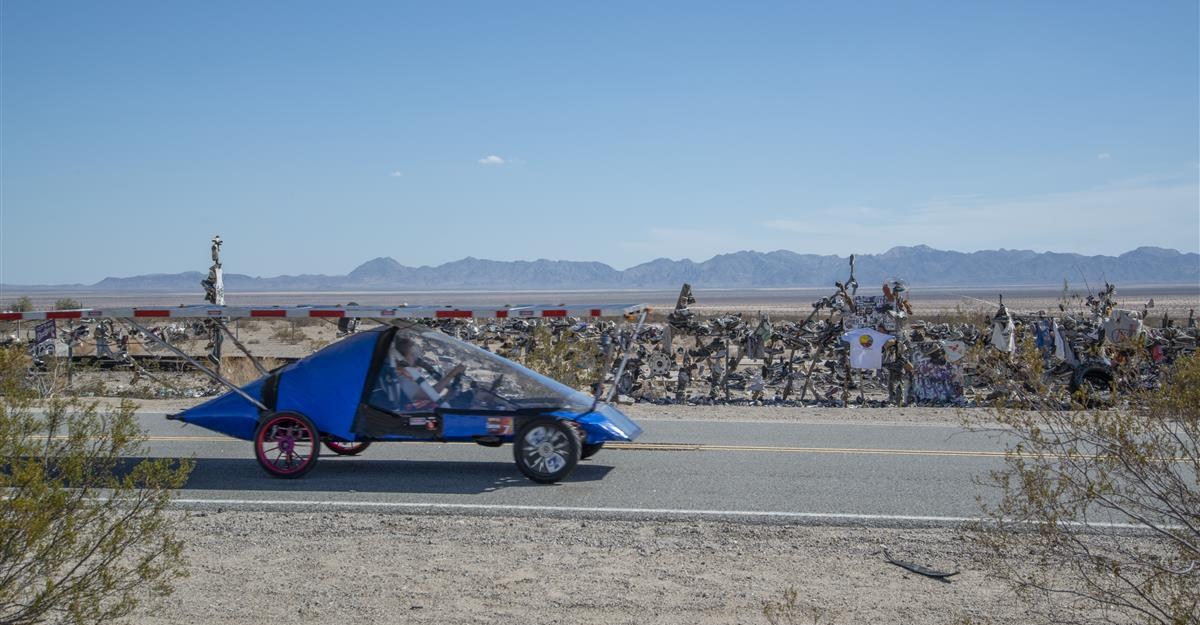
High school teams are sending student-built solar cars onto Texas roads on July 19 for a five-day, 630-mile race from Fort Worth to Fort Stockton. The Solar Car Challenge counts the team that drives the most miles as the winner, which is a pleasingly blunt metric for a contest where the cars only get energy from the sun.
The event is also a long-running engineering class with fewer worksheets and more things that can shear, short, overheat, or fall off. Students design and assemble the vehicles themselves, using off-the-shelf components and, in some cases, 3D-printed parts. The Solar Car Challenge says the program teaches project management, budgeting, fundraising, engineering, and the less glamorous skill of making hardware survive outside a lab.
This year marks the 30th anniversary of the national competition. Dr. Lehman Marks, a Texas educator, founded the Solar Car Challenge after seeing students respond to a university solar car project in the early 1990s. Marks told The Verge he concluded high school teams needed their own competition because college teams had more money, more tools, and more technical experience. The educational program began in 1993, and the first national competition followed in 1995.
A road race, not a science fair table
The 2026 route starts in Fort Worth and runs through Palestine, Round Rock, Fredericksburg, and San Angelo before ending in Fort Stockton, according to the event plan. Marks told The Verge that local residents turn out when the teams pass through those towns.
The program says it has involved more than 85,000 students across 39 states and several countries, including Canada, Mexico, Costa Rica, Spain, and Singapore. More than 260 high school solar projects are active, according to the Solar Car Challenge.
The competition alternates between track events and cross-country races. Marks has been warning teams to test their machines before arriving, telling The Verge that students should put 500 miles on a car ahead of the event so failures happen in a parking lot, where they can fix them, rather than on the route.
The usual divisions are classic, advanced, and electric-solar power. In the electric-solar category, teams race electric vehicles that draw energy from stationary solar power stations. Organizers added a new cruiser division this year. Those teams must build four-seat vehicles with solar arrays worked into the body, rather than the familiar flat-panel shapes that make many solar racers look like a go-kart hiding under a cafeteria tray.
Marks said the new category came after years of people asking whether solar cars could look more like usable passenger vehicles. He told The Verge the goal is to show a version with four doors, a trunk, room for four people, and solar cells built into the bodywork.
Students build the messy part
One team captain, 17-year-old Blake Wood of Benbrook Middle-High School near Fort Worth, is racing with Old Rip Racing. Wood told The Verge the independent team has 14 students from three schools, which he sees as an advantage because it puts students together who otherwise would not work on the same engineering problem.
Wood said the team started planning about a year before the race, first sketching on paper and studying earlier Classic Division cars. The students then moved their designs into CAD software as they learned the tools. He described a familiar hardware loop: assemble something, discover the next job requires access to the same area, remove the part, and do it again.
Solar cars remain far from mainstream transport. The Verge noted that some solar-car startups have shifted toward more conventional technology or collapsed, while companies such as Aptera continue chasing solar-assisted production vehicles. Wood said he thinks the technology can progress if competitions keep training students early. Marks put the program’s aim more plainly: he said he is trying to build capable students and future engineers, rather than just a better solar car.
This story draws on original reporting from The Verge.


