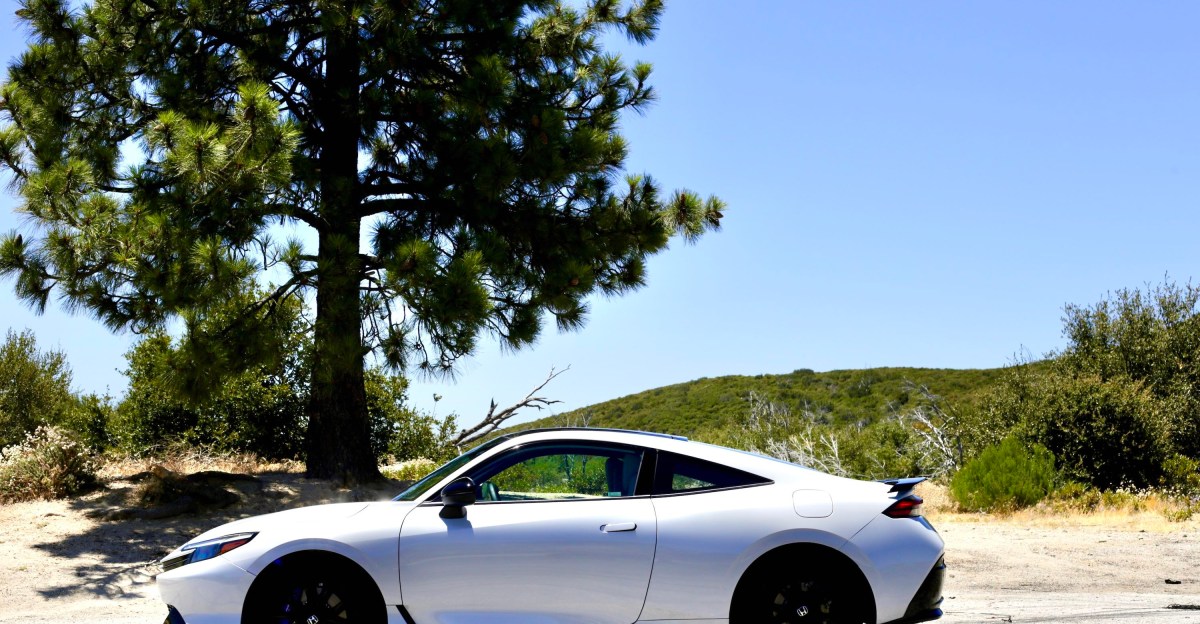
Honda has revived the Prelude after a 25-year absence, and the new car arrives as a hybrid coupe rather than a manual-transmission nostalgia play. According to Peter Nelson’s review for The Verge, the 2026 Prelude costs just over $43,000 and is pitched as a more technical, more engaging alternative to Honda’s everyday Civic Hybrid.
The mechanical trick is that the Prelude does not use a conventional transmission for most driving. Honda pairs a 2.0-liter inline-four with a two-motor hybrid system and a 1.05kWh battery. The company calls the layout an In-Line Motor Configuration, a name that sounds like a committee survived contact with a whiteboard.
In normal operation, the front wheels are driven by an electric motor. Power can come from the battery, from the gasoline engine running a generator, or from both systems together. The engine connects mechanically to the wheels through a clutch only at highway speeds. Nelson reports that the car can also drop back into battery-only operation at highway pace when conditions allow, such as on downhill sections, to improve economy.
The numbers
Honda rates the combined system at 200 horsepower and 232 pound-feet of torque. The Verge reports a curb weight of 3,261 pounds and a 0-to-60mph time of just over six seconds. EPA fuel economy is listed at 46mpg city, 41mpg highway and 44mpg combined.
Honda also claims emissions improvements from a low-temperature active catalytic converter that uses a reduced amount of noble metals. According to the company, the setup cuts NOx emissions by 24 percent and total hydrocarbon emissions by 22 percent.
Honda added hardware meant to make the hybrid less buzzy and more composed. The engine gets a crankshaft balance shaft and extra flywheel damping, both aimed at smoothing idle and low-rpm operation. The chassis is reinforced in key areas, while the front suspension comes from the Civic Type R’s dual-axis setup. Adaptive dampers, a thicker rear sway bar than the Civic’s and multi-piston front Brembo brakes from the Civic Type R round out the parts-bin raid.
Fake gears, real tuning
The most contentious bit is S+ Shift, Honda’s simulated shifting system. According to Nelson, it imitates eight transmission ratios by changing how motor regeneration and engine behavior interact. It also brings more noticeable engine sound than the Civic Hybrid.
Nelson wrote that the shifts felt crisp and close enough to a conventional gearbox to add driver involvement. The system did not hold its pretend gears for long, he said, but it held them long enough during cornering to help the car feel more deliberate on exit. That is synthetic, yes. It is also a more honest use of software than pretending a crossover is sporty because the screen has red graphics.
On public roads, Nelson reported that the Prelude felt solid in comfort, GT and sport modes, with smooth transitions between battery and generator power. In sport mode, he said the car handled well on mountain roads, helped by 235-width Continental summer tires on 19-inch wheels, firmer damping, strong front-end grip and the Type R-derived brakes.
There was one caveat: when the battery state of charge dropped, uphill acceleration sometimes felt weaker than the peak power figure suggested. Nelson said the battery recovered enough charge after several corners.
During a week that included a Los Angeles to Big Sur road trip, Nelson averaged about 38mpg over roughly 70 percent highway and 30 percent city driving, below the EPA combined rating but still strong for a sporty coupe. He also noted comfortable cabin space, supportive manual seats, good forward visibility and enough ground clearance for rough rural roads and light gravel trails.
The result, based on The Verge’s testing, is a Prelude that treats hybrid hardware as the point rather than an apology. Buyers hoping for a manual gearbox will not find one here. Honda’s bet is that careful regen tuning, chassis hardware and a coupe body can make the compromise feel intentional.
This story draws on original reporting from The Verge.