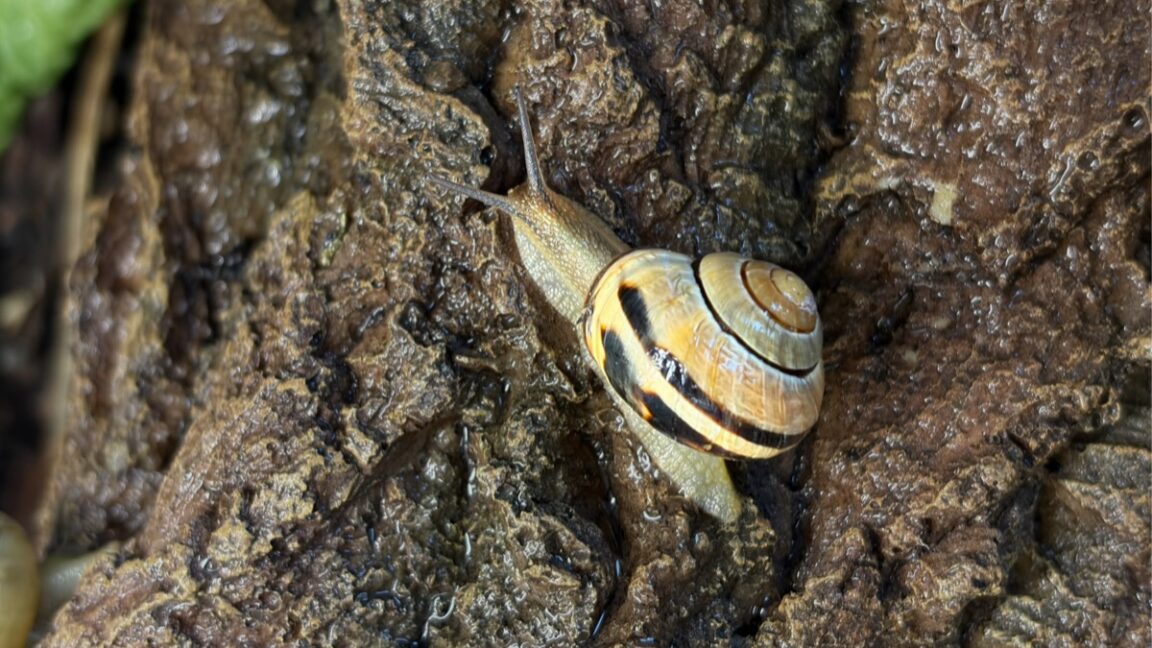
New research into how snails engineer slime finds that the brown-lipped snail, Cepaea nemoralis, makes five purpose-built mucus secretions by changing the proportions of proteins and ions in the mix. The result is a biological materials lab in a shell: one animal produces substances for crawling, clinging, defense and sealing itself in for winter.
The work, published in Science and reported by NPR and Ars Technica, examined snails collected near Germany's Max Planck Institute of Colloids and Interfaces. Mariella Gabler, a physical-chemistry doctoral student involved in the research, said the species uses the same general ingredients to make materials with different properties.
That distinction matters. The study concerns C. nemoralis, not a universal recipe for every snail and slug. Still, it offers a clearer account of how one species changes mucus chemistry to suit a job rather than producing one generic trail of goo.
How do snails make slime for different jobs?
Snail mucus is largely water. Its viscosity comes from mucins, which are glycoproteins, along with complex carbohydrates, according to Ars Technica. In the new work, researchers found that C. nemoralis adjusts relative levels of particular proteins and ions. Ars Technica reported that collagen and calcium act together in the tuning of the mucus's mechanical properties.
The five reported secretions have distinct roles:
- Locomotion mucus helps the snail move while maintaining contact with a surface. NPR described it as both sticky and slippery.
- Adhesive mucus helps the snail cling to materials including wood, glass and aluminum.
- Defensive foam can help wash out small pests when the animal is stressed or threatened.
- Defensive glue is sticky enough to immobilize pests, according to Gabler's description to NPR.
- Protective winter mucus seals the snail inside its shell. Ars Technica reported that this layer, called an epiphragm, contains calcite.
The winter seal is less glamorous than adhesive glue, but it is a useful example of why “slime” is an unhelpfully broad label. It is a protective layer used during hibernation, while the crawling secretion has to support movement and surface contact.
Does crawling mucus change under force?
That is a separate question from the new study's chemical tuning. A 2020 explanation of earlier experiments on pedal mucus from the terrestrial slug Ariolimax columbianus reported that the material behaved like an elastic solid under small pushes, then became more fluid under stronger sustained force. When that force stopped, it recovered a thicker state.
Those older slug experiments describe how a locomotion secretion can respond mechanically while an animal moves. They do not establish that the five secretions in C. nemoralis use the same mechanism. The current work instead points to the animal changing its ingredient ratios before producing mucus for particular functions.
Gabler told NPR that the system could give engineers a model for making different materials from common starting components. Wound sealing and drug delivery are possible applications she identified, not demonstrated medical products. The study explains a snail's toolkit; turning that toolkit into a reliable engineered material remains work for humans.
This story draws on original reporting from Ars Technica.


