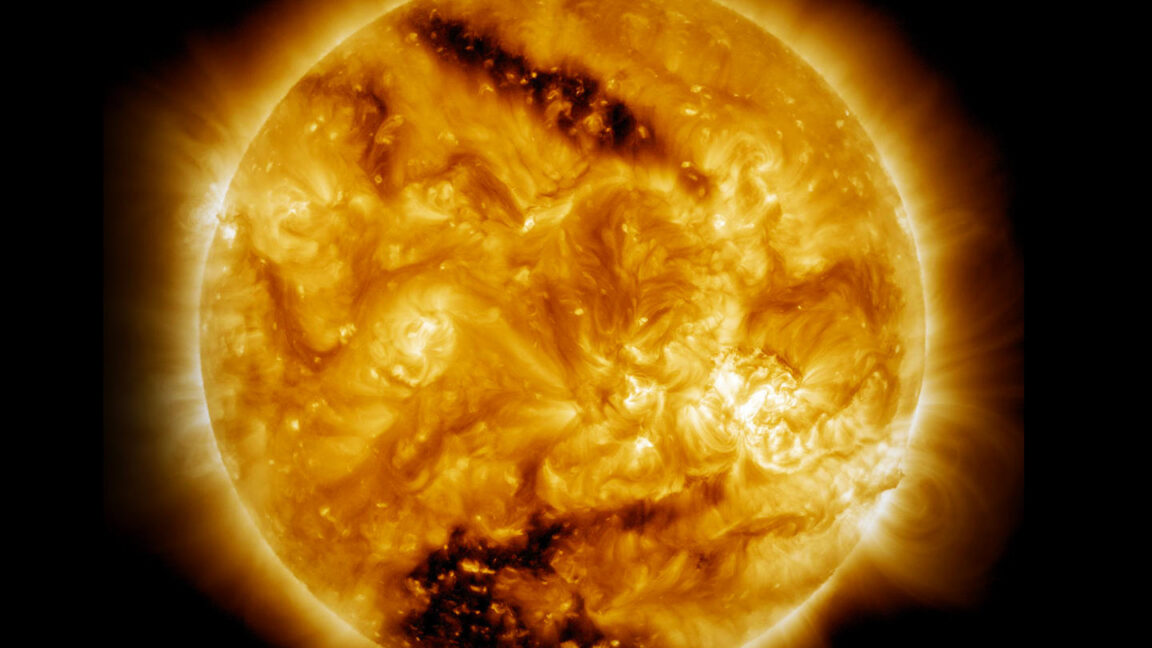
The Inouye solar telescope vortices are tiny swirling patterns at the boundaries of magnetic structures on the Sun, an international research team reports. Images from the 4-meter Daniel K. Inouye Solar Telescope on Maui resolved features near the 20-kilometer limit, while physics-based simulations recreated their appearance and movement. The researchers interpret the patterns as Kelvin-Helmholtz instabilities, a long-predicted effect now identified in the Sun’s visible surface, or photosphere.
The National Solar Observatory said the work, involving its scientists, the NSF NCAR High Altitude Observatory and Germany’s Max Planck Institute for Solar System Research, was published in Nature. The result does not establish why the corona is so hot or what causes solar eruptions. It gives solar physicists a newly observed small-scale process to test in those larger problems.
What are the vortices seen by the Inouye solar telescope?
Kelvin-Helmholtz instability forms when two fluids, or in this case plasma flows, move past one another at different speeds. Shear at their shared boundary amplifies small disturbances into waves and curls, much like wind-driven water ripples or some cloud bands.
On the Sun, the team found the structures around magnetic elements and at the edges of granules. Granules are convection cells, typically 500 to 2,000 kilometers across, where hot plasma rises from below, cools near the surface and then sinks. The observations show the fine swirls where those moving plasma flows meet magnetic regions.
The telescope observed an active region on April 14, 2025, at a wavelength of 416 nanometers. David Kuridze and Friedrich Wöger’s team used a three-minute sequence assembled from high-speed camera frames and atmospheric-blur correction. According to Ars Technica’s account of the research, the resulting imagery had about 19-kilometer spatial resolution.
That resolution exposed 47 interfaces carrying vortex-like features in the observed field. Adjacent curls were generally 60 to 100 kilometers apart, while individual vortices measured roughly 25 to 170 kilometers across, Ars Technica reported. Some fine fringes were only a little more than 20 kilometers wide, according to the Max Planck Society.
Why researchers think the patterns are real
A sharp image alone would not settle the physics. The researchers ran numerical simulations of the observed photospheric region, using its magnetic-field map, then generated synthetic telescope observations from those calculations. The simulations reproduced the structures’ visual form and behavior, including their growth and motion, according to the National Solar Observatory and Ars Technica.
That comparison supports the Kelvin-Helmholtz interpretation rather than treating every dark stripe in an image as a confirmed whirlpool. It also explains why the effect had remained elusive: previous solar telescopes could not resolve structures on this scale.
The possible consequences are interesting but remain hypotheses. The team proposes that widespread shear-driven mixing could affect how magnetized and nonmagnetized plasma exchange heat and mass beneath the visible surface. NSO also says such motion may help twist magnetic fields that later store and release energy. Researchers have not shown that these vortices heat the corona, trigger flares or predict space weather.
Readers can review the observatory’s description of the observations and simulations. For now, the useful conclusion is narrower: the Sun’s magnetic boundaries are not as quiet as lower-resolution imagery made them look.
This story draws on original reporting from Ars Technica.


