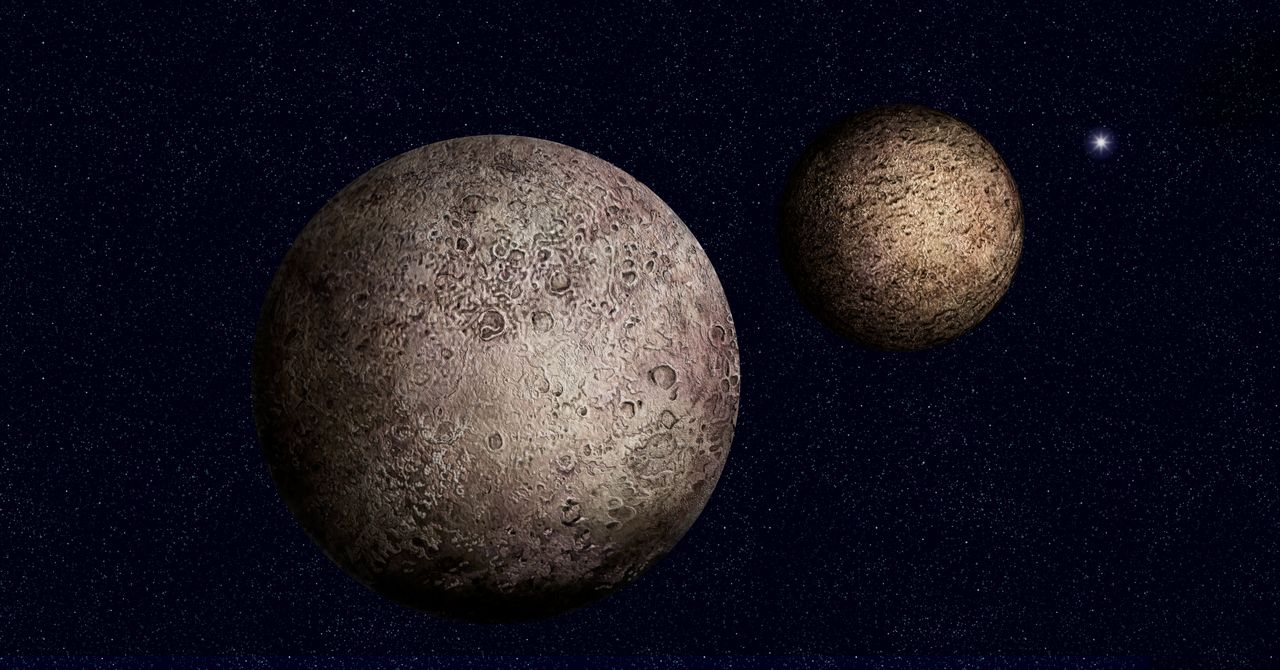
The James Webb Space Telescope has spotted the same unidentified chemical fingerprint on Pluto and Titan, according to researchers behind a study awaiting publication in Astronomy & Astrophysics. The feature does not line up with entries in existing spectroscopic databases, which is the scientific version of getting a barcode scan and watching the register shrug.
The reported signal is an absorption band centered at 5.113 micrometers. Researchers found it on Titan, Saturn’s largest moon, and on Pluto, the dwarf planet visited by New Horizons. Those are not neighboring lab samples. They are separated by billions of kilometers and have sharply different surface and atmospheric conditions.
The team argues that the reading is unlikely to be a Webb glitch. According to the study, the same band appeared in observations from two different JWST instruments, which led the researchers to discount calibration trouble or another obvious technical artifact. That does not identify the compound, but it makes the “bad data” explanation harder to keep alive.
What the telescope actually measured
The method is spectroscopy, the workhorse technique astronomers use to infer chemistry from light. Molecules and elements absorb light at particular wavelengths. Those missing slices of light form patterns that can be compared with laboratory measurements of known substances, including water, methane, carbon dioxide and ammonia.
Here, the comparison came up short. The researchers checked laboratory spectra for ices and organic molecules that could plausibly exist on Pluto or Titan, including acetylene, benzene, ketene and a class of molecules called alenes. None reproduced the observed feature closely enough, according to the study.
The authors’ preferred explanation is conservative: the signal may come from a known compound in a physical state or mixture that has not been tested in a lab. They also leave open a more awkward possibility, that the material’s chemistry has not yet been characterized. That is not a claim of alien weirdness. It is a claim about the limits of the lookup tables scientists use when the solar system hands them cold, dirty chemistry.
Two cold worlds, one awkward fingerprint
Titan and Pluto share enough chemistry to make the match plausible, even if their environments are otherwise mismatched. Titan has a nitrogen and methane atmosphere, surface pressure of about 1.5 bar, methane rivers and lakes, and temperatures near minus 180 degrees Celsius. Pluto’s atmosphere is far thinner, about 10 microbars, and its surface contains nitrogen, methane and carbon monoxide ices at temperatures close to minus 235 degrees Celsius.
Both bodies also host complex organic chemistry driven by sunlight and cosmic rays. Researchers say that radiation can produce new compounds that later settle onto the surface, giving Titan and Pluto a possible common route to the unidentified signature.
Resolving the identification will take more than pointing at a database and hoping harder. The study says researchers need additional JWST observations and laboratory experiments that better mimic the chemistry and physical conditions of the outer solar system.
NASA’s Dragonfly mission to Titan may also help, though with a caveat. The spacecraft is not expected to observe this exact infrared feature directly. Its onboard chemistry lab could, however, analyze candidate materials on Titan’s surface and narrow the list of suspects. For now, Webb has supplied the puzzle. The lab work has to catch up.
This story draws on original reporting from WIRED.