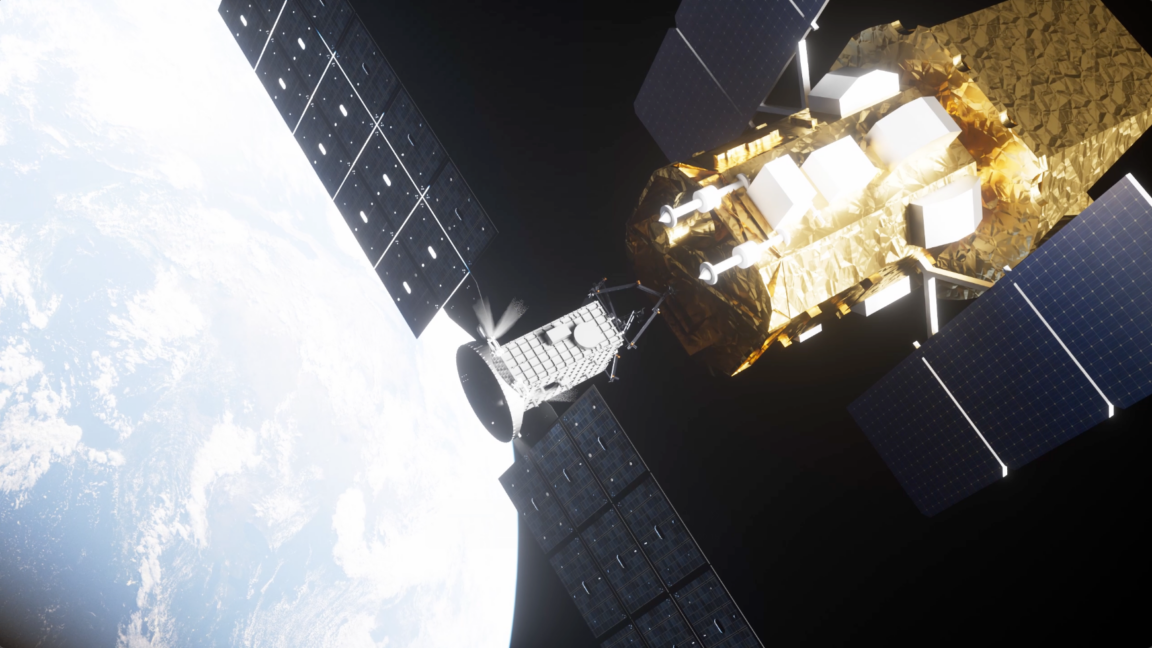
The Katalyst Link Swift rescue is still possible, according to the company, after its servicing satellite lost control more than 200 miles above Earth while chasing NASA’s Swift gamma-ray observatory. Katalyst Space Technologies CEO Ghonhee Lee told Ars Technica that engineers have cut the spacecraft’s tumble roughly in half and are working with NASA on new control software.
Link, a satellite about the size of a refrigerator, was built, owned and operated by Katalyst under a $30 million NASA contract. Its job is to reach Swift, attach to it and raise its orbit before atmospheric drag pulls the observatory too low. Swift is valued at about $500 million, and NASA gave Katalyst less than a year to assemble the mission.
The failure hit last Saturday during a period when the satellite was out of contact with the ground, Lee told Ars Technica. Before that pass, he said, Link had been in a stable state. Afterward, the spacecraft was rotating on multiple axes, could not keep steady communications with controllers near Denver, and had lost two of its three reaction wheels, the devices spacecraft commonly use to point themselves.
How can Katalyst save the Link satellite?
Katalyst is using Link’s xenon electric propulsion system to fight the spin. Those plasma engines were mainly included to raise the satellite’s orbit, but Lee told Ars Technica they can also steer the spacecraft because their thrust can be aimed with a two-axis gimbal.
The catch is thrust. Electric propulsion is efficient, which is why spacecraft engineers like it, but it pushes gently. That means Link cannot snap back into position; it has to bleed off rotation over time. As of Friday, Ars Technica reported, the spin rate had fallen from about 9 degrees per second to about 4 degrees per second.
Better pointing should also mean better data. Lee said Katalyst wants a steadier communications link so it can download more telemetry and confirm the condition of the spacecraft. The company’s guidance, navigation and control team is working with NASA to rewrite the control approach so Link can use its one working reaction wheel together with thrusters and electric propulsion.
A reaction wheel is a spinning wheel inside a spacecraft. By speeding it up or slowing it down, a satellite can rotate itself without firing a thruster, which saves propellant and gives precise pointing control.
What went wrong with Link?
Katalyst has not identified the original trigger. Lee told Ars Technica it could have been an internal spacecraft fault or a strike from orbital debris. After controllers regain enough stability, two onboard cameras are expected to inspect the satellite for visible damage.
The later failure chain is clearer, at least in outline. Link went more than 24 hours without ground contact, then activated built-in fault protection that power-cycled the spacecraft. Lee said that reset was expected behavior, but the abrupt shutdown produced thermal effects that overheated electronics upstream of the reaction wheels, leaving two of them unusable.
The cold gas thrusters also have a problem, Lee told Ars Technica, though Katalyst currently views that as a separate issue. He said the team still needs fuller data before it can sort causes from consequences.
Katalyst still hopes to resume the trip toward Swift, possibly around the end of August, according to Lee. He told Ars Technica that the company has not completed a formal assessment, but believes three-axis control, a close inspection of Swift from within a few dozen meters, and an attempted capture remain feasible.
The schedule is unforgiving. Ars Technica reported that Swift will be too low for Katalyst’s rescue attempt within a few months. If Link cannot recover in time, NASA’s first contracted commercial servicing mission for one of its own satellites may run out of altitude before it gets a hand on the spacecraft it was sent to save.
This story draws on original reporting from Ars Technica.