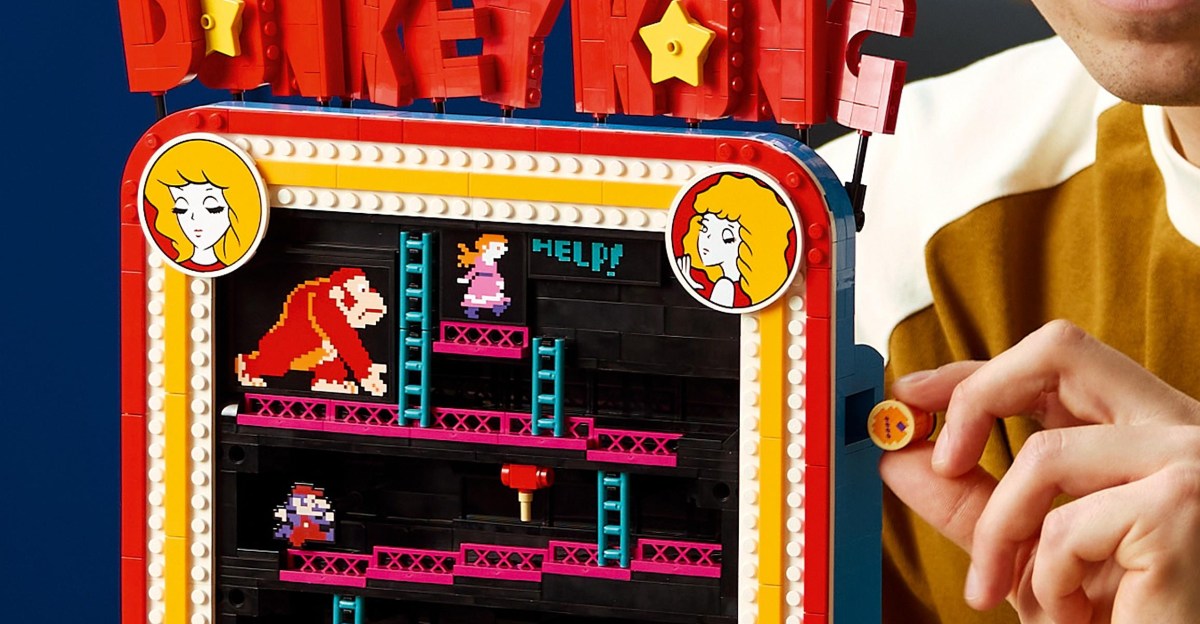
Lego has made a Donkey Kong arcade cabinet set with a working mechanical game inside, according to The Verge’s Sean Hollister. The point for collectors is obvious enough: this is another nostalgia build aimed at adults with shelf space and Nintendo muscle memory. The more useful detail is that it is not only a plastic shrine to an old cabinet.
The set lets players move Jumpman, the character later renamed Mario, with a joystick. A separate button makes him jump. Pulling a lever releases barrels down the playfield, giving the figure something to dodge in a loop that approximates the arcade premise without trying to become the arcade game.
Hollister reports that the figure cannot climb all the way to the top of the structure by itself. So, no, this is not Donkey Kong implemented in bricks with a full win state. It is a mechanical toy that captures one central action from the original: barrels roll, Jumpman jumps, and the player tries to time the movement.
Carl Merriam, a Lego designer whose past work includes the Lego Nintendo Game Boy and Piranha Plant, helped create the set, according to The Verge. Merriam has also worked on Lego’s Lion Knights’ Castle, Galaxy Explorer and Pirates of Barracuda Bay sets.
The barrel mechanism is the part that sounds least glamorous and most like actual toy engineering. Merriam told The Verge that the barrels are the same Lego barrel element first released in 1989 for the company’s pirate sets. He said that reuse was his favorite part of the build.
The problem, Merriam said, was controlling the barrels once gravity got involved. They had to move slowly enough for the game to work, without jamming in the tracks. “I rolled thousands of barrels down those tracks to figure it out,” Merriam told The Verge.
Nintendo’s fingerprints are on the build
The Verge reports that the set won approval from Shigeru Miyamoto, Nintendo’s creator of Donkey Kong and Mario, though the report frames that as something Merriam was told rather than a direct comment from Miyamoto. That distinction matters because licensed nostalgia products tend to come wrapped in corporate fog, and “Miyamoto liked it” is the kind of sentence that sells a lot of plastic.
Still, the collaboration tracks with Lego and Nintendo’s broader run of brick-based Nintendo sets. The Donkey Kong cabinet fits the pattern: a display object first, with just enough mechanism to make it feel engineered rather than embalmed.
For anyone expecting a brick-built arcade emulator, the described feature set is narrower. For anyone who wants a small physical system of levers, barrels and timing built around one of Nintendo’s oldest loops, Lego appears to have aimed directly at that shelf.
This story draws on original reporting from The Verge.