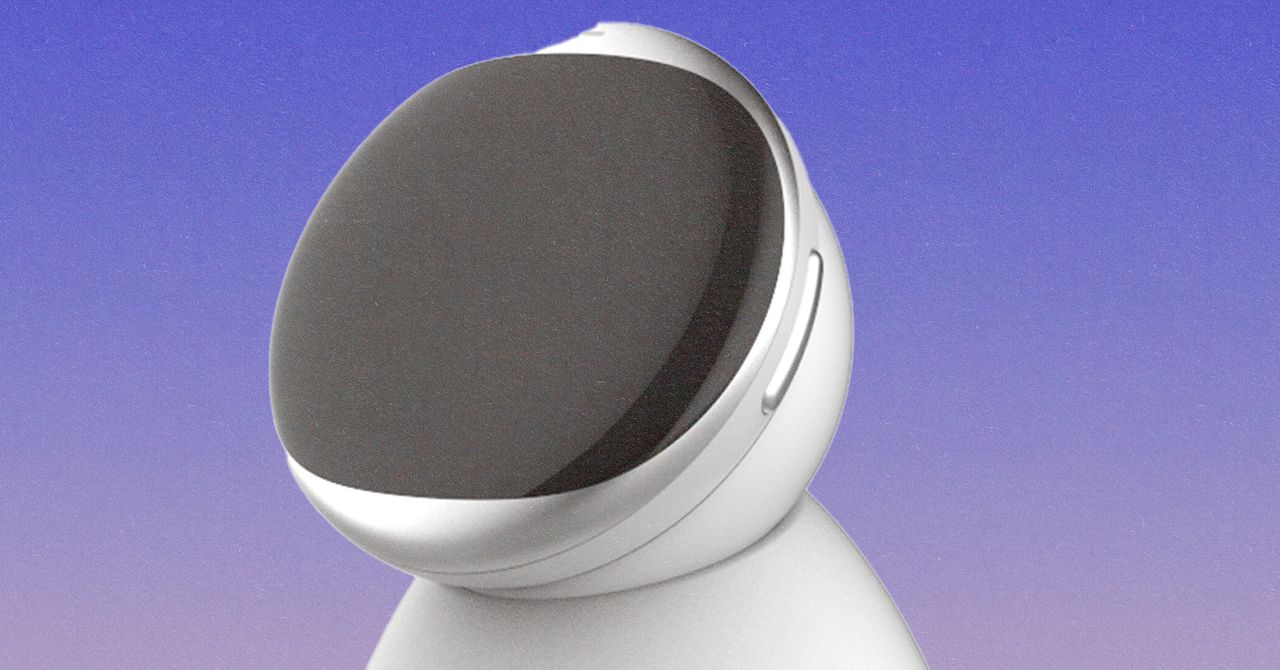
Lingverse, the company formerly called Ling AI, has raised $29 million to build iKairos, a wearable AI device that borrows the emotional residue of Jibo, the defunct social robot, while moving the product into a much more camera-heavy category.
The pitch is familiar for anyone who has watched the current AI hardware cycle: put microphones and a camera near a person, collect contextual signals, then have software summarize, answer questions or generate artifacts from daily life. Lingverse says iKairos can be worn as a pendant, clipped to clothing or placed in a tabletop dock where it observes from a fixed spot.
Jiawei Gu, Lingverse’s chief executive, told WIRED that the product is meant to continue Jibo’s ambition. “With iKairos, we are carrying forward Jibo's original dream,” Gu said.
That lineage needs parsing. Jibo, introduced in 2014, was a stationary home robot that could speak, swivel and show some personality, but could not manipulate objects or move around a room. It arrived before Amazon’s Echo speakers became mainstream and later failed as a business. Gu was a board member before Jibo collapsed, according to WIRED, but he was not part of the founding team.
Lingverse says it has “the blessing of Jibo’s founding team,” according to WIRED. The company does not own Jibo’s intellectual property rights, though it lists Jibo as a product on its website. Lingverse also told WIRED it holds several core Jibo patents, but did not identify them.
What Lingverse says iKairos does
Lingverse has not given a full technical description of iKairos. The company says the device will likely sell for $199 to $249, with a possible subscription for additional AI features. Presales are planned for later this year.
In marketing material cited by WIRED, Lingverse describes iKairos as a device that will continuously observe the user and nearby surroundings and develop into a “personal AI guardian.” The company did not explain what that guardian role means in operational terms.
The iKairos website now frames the product as an “AI journal.” Based on Lingverse’s description to WIRED, the device captures a user’s day and produces an end-of-day reflection. Its software can also turn captured moments into AI-generated images for a personal journal.
A Lingverse representative told WIRED that generated images are based on real scenes the device captured. The representative said entries pass through a quality check that compares the visual scene with audio context, including where the user was, who was present and what was said. Users will be able to choose preferred images, according to the company.
The privacy claims are doing a lot of work
Lingverse told WIRED that iKairos does not record video. The company says the camera takes snapshots, later deletes them, and records audio only when it detects a human voice. It also says the hardware will include a physical camera shutter, and that data will be processed on-device or encrypted during transmission.
Lingverse further says iKairos data will not be used to train AI models. Those are company claims, not yet tested in market. For a device meant to watch homes and bodies from multiple angles, the implementation will matter more than the slogan.
Lingverse already sells AI products for children, including the Luka AI Reading bot and a camera-enabled Luka AI cube shown at CES 2026, according to WIRED. The cube can answer questions and turn artwork into talking AI videos.
iKairos will enter a crowded category. WIRED points to AI wearables such as Bee AI and the Looki L1 bodycam, plus AI photo features already available through Google Photos. Larger companies are also pushing home assistants, including Google’s AI-enabled smart speakers, Amazon and Apple smart-home work, and OpenAI’s hardware partnership with Jony Ive.
Lingverse is selling nostalgia for Jibo and a promise that today’s generative AI can finish what an earlier social robot could not. For now, the confirmed product is a planned wearable camera assistant with a funding round, a price target and many unanswered questions.
This story draws on original reporting from WIRED.