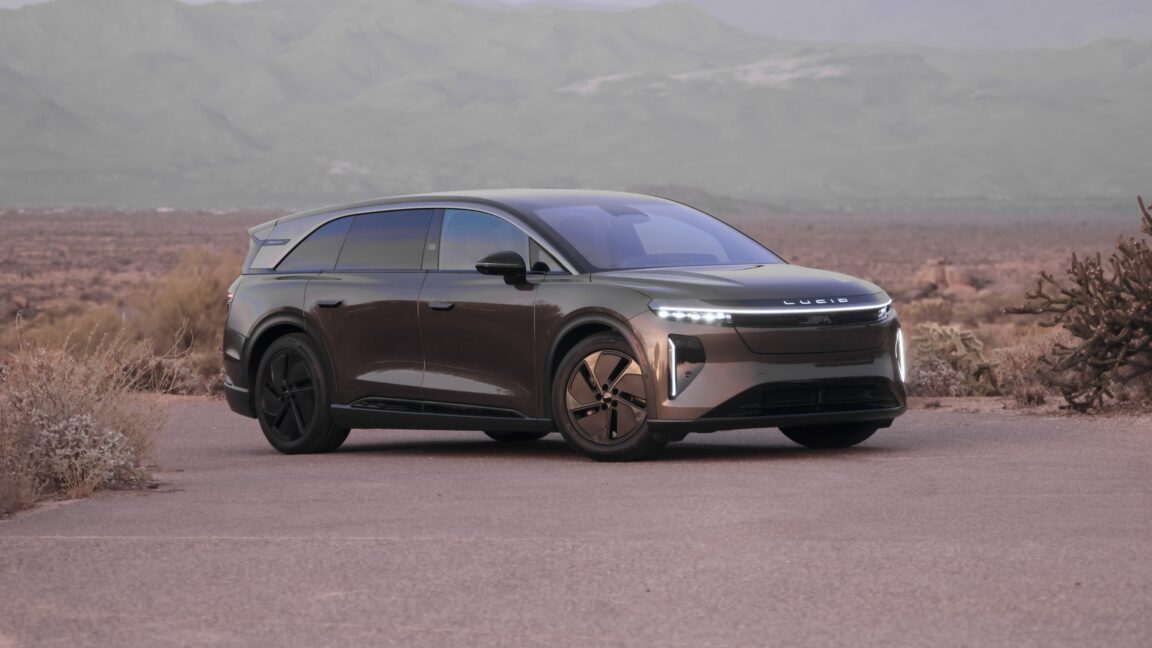
Lucid’s second production vehicle is starting to look less like a halo exercise and more like an actual family EV. Ars Technica reviewer Jim Resnick spent a week with the 2026 Lucid Gravity Touring, the lower-priced version of Lucid’s electric SUV, and found that the cheaper trim keeps much of what makes the Gravity work: quick charging, strong acceleration, and space that embarrasses many conventional SUVs.
The Gravity Touring starts at about $82,000 in the US, including the mandatory destination charge, according to Ars Technica. Resnick’s test vehicle landed at $107,200 after options including a 22-speaker audio system, a Comfort and Convenience package, third-row seating, a Dynamic Handling package with rear-wheel steering and three-chamber air suspension, Nappa leather with massaging and ventilated front seats, metallic paint, and Lucid’s Dream Drive 2.0 Pro driver-assistance package.
Dream Drive 2.0 Pro adds features beyond the standard adaptive cruise control, lane warnings, lane keeping, blind spot warnings, and drowsy-driver alert. Ars Technica said the option bundle includes hands-free driving assistance, automatic lane-change assistance, and a parking alert meant to warn drivers before they grind a wheel into a curb. Lucid also supports automatic over-the-air software updates.
Less battery, still plenty of SUV
The Touring uses a 16-module, 89 kWh battery pack and two motors producing a combined 560 horsepower and 811 pound-feet of torque. The front motor makes 147 hp, while the rear motor contributes 413 hp, according to Ars Technica. Lucid’s pricier Gravity Grand Touring starts above $100,000 and uses a 22-module, 123 kWh pack, with output rising to 828 hp.
The paper gap is large. The real-world penalty sounds smaller. Lucid rates the Touring at 337 miles of range, compared with 407 miles for the Grand Touring. Resnick reported 320 miles from a full charge in mixed suburban and highway driving, close to the EPA figure. He also wrote that the Touring never felt short on power during his week with the SUV, despite the Grand Touring’s much louder spec sheet.
Charging is one of the more useful parts of the package. The Gravity has a native NACS port, so Resnick used Tesla Supercharger stations without an adapter. Because the SUV supports plug-and-charge using ISO 15118, compatible chargers can authenticate the car and account during the charging handshake, avoiding the usual app ritual. In one session, Ars Technica said the Gravity charged from 15 percent to 95 percent in 31 minutes.
Lucid claims the Gravity can add as much as 200 miles in 11 minutes, but the company’s own consumer site says that requires a 400 kW DC fast charger. Resnick reported efficiency of 3.3 miles per kWh in suburban and city driving, and 3.8 miles per kWh during steady freeway driving.
Polished drive, uneven cabin details
Lucid claims the Gravity Touring reaches 60 mph in 4.0 seconds. Resnick did not run instrumented testing, but described the SUV as very quick and more agile than its roughly 5,200-pound weight suggests. He praised the steering, the optional air suspension’s balance of comfort and control, and the braking setup, which uses six-piston Brembo front calipers and 15-inch rotors.
The cabin makes a stronger case on packaging than on every material choice. Ars Technica said the Gravity has nearly 41 inches of front legroom and 42.6 inches in the second row, with a third row that fit Resnick’s 6-foot-1 frame. Cargo space is listed at 56 cubic feet behind the second row and 112 cubic feet with seats folded and slid forward, more than the standard Ford Expedition’s 108.5 cubic feet with all rows folded.
The tech stack fared better than some trim pieces. Resnick praised Lucid’s 34-inch curved 6K OLED display and 12.6-inch central touchscreen, along with quick Apple CarPlay connection. He noted some audio-display lag, thin floor mats, cheap-feeling removable cargo panels, awkward third-row folding, and interior panel quality that he said failed to match the price.
The verdict is mostly pragmatic: the Touring gives up battery capacity and headline horsepower, but keeps the Gravity’s charging speed, cabin volume, ride quality, and design. For Lucid, a company that arrived with a 1,100 hp luxury sedan, that is a healthier kind of flex.
This story draws on original reporting from Ars Technica.