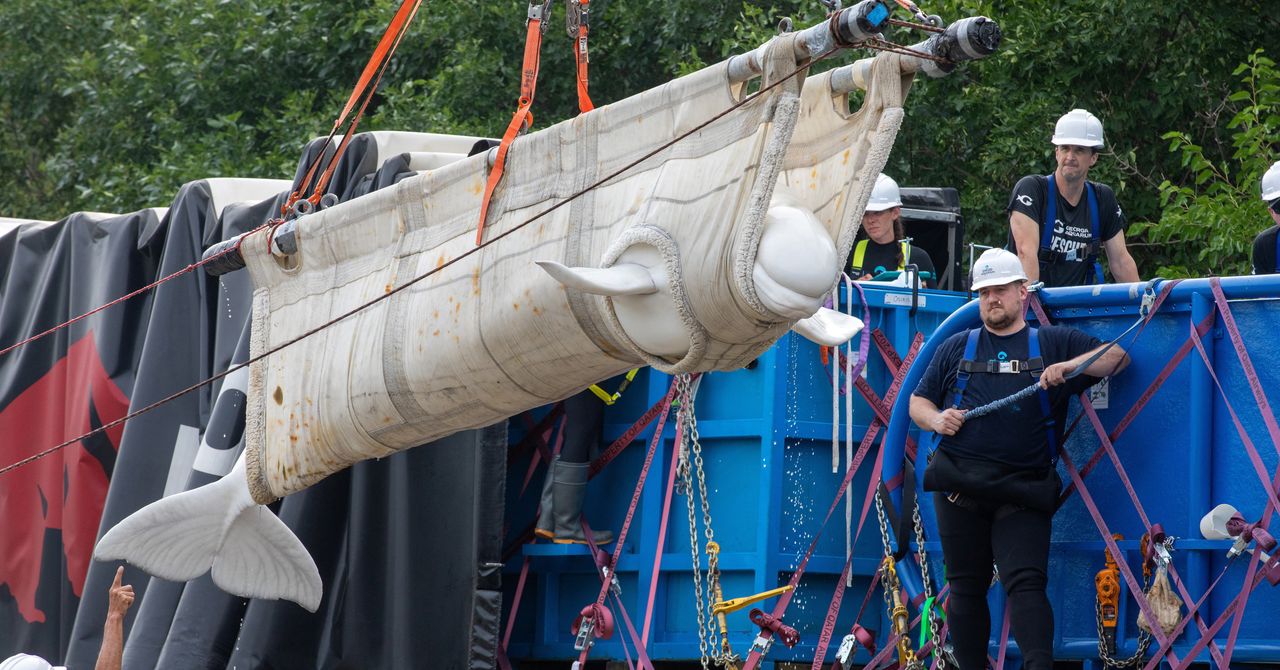
The Marineland beluga transfer has brought four adult female whales from the closed Niagara Falls park to Chicago’s Shedd Aquarium, WIRED reported, after Canada and Marineland struck a June agreement to begin moving animals out of the bankrupt facility.
The whales, named Acadia, Lillooet, Osiris and Sierra, traveled with Shedd veterinarian Karina Tang and animal behavior director Charlie Jacobsma. Two other belugas took the same chartered Boeing 777 freighter and were later sent to an aquarium in San Antonio, according to WIRED.
Marineland closed to the public in 2024 and later went bankrupt after its owners died. As its finances deteriorated, the park previously asked Canada for help caring for animals. In 2025, Marineland said it had made the “devastating decision” to consider euthanasia if it could not relocate them.
How did the belugas get from Marineland to Chicago?
The transfer was a deliberately boring operation for the animals, which is the point when moving more-than-1,000-pound marine mammals across a border. Tang told WIRED the team wanted the whales to notice as little disruption as possible.
Each whale was lifted in a custom stretcher, placed into an individual container filled with cold saltwater, driven by truck from Niagara Falls to Toronto Pearson Airport, loaded onto the cargo aircraft, then flown to Chicago. During the flight, Shedd staff stayed near the whales, monitored them and poured water over their backs to keep them comfortable, Jacobsma told WIRED.
The cross-border part added paperwork and timing headaches, because the mission involved agencies including Fisheries and Oceans Canada and the U.S. Department of Agriculture, and had to comply with an international animal-trade treaty. Tang told WIRED the team had to account for every stretcher, pole and other piece of equipment before the move.
Customs agents at O’Hare boarded the plane to check staff passports so the caretakers could remain with the whales, Jacobsma told WIRED. That is the kind of procedural detail that turns “fly some whales to Chicago” into a sprawling logistics stack with fins.
What happens to Marineland’s belugas now?
The four whales are being kept away from Shedd visitors while they adjust. WIRED reported that the habitat is under continuous watch by veterinarians and marine-life staff, and signs in the Oceanarium ask guests to keep quiet to help the new arrivals settle in.
Jacobsma told WIRED the Shedd team is “cautiously optimistic.” The whales are eating regularly and searching for fish and enrichment toys placed in their habitat, according to the report.
The broader rehoming plan may send more Marineland animals to aquariums in Georgia, San Diego and Spain, in addition to those already moved to Chicago and Texas. Tang told WIRED that Shedd is open to taking more belugas, up to ten.
The transfer has critics. The Whale Sanctuary Project, a Canadian nonprofit, has called the effort a “so-called ‘rescue’ situation” and said it is planning a sea pen in Nova Scotia in 2027. A sea pen is a fenced coastal enclosure meant to give captive whales more natural seawater conditions while keeping them under human care.
Options appear limited. Fisheries and Oceans Canada told Canadian news outlets that Marineland’s belugas could not survive in the wild. Shedd says it can provide a high level of care and is not focused on breeding now. Only one sea pen currently exists, in Iceland, and that sanctuary recently said on Instagram that it is not able to accept more animals.
This story draws on original reporting from WIRED.


