Meta has introduced Content Seal, an invisible watermarking system meant to identify images made by its new Muse AI model, after its Oversight Board urged the company in March to use its own tools against deceptive generative AI during conflicts.
The catch is in the implementation. According to Meta, Content Seal currently applies to images generated by Muse in the Meta AI app and on Meta.ai. It does not cover images made with Meta’s older AI tools, and video support is not available yet, though Meta says it is coming “soon.” For users trying to sort real media from synthetic sludge on Facebook, Instagram, or anywhere else, that is a narrow net.
Meta describes Content Seal as a hidden provenance signal embedded in AI-generated images. A detector can scan for that signal and flag the image as made or edited with Meta’s system. Meta says the watermark should survive common transformations such as cropping, compression, resizing, and screenshots.
That mechanism sounds close to Google’s SynthID, which also uses invisible watermarking for AI media. Google has added SynthID detection to Gemini, and OpenAI has adopted SynthID for some of its own AI-generated output. Meta is also a steering committee member of the Coalition for Content Provenance and Authenticity, the group behind the separate C2PA Content Credentials standard, alongside Google.
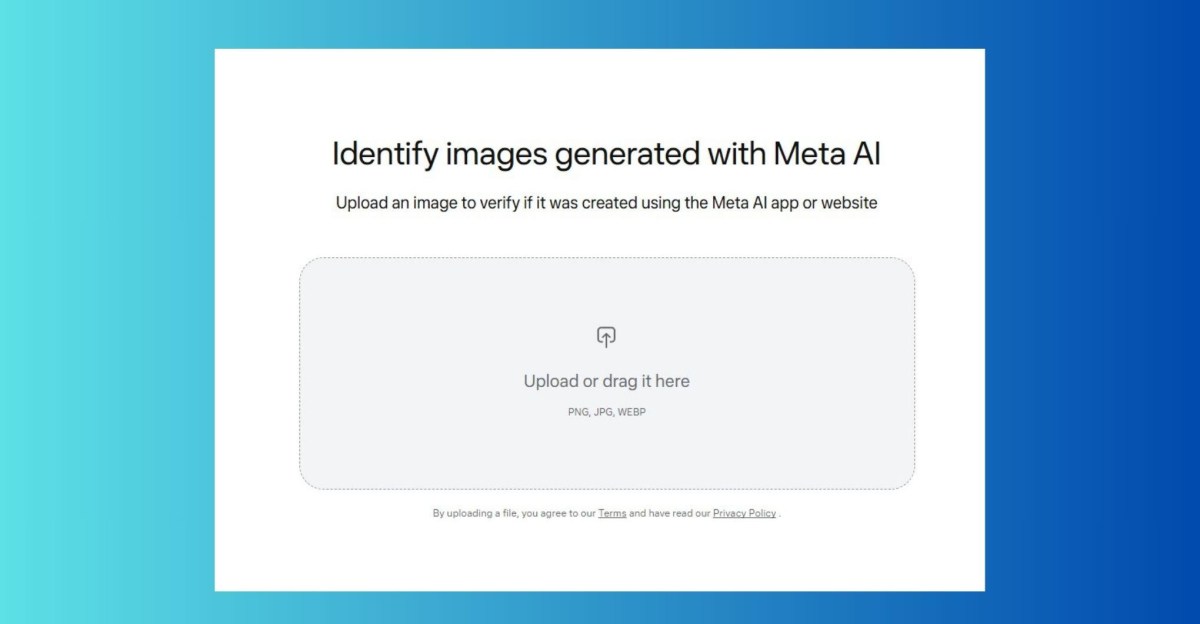
Meta has not built Content Seal detection into its Meta AI chatbot at launch. Users must instead use a dedicated web tool that Meta is testing. Meta spokesperson Faith Eischen told The Verge that the company is “exploring ways to bring detection closer to where people encounter AI-generated content.” That is the obvious place to put it, which makes its absence at launch harder to wave away.
The detector also has a daily usage limit. Eischen said the cap is meant to support “normal usage” and protect the system from abuse. Google and OpenAI also impose limits on their detection tools, according to their support materials. C2PA’s detection portal, by contrast, does not limit the number of checks users can run.
Meta’s own platforms use unspecified metadata “alongside Content Seal watermarking” to help label AI-generated material, Eischen said. Asked whether Meta is helping other platforms such as TikTok and LinkedIn detect Content Seal, Eischen said Meta is “determined to work with our industry peers to make sure users have the best experience possible.” That leaves open how widely the watermark can be recognized outside Meta’s walls.
Independent checks have not made the launch look stronger. The Verge reported that Gemini and the official C2PA detection portal could not confirm a test image made with Muse was AI-generated. Meta did not clarify on the record whether Content Seal can coexist with SynthID and Content Credentials in the same image or video files without interfering with them.
Reuters also reported that Content Seal failed to detect more than half of the cropped Muse-generated images it tested. That is a bad look for a system Meta says should withstand cropping.
Meta has been wrestling with AI labels for years. The company introduced AI image generation tools in 2023 and later drew complaints from photographers after Instagram and Facebook mislabeled some real photos as “Made by AI.” Instagram head Adam Mosseri has said users should be told whether content is AI-generated, while also saying he does not think Instagram should filter out AI content. He has also suggested it may be more practical to fingerprint real media than fake media.
Content Seal may improve. Eischen said Meta has contributed open-source watermarking research for years and will share more about the system soon. For now, Meta has shipped another detection standard that works only on a slice of its own AI output, through a separate checker, with limited evidence that other platforms can read it.
This story draws on original reporting from The Verge.