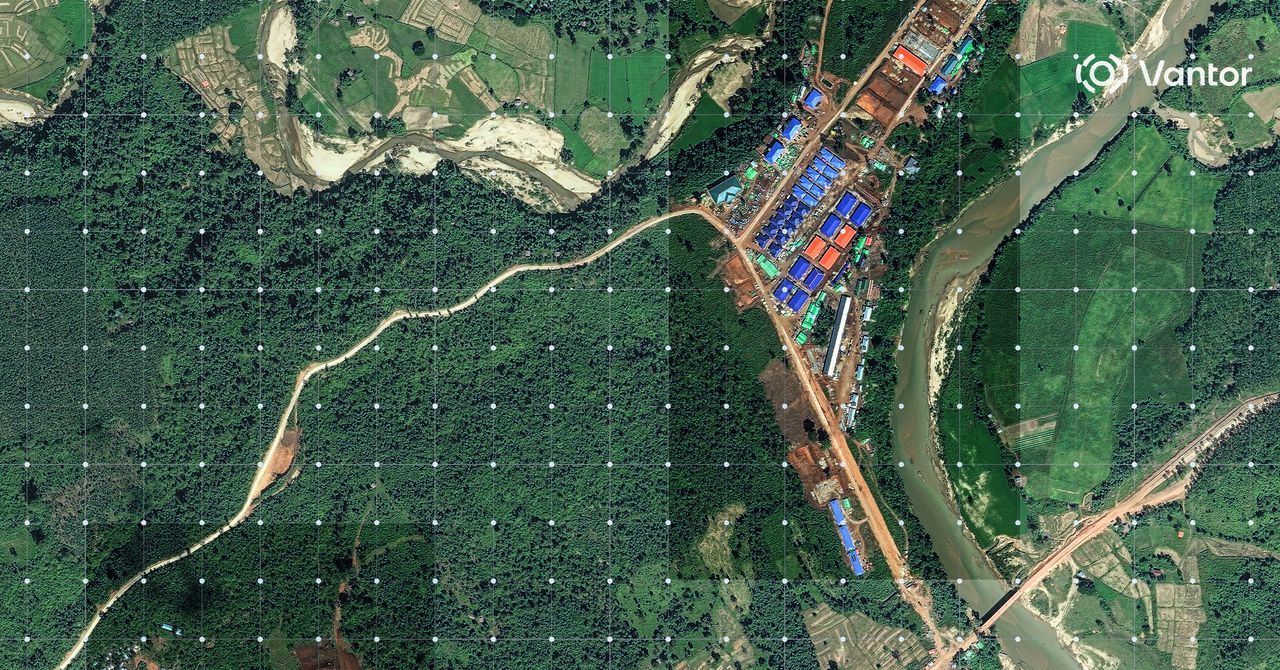
At least 25 suspected Myanmar scam compounds have been built or substantially expanded near the Thai border since around the start of the year, according to satellite imagery analyzed by the International Justice Mission and reviewed by WIRED. The finding points to a blunt result from Myanmar’s highly visible raids last year: some buildings were destroyed, but the business appears to have kept scaling.
The sites are in the Myawaddy region, an area already associated with large online fraud operations. Eric Heintz, a global analyst at the International Justice Mission, told WIRED that satellite images show cleared forest, leveled ground, new roads and clusters of buildings appearing over a short period. At one location, roughly two dozen buildings showed up between January and April, according to WIRED’s review.
Heintz said some of the developments were already beginning around the time of the crackdown, while other construction appears to have started around January. In his assessment, the new capacity may more than replace what was damaged in last year’s raids.
What are Myanmar scam compounds?
Myanmar scam compounds are alleged criminal sites where organized groups run online fraud operations at industrial scale, including cryptocurrency and romance scams. Anti-trafficking groups say many of the people doing the scamming are trafficking victims who were lured with fake job offers, stripped of documents and forced to work under threat of violence.
Over the past decade, similar compounds have spread across Myanmar, Cambodia and Laos, according to WIRED. The operations are often linked to Chinese organized crime groups and have been tied to billions of dollars in losses from victims in the United States and elsewhere. Anti-trafficking groups say people from more than 60 countries have been drawn into the networks, with hundreds of thousands of victims tricked into compounds in recent years.
Myanmar’s military junta staged raids on some known compounds starting around October, ahead of elections, according to WIRED. Authorities blew up buildings and crushed phones and computers used in fraud operations. International sanctions were also issued last year against people allegedly involved in or connected to compounds in Myanmar and Cambodia.
Mechelle B. Moore, CEO of Global Alms Incorporated, an anti-trafficking nonprofit based in Thailand near the Myanmar border, told WIRED that her group has identified at least a dozen new sites. She said some previously raided areas have been repopulated, while other construction was underway late last year without attracting public attention.
The Associated Press first noted some of the new and expanding sites in June, according to WIRED. Heintz said their layouts resemble more than 30 larger compounds already known in the area. He also said the International Justice Mission has not interviewed escapees from the newly identified sites, but is aware of people inside them.
Heintz’s assessment does not rest on rooftops alone. He told WIRED that many of the sites are remote and have no obvious alternative use in the region. He also cited technical data showing multiple foreign internet service providers associated with the locations.
Connectivity remains one of the more awkward parts of the story. Heintz has previously used mobile advertising industry data to study devices and internet providers at known compounds, including Starlink, SpaceX’s satellite internet service. A WIRED investigation last year found at least eight Myawaddy-area compounds that appeared to be using Starlink equipment, including rooftop antennas. US law enforcement officials later ordered the seizure of Starlink terminals used at some compounds.
Heintz told WIRED that Starlink terminals appear to be in use at at least half of the newly identified locations. Starlink did not immediately respond to WIRED’s request for comment, but has previously said it cut service to 2,500 devices linked to scam compounds in Myanmar. The Embassy of Myanmar in London also did not immediately respond to WIRED.
Moore said Global Alms has drone footage confirming people at nine sites her group believed had been emptied. Her conclusion was unsparing: raids have moved people around, while the organizations behind the compounds remain largely intact.
This story draws on original reporting from WIRED.


