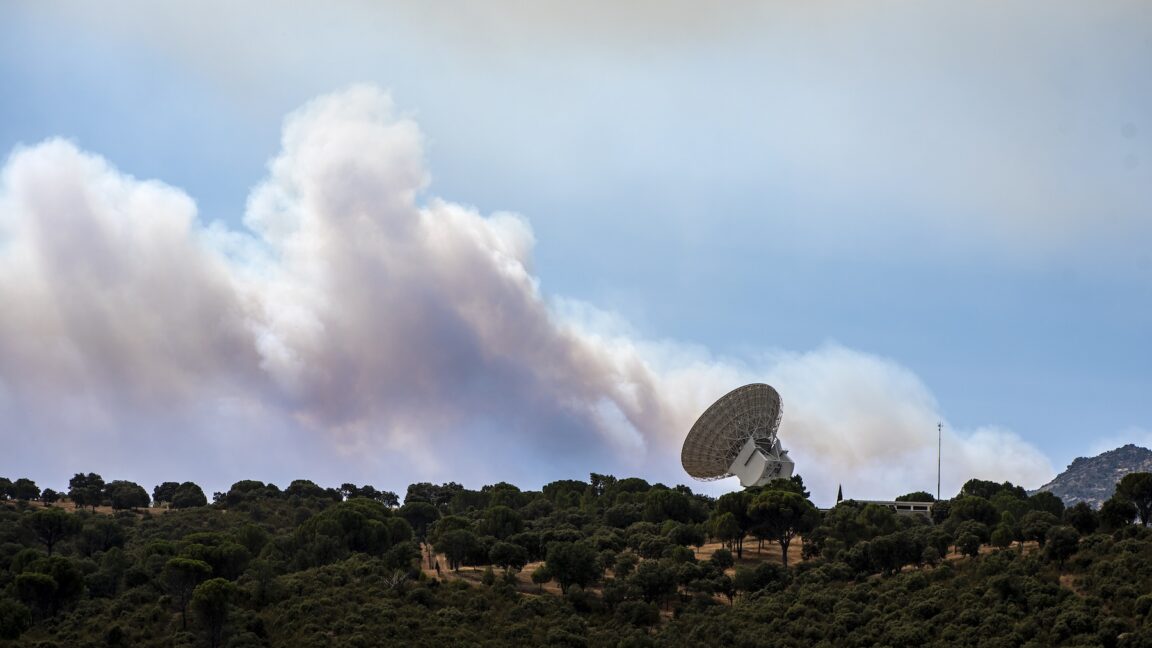
The NASA Madrid evacuation on Friday took one of the agency’s three Deep Space Network complexes out of service as wildfires spread through the mountains west of Spain’s capital. NASA said personnel left the Madrid Deep Space Communications Complex and operations there were temporarily suspended, with spacecraft communications support moved to the Goldstone complex in California.
The Madrid site sits in the hills nearly 40 miles, or 65 kilometers, west of central Madrid. Photos and video from the area showed flames and smoke near the complex’s antenna field, which includes a 70-meter, or 230-foot, radio dish and several 34-meter, or 112-foot, antennas.
A NASA spokesperson said any damage would be checked once conditions allow crews to return safely. The agency said it is tracking the fires with local authorities and the US Embassy. NASA’s Space Communications and Navigation program and the Jet Propulsion Laboratory manage the Deep Space Network.
What does the Madrid Deep Space Network station do?
The Madrid complex is one leg of NASA’s Deep Space Network, the radio system that talks to spacecraft far beyond low-Earth orbit. Its sister sites in Goldstone, California, and Canberra, Australia, give NASA near-continuous coverage as Earth rotates and different spacecraft rise and set in each station’s sky.
The network supports more than 40 missions, according to NASA, including Artemis, the James Webb Space Telescope and the twin Voyager spacecraft. That is not background plumbing. If the DSN is constrained, mission teams have fewer high-gain antennas available for commands, telemetry and science data, which means scheduling gets tighter fast.
NASA said it had “seamlessly transitioned” mission support to Goldstone and that spacecraft communications were continuing without interruption. A NASA status page on Friday afternoon showed no Madrid activity, while antennas in California and Australia were communicating with missions including Voyager 2 and Juno.
Why losing Madrid is awkward for NASA
NASA normally runs the DSN with a “follow the Sun” staffing model: control centers at the three sites can operate the network remotely during local daytime hours, while the antennas themselves work around the clock. Removing one site does not blind NASA, but it narrows the system at a bad time for a network that already has scarce capacity.
The 70-meter antenna at Goldstone has been offline since last year after an accident over-rotated the structure, damaging cables and water lines. The incident flooded the antenna’s base with 200,000 gallons of water containing glycol, an environmental hazard. Repairs and cleanup are expected to cost between $4.1 million and $4.6 million, and NASA officials are combining that work with planned upgrades. The antenna is expected to remain offline into 2028.
With Madrid unavailable, the DSN has one operational 70-meter dish left, in Australia. Smaller antennas remain part of the network, but the big dishes are the scarce assets for faint, distant spacecraft signals. The timing is less punishing than it could be because the next Artemis flight to the Moon is still at least a couple of years away. Artemis missions add heavy DSN demand because human spaceflight needs extra telemetry and imagery downlinks.
Spanish news reports said the nearby Cebreros tracking station, operated by Spain’s government and the European Space Agency as part of ESA’s Estrack network, was also evacuated because of the fires.
Reuters reported that Spanish authorities ordered more than 19,000 people to evacuate towns in the mountains west of Madrid. More than 2,000 personnel and 10 aircraft were deployed to fight the fires. Reuters also reported that a summer heat wave and long-running drought have created dangerous wildfire conditions across Spain and France.
This story draws on original reporting from Ars Technica.