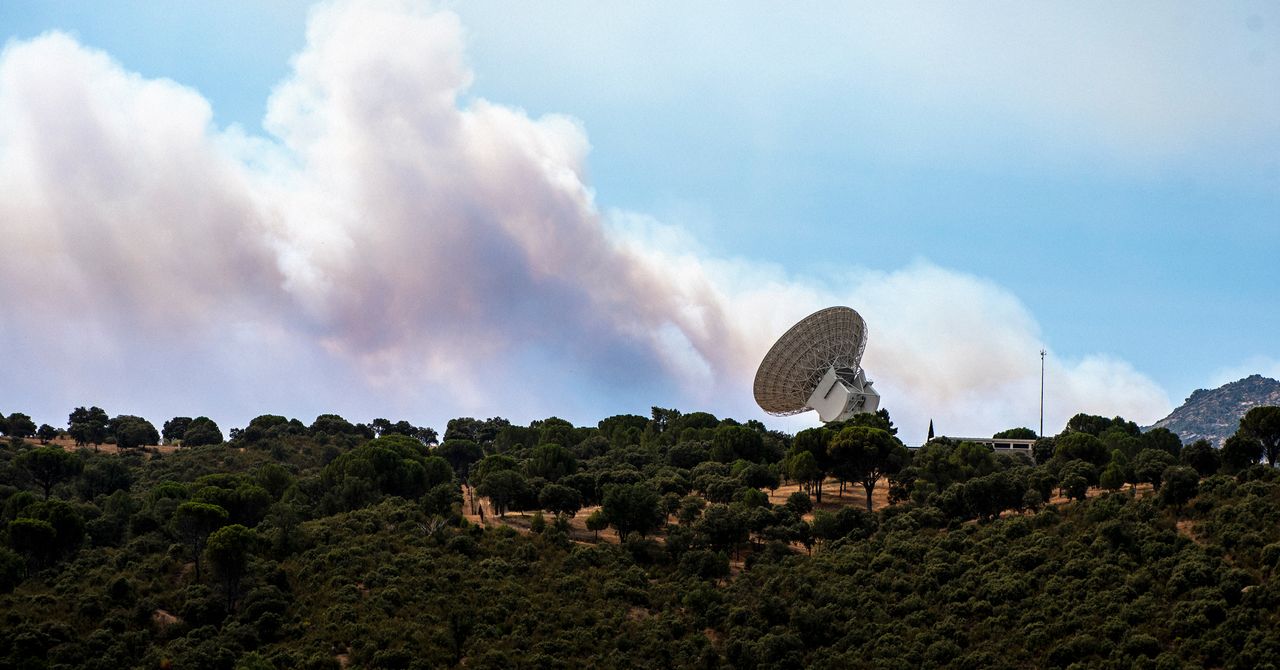
A wildfire has swept through a NASA observatory in Spain that helps the agency talk to spacecraft across the solar system, including Voyager 1 and the James Webb Space Telescope. NASA told WIRED that all personnel were evacuated from the Madrid-area site and that the agency had moved mission support to its Goldstone complex in California.
The affected facility is the Deep Space Communications Complex near Robledo de Chavela, west of Madrid. Spain declared a wildfire emergency as several fires burned near the capital, with evacuation orders covering 60,000 people, according to WIRED.
News photographs showed the site's radio telescopes surrounded by smoke and flames. NASA said the fire had passed through the complex, but the agency had not yet determined whether the equipment was damaged. A NASA spokesperson told WIRED that any damage assessment would wait until crews could enter safely, and that an inspection could happen as soon as Saturday if conditions allowed.
For spacecraft operators, the immediate problem is continuity. NASA said it had shifted support for mission operations to the Goldstone Deep Space Communications Complex in California, maintaining spacecraft communications while the Spanish site remains under assessment. That is the bureaucratic version of a failover, and in this case the backup is another continent with big antennas.
What is NASA's Deep Space Network?
NASA's Deep Space Network is a three-site radio communications system with facilities in Spain, Australia, and California. NASA describes it as the world's largest and most sensitive scientific telecommunications system, used to send commands to spacecraft and receive data from missions far beyond Earth orbit.
The Spanish complex works alongside sites in Canberra, Australia, and Goldstone, California. The spacing is the point: as Earth rotates, at least one facility can usually keep a spacecraft in view. The network supports communications with Voyager 1, which NASA identifies as the most distant human-made object in the solar system, and receives data from the James Webb Space Telescope. The same infrastructure also supports radio astronomy observations.
The fire near NASA's Spanish facility is part of a wider wildfire emergency in Europe. The Associated Press reported that roughly 200,000 people have been told to evacuate across Spain and France. In France, fires have also burned out of control, including one moving toward the Bordeaux metropolitan area.
French interior minister Laurent Nunez told national television channel TF1, in remarks cited by PBS, that a wind shift had turned one fire into a large, self-sustaining blaze that was difficult to control. He said responders were reorganizing efforts on the ground to prevent it from advancing toward Bordeaux.
Europe has also been dealing with record high summer temperatures, repeated heat domes over the continent and the UK, and climate change, according to WIRED. Hot, dry weather leaves vegetation ready to burn when a spark arrives, which is the part of wildfire physics that does not care about whether the nearby hardware talks to deep-space probes.
Cooler weather was expected in the Mediterranean over the weekend, which could help firefighters. WIRED reported that the break may be brief, with temperatures forecast to rise again Monday and keep climbing through the week, potentially reaching 10 degrees Celsius, or 18 degrees Fahrenheit, above normal.
This story draws on original reporting from WIRED.