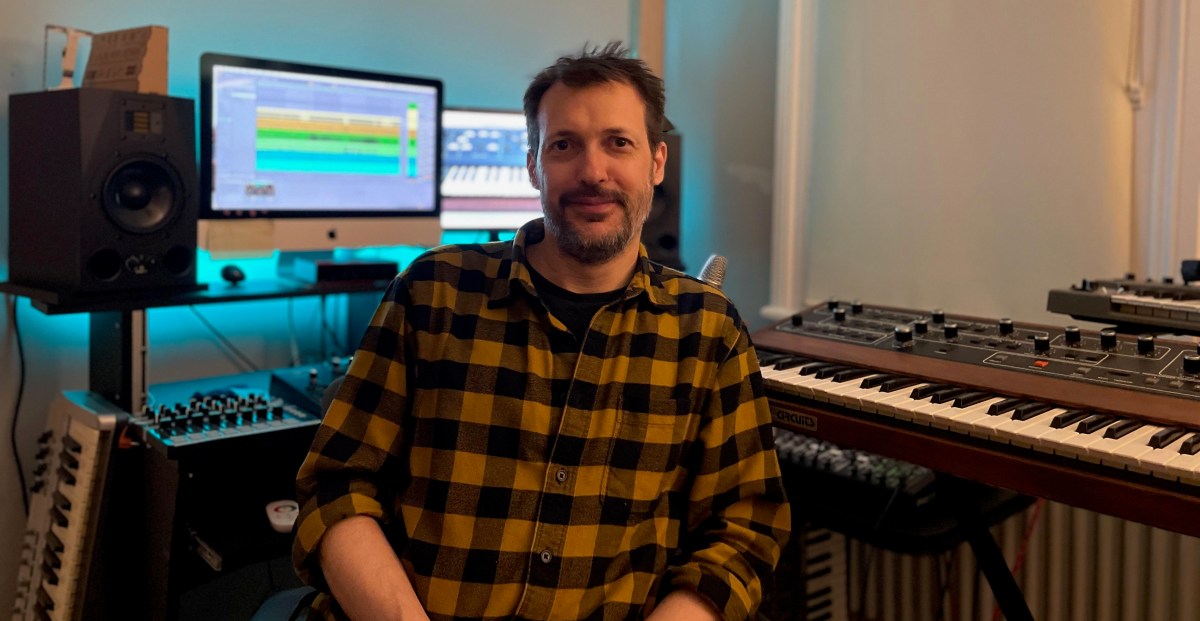
Oli Freke’s Beat Gems is the next project from the musician and journalist best known for writing about electronic instruments with a working musician’s patience for actual knobs, timing, and signal flow. In a Verge interview with Terrence O’Brien, Freke discussed the forthcoming Bjooks title, his music software habits, and why a serious road bicycle is one of the few things he thinks deserves a splurge.
Freke has written for Sound on Sound, The Quietus, and Mixmag. His previous work includes articles on the melodic possibilities of the Western 12-tone scale, coverage of Ableton Live’s Granulator III, and a book on synthesizer history that follows the instrument from 1963 to 1995, including the swing from analog machines to digital systems and back again.
His current assignment is Beat Gems, a coffee-table-style book from Bjooks about drum machines in modern music. According to The Verge, the book follows the format of other Bjooks releases: large-format photography, historical context, and practical guidance for musicians using the gear rather than just admiring it on a shelf.
What is Oli Freke’s Beat Gems book?
Beat Gems is a visual history of drum machines, covering instruments that helped define electronic rhythm, from vintage hardware such as Roland’s TR-808 to newer devices including Erica Synths’ Pērkons. Freke told The Verge that working on the book has reinforced for him how central rhythm is to music and how drum machines have changed musical culture over roughly six decades.
That claim is easy to oversell, so the useful version is narrower: drum machines turned repeatable, programmable rhythm into a portable creative tool. Once artists could store patterns, tune synthetic percussion, and lock machines to other instruments, rhythm sections stopped being only a performance problem and became a compositional system.
Freke’s own workflow still starts with software. Asked which app he installs first on a new computer, he named Ableton Live, saying a new machine would likely be his music computer. He contrasted modern production software with his early electronic-music setup on an Atari ST 520, which he said could handle MIDI but no audio.
Freke also described YouTube as the social platform he uses most, if it counts as social media. He said he watches material on science, math, chess, and electronic music, while also criticizing the pull of algorithmic clickbait and saying he is not a heavy user of other social platforms.
His answers sketch a familiar kind of electronic-music nerd: the person who can enjoy a meme about hard sync and pulse-width-style effects, then buy the Resynator soundtrack on vinyl. Freke said the last physical media he bought was the soundtrack to Resynator, a film about an obscure early-1980s synthesizer and the daughter of its inventor learning about him after his death.
Freke’s focus method is equally specific. He said he puts on Rinse FM’s Kool stream and listens to drum-and-bass rollers when he needs to work. When stuck, he thinks about the number of possible idea combinations, referring to an article in which he calculated 82 quintillion possible 10-note melodies using the eight notes of an octave.
The bicycle bit is not a stray lifestyle flourish. Freke told The Verge that a high-quality road bike is worth paying for because bikes cost little compared with cars, yet buyers can get close to professional-grade machines for relatively reasonable money. He said the gap between an ordinary bike and a good one is large, and that riding through the countryside on one gives him considerable joy.
This story draws on original reporting from The Verge.