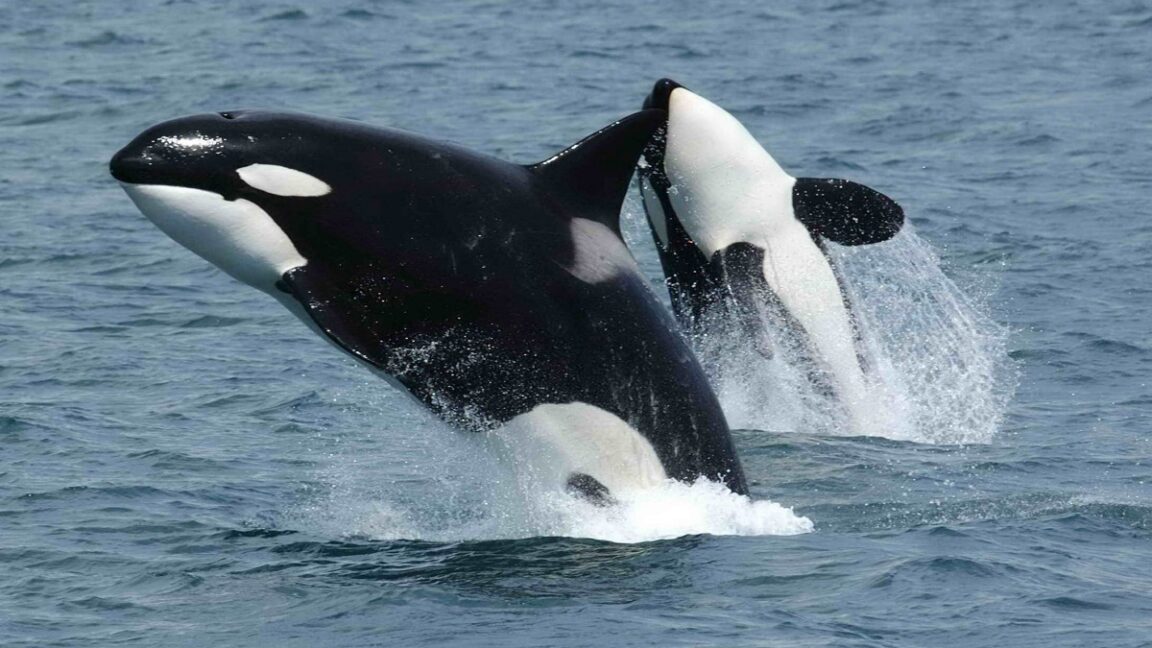
Orcas in Mexico’s Gulf of California have been filmed working together to smash dead sunfish into bite-size debris, according to a paper published in Frontiers in Ethology. The researchers describe the behavior as a food-processing tactic, and possibly play, rather than a strike meant to kill prey.
The observations add another entry to the growing file of orca behavior that looks a lot less like brute force and a lot more like learned technique. Orcas already have documented cooperative hunting methods: they herd rays, block sharks from escaping, knock penguins from ice with waves, and have been seen ramming whale sharks while another orca holds the animal in place. The new paper says these sunfish encounters differ because the impact breaks the carcass apart so extensively.
Kathryn Ayres of the ocean-health nonprofit Beneath The Waves, a co-author of the paper, said the behavior may make feeding easier for younger animals, or may be play. Ayres also said orcas are known to play with their food.
Two filmed encounters in Mexico
The first recorded case happened in July 2024 near San Jose del Cabo, Mexico. A tourism operator filmed three adult female orcas, one male, and one juvenile as they caught and ate a spine-tail devil ray. Soon afterward, the same operator recorded an adult female carrying a sunfish carcass in her mouth.
According to the researchers, the sunfish already had a large wound along its side, suggesting the internal organs had been removed before the ramming began. The male orca then accelerated toward the carcass. The female let go just before impact. The collision produced an audible sound, and the carcass broke into scattered pieces. The juvenile ate smaller fragments while the adults fed from the remaining split body.
The second case was filmed in September 2025 in the channel of Isla Cerralvo, also in the Gulf of California. An adult orca held a dead sunfish while another orca hit it at speed, breaking the body apart. The holding orca then moved through the pieces and handled them with its mouth, while the ramming orca, another adult, and a juvenile ate from the remains. The same group had been seen hunting a mako shark earlier that day, the paper says.
A processing trick, not a killing blow
Researchers describe the behavior as “ram-to-fragment” foraging. That label is clinical, but accurate enough: one orca pins or presents the carcass, another supplies the kinetic energy, and the fish comes apart.
Orcas already have a known method for feeding on sunfish. They typically target the pectoral fins, cut through the body to remove the viscera, then use the beak area to reach remaining tissue. In both new observations, the sunfish were already dead and apparently missing their viscera before the high-speed hits. That points to carcass processing rather than predation.
The authors suggest the technique may be specific to sharp-tail sunfish. They note that the species’ body may respond to impact in a way that makes fragmentation more likely, while its rudder-like tail gives an orca a convenient place to grip the carcass. That is a hypothesis from two recorded events, not a settled rule of orca cuisine.
The juvenile feeding in both encounters raises another possibility: adult orcas may be reducing large prey into smaller pieces that younger animals can manage. The fact that the groups had already fed on other prey also leaves room for a less tidy explanation, play. Orcas ramming boats have also been discussed by scientists as a possible culturally learned game.
Ayres said better identification photos remain important because researchers are still documenting new orca hunting and prey-processing techniques. The paper was published in Frontiers in Ethology.
This story draws on original reporting from Ars Technica.