The Palestinian Museum in Birzeit has turned a cultural preservation project into a redundancy problem: scan the material, describe it properly, copy it elsewhere, and assume the building or the server may not be there later.
Amer Shomali, the museum’s general director and a visual artist, says the work has become more urgent since October 2023, as Gaza’s cultural institutions and historic sites have been damaged during Israel’s war in the territory. Shomali said that within one week Israel struck two art galleries, seven museums, two major archives in Gaza and hundreds of archaeological sites. His account could not be independently verified here, but Unesco says it had confirmed damage to 164 cultural sites in Gaza as of March 24, 2026, including historic buildings, religious sites, museums and archaeological locations.
The museum’s answer is the Palestine Museum Digital Archive, an open-source collection that began in 2018 with staff visiting Palestinian families in the West Bank and asking to scan photographs, letters and records. It now contains more than 500,000 digitized items, according to the museum, including photos, identity documents, diaries, maps, films and correspondence.
The point is not glamorous software. It is custody. A photograph in one family drawer can burn, be lost in displacement, or disappear into a private collection. A scanned file with metadata, translations and backups has a better shot at being found again. Annoyingly for anyone who wants a magic fix, the mechanism is mostly patient archival labor.
A museum with a network problem
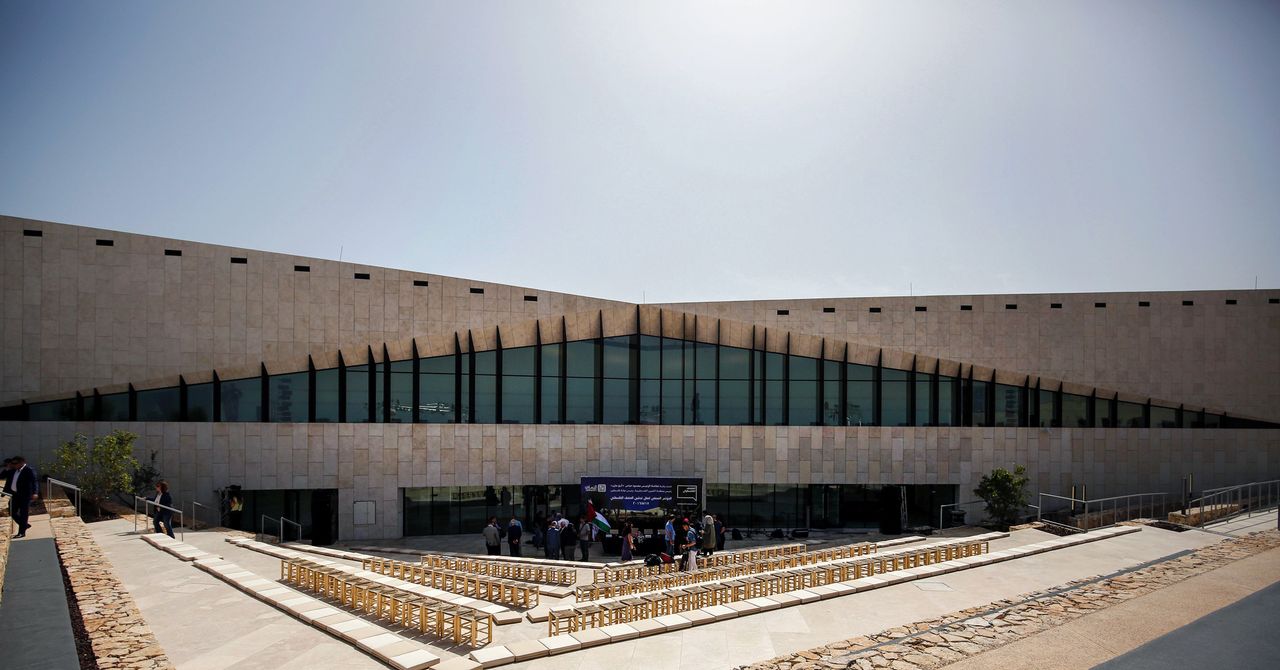
The Palestinian Museum’s physical site is itself part of the story. The building, designed by New York-based Heneghan Peng Architects, sits in Birzeit in the occupied West Bank and houses Palestinian collections including work connected to photographer Khalil Raad and artist Vera Tamari. Shomali says checkpoints make the museum difficult for some Palestinians to reach.
Pressure on Palestinian heritage is not limited to Gaza. A 2025 report by the Applied Research Institute-Jerusalem said at least 2,400 archaeological sites in the West Bank had been taken over by Israel. Reuters reported in June that Israeli lawmakers were advancing legislation to put ancient sites in the occupied territory under Israel’s Ministry of Heritage, a proposal Palestinians and Israeli rights groups described as de facto annexation.
Shomali says about 80 percent of Palestinian national collections have been looted, destroyed or remain under Israeli control. That figure is his estimate, and it explains the museum’s design assumption: do not keep memory in one place.
According to Shomali, copies of the archive are stored in multiple countries. He said the archive’s website is hit by cyberattacks almost every month, and staff bring it back using backups. The claim is blunt and technically modest: the museum says it cannot guarantee the site will not be hacked, but it can reduce the chance that the archive vanishes.
The hard part is the metadata
The project is run by three full-time staff focused on digitization, metadata and research, with support from volunteers. Funding comes from diaspora donations and partnerships with the University of California and the Gerda Henkel Foundation, according to the museum. The team is also looking at a bot that could read Ottoman Arabic, which would help process older records if it works well enough for archival use.
Mohammad Rabae, who oversees digitization, said some material arrives in poor condition, with torn pages and fading handwriting. He cited a 19th-century Bible printed in Jerusalem and a brittle Palestinian newspaper from 1930 among the delicate items staff have handled. Rabae said digitization also requires attention to the privacy and dignity of people represented in the records.
The archive is already being reused outside Palestine. One museum initiative lets people download and print exhibition materials, a low-cost kit Shomali describes as an exhibition in a box. The museum says that project has been staged more than 260 times and translated into five languages.
Artist and curator Leyya Mona Tawil used the archive for a San Francisco exhibition in May 2026, calling it a living archive of a society under threat. In Spain, curator Pablo Llorca spent two months working through archive images before opening To Tell My Story in Madrid in October 2025. That exhibition has since traveled to about 15 Spanish locations, according to the museum.
The archive does not save buildings, families or artifacts already lost. It gives the surviving record more places to live, which in this case is the technical architecture and the political argument.
This story draws on original reporting from WIRED.


