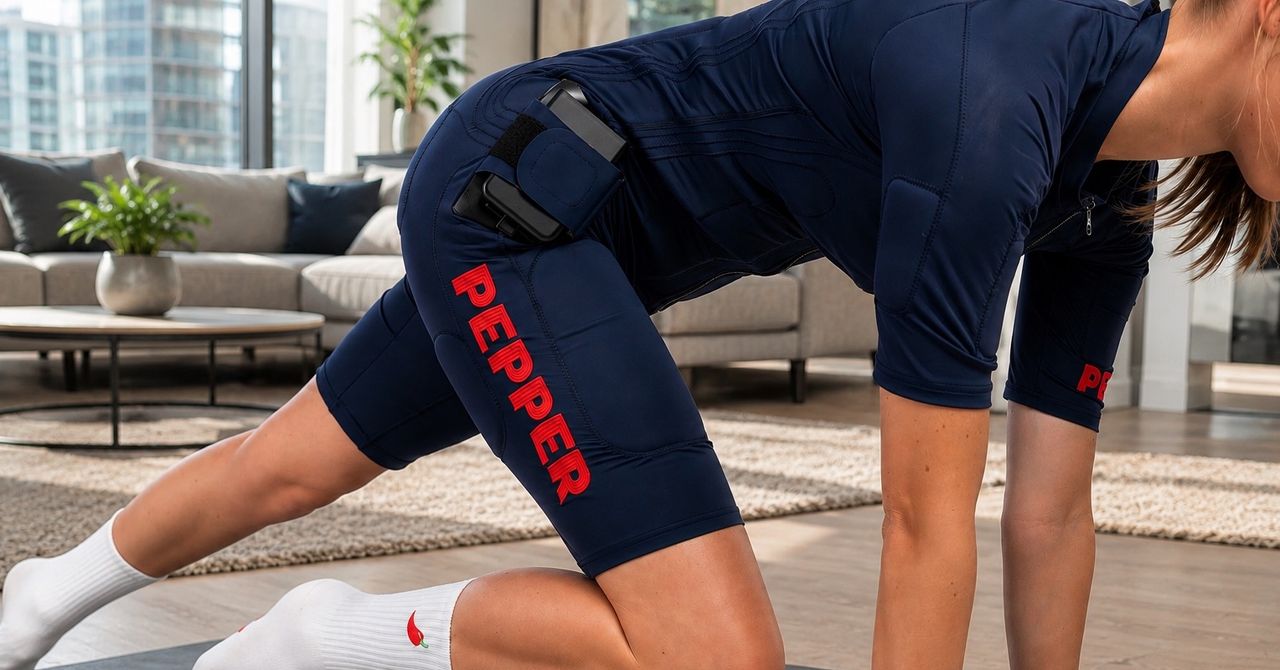
A Pepper EMS suit review published by Wired examines the sales pitch behind at-home whole-body electrical muscle stimulation: wear a suit fitted with electrodes, perform exercises, and let electrical pulses add forced contractions across major muscle groups. Pepper, the German manufacturer that supplied the suit for the test, says 20 minutes can match the calorie burn and muscle activation of an hour of conventional exercise, with less stress on joints. That is a company claim, not an established equivalence.
The important mechanical detail is less futuristic than the marketing suggests. An EMS system sends impulses through electrodes into muscle, prompting contractions while the user moves or flexes. The suit does not turn a motionless person into a fitness project. Wired notes that the wearer still has to activate the muscles during exercise.
Do whole-body EMS suits actually work?
They can cause muscle contractions, and the evidence points to possible benefits in specific settings. Whether that makes an EMS suit a replacement for resistance training in healthy people is much less settled.
Wired cited a 2021 meta-analysis that found large effects of whole-body EMS on muscle mass and strength measures, but not body-fat mass. It also cited a 2023 analysis in which resistance training combined with daily EMS over eight weeks improved muscle mass, upper-body strength and body-fat percentage in healthy participants. Those findings describe EMS alongside ordinary training, not a person lying around while a vest does the work.
ABC News reported that EMS may recruit muscle motor units in a different order from voluntary exercise, a proposed reason it could help with muscle development. But the outlet also reported that a review of 10 studies found stimulated muscles grew in healthy adults without showing improvements in functional strength, the kind that makes everyday tasks or gym movements easier.
That limitation is not a footnote. Exercise relies on coordinated action among muscles, with some contracting while others lengthen or stabilize a joint. EMS can trigger contractions, but it does not automatically reproduce that coordination. That is why EMS is commonly combined with conventional movements rather than used in isolation, according to ABC.
Where does EMS have the clearest use?
Rehabilitation is the more defensible case. A University of Melbourne researcher told ABC that evidence for muscle adaptation and recruitment is strong for people unable to exercise because of illness or injury. Wired similarly reported that physicians saw value in rehabilitation and critical-care settings involving severe mobility limits.
For otherwise healthy users, the evidence is more conditional. Joseph R. Hribick, a Lebanon Valley College physical-therapy professor quoted by Wired, said available research does not show EMS alone outperforming strength training and that it should supplement, rather than replace, resistance work. Another physician told Wired he uses EMS as an addition to his own workouts.
Wired reported that its writer found at least five consumer EMS-suit makers during the reporter’s search, with Pepper priced at $1,400 and an Apeborn option at $4,000. Those were reported prices at the time, not a current market check. Studios including Body20 and Manduu also pair electrode-equipped clients with trainers and promote sessions of 20 minutes or less.
The clean reading of the research is not that the electricity is fake. The leap from electrically induced contractions to an hour of proven, whole-body fitness is where the advertising gets ahead of the record.
This story draws on original reporting from WIRED.