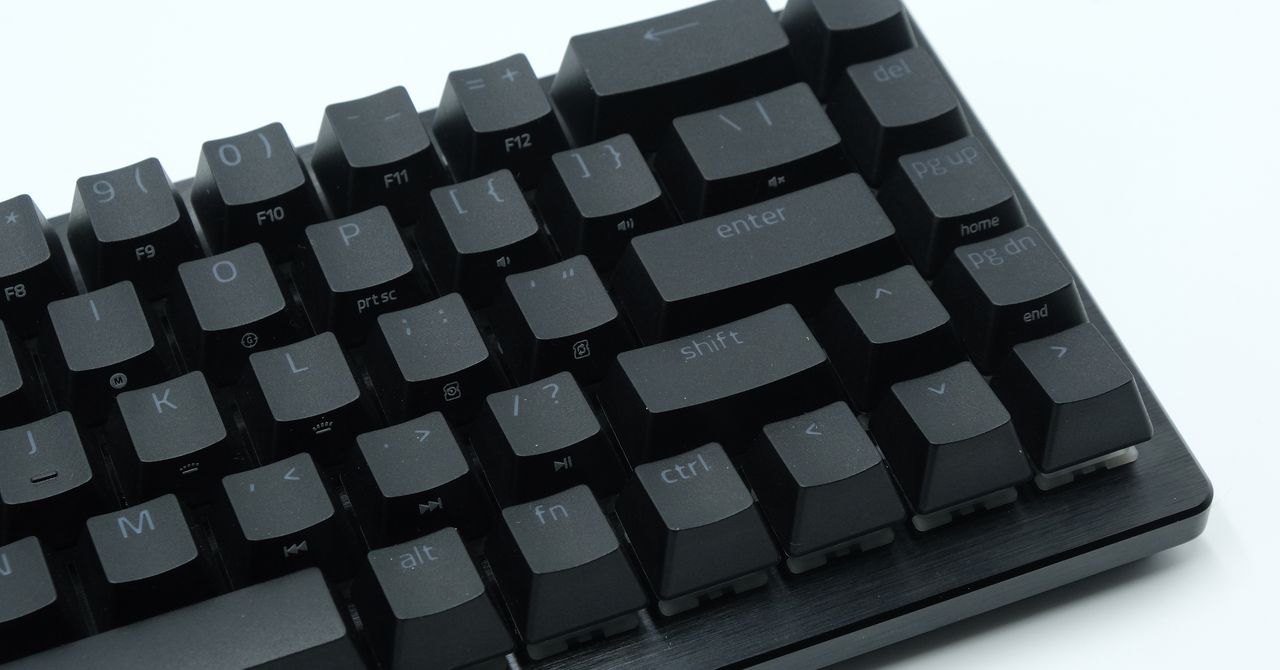
Razer’s Huntsman V3 HE is the company’s first Hall effect gaming keyboard, and a Razer Huntsman V3 HE review by WIRED’s Henri Robbins says it lands as a competent, gaming-first board rather than a radical reset of Razer’s keyboard line.
The shift is notable because Razer has spent years backing optical switches. According to Razer representatives cited by WIRED, the company still considers optical switches more accurate and less vulnerable to outside interference, including electromagnetic fields or a metal desk. Customer demand for magnetic switch keyboards appears to have forced the issue anyway.
The Huntsman V3 HE uses Razer-branded linear Hall effect switches and comes in 65 percent and tenkeyless layouts. WIRED reports pricing at $120 for the smaller version and $140 for the TKL model. Both are currently sold only in black and use wired connectivity.
What does the Razer Huntsman V3 HE actually change?
Hall effect keyboards use analog switch sensing, which lets the board read how far a key has been pressed rather than treating every keypress as a fixed on/off event. On the Huntsman V3 HE, WIRED says users can set actuation from 0.1 mm to 4.0 mm, covering almost the full travel of the switch.
That enables gaming features such as Rapid Trigger, which registers a new input based on key movement instead of waiting for the switch to cross a fixed reset point. WIRED found Razer’s implementation broadly comparable to competing systems and useful for faster repeated inputs in games.
The keyboard also supports Dynamic Keystroke, Snap Flex and controller-style analog input emulation. Robbins wrote that Razer Synapse makes those settings unusually easy to change, with clear controls, tooltips and animations. That software polish is one of the board’s stronger arguments, especially for players already living inside Razer’s device stack.
Razer also includes 8,000 Hz polling, meaning the keyboard reports to the PC 8,000 times per second. WIRED notes that this is high-end peripheral territory, but says it is likely excess for most users outside elite competitive play. Mechanical keyboards can also offer high polling rates, so the feature is not unique to Hall effect switches.
Where does the Huntsman V3 HE fall short?
WIRED’s testing found the switch feel acceptable but inconsistent. Robbins reported smooth keypresses overall, but some switches felt over-lubed, and the tray-mount construction created small stiffness differences depending on key position. The 40-gram springs were described as light, similar in weight to Cherry MX Reds, though not especially quick on the return.
The spacebar drew the sharpest criticism. WIRED said foam strips under the key changed the sound and made the bottom of the press feel soft on the review unit. Because the spacebar is a standard 6.25-unit size, Robbins found that replacing it improved both sound and feel.
The case is also plain Razer: metal top plate, plastic bottom shell, tray-mount design and internal foam. WIRED says the design is easy to open for repairs or modifications, but the plastic base feels thin and could be more vulnerable to damage around the threaded posts during repeated disassembly.
There were software or firmware rough edges, too. Robbins reported an N key that began repeating continuously until another key was pressed, and said a full reset fixed the problem. WIRED also observed sporadic missed inputs during typing at multiple actuation settings, though the review could not rule out every possible user-side cause.
The verdict is narrow but clear: WIRED found the Huntsman V3 HE to be a solid Hall effect keyboard for Razer users and competitive players who want easy tuning and 8 kHz polling. Buyers looking for wireless support, a premium case or a consistently refined typing feel may see the compromises faster than the spec sheet does.
This story draws on original reporting from WIRED.