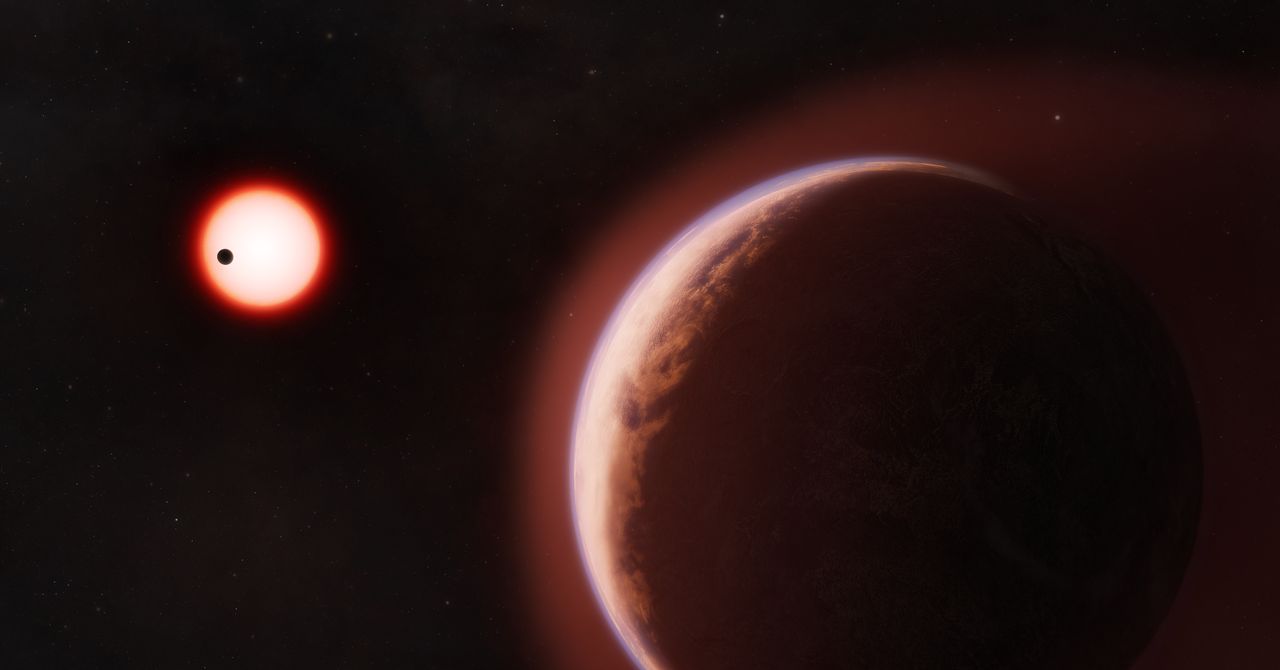
Astronomers at the Harvard-Smithsonian Center for Astrophysics say they have found evidence of an atmosphere around LHS 1140 b, a rocky exoplanet 48 light-years from Earth. The finding, published in Science, gives planet hunters a rare combination: a solid planet, inside its star’s habitable zone, with gas still wrapped around it.
That is the checklist researchers keep reaching for when they talk about worlds that could be remotely hospitable to life as we know it. LHS 1140 b now appears to be the first exoplanet with strong evidence for all three conditions, according to the researchers. That does not make it Earth 2.0, and it certainly does not prove biology. It makes the planet a better target than the usual catalog entry with a hopeful adjective stapled to it.
LHS 1140 b was discovered in 2017. It orbits a cool red dwarf star and had already been identified as rocky. Its orbit places it at a distance where liquid water could remain on the surface, assuming the rest of the planet’s environment cooperates. The new work adds the atmospheric piece.
The team used observations from 2024 and 2025 to look for helium associated with the planet. They detected helium’s spectral signature, then used physical models to infer how the gas is escaping from the upper atmosphere. According to the researchers, that leakage is strong evidence that LHS 1140 b has an atmosphere and that it has held on to one for at least 3 billion years.
The mechanism is not magic. Atoms and molecules absorb and emit light at specific wavelengths, so a gas can leave a fingerprint in the spectrum seen by astronomers. In this case, helium escaping from the planet’s outer atmospheric layers provided the clue. The modeling step matters because seeing helium leave is not the same thing as directly sampling the whole atmosphere, which would be convenient, but astronomy rarely does convenient.
The atmosphere probably does not resemble Earth’s, the researchers say. The measured helium loss points to an upper layer unlike our own. Deeper down, the planet may contain heavier gases such as nitrogen, carbon dioxide, or carbon monoxide, but the study does not claim a full inventory.
Atmospheres matter because they help make surface liquid water possible, regulate temperature, and limit harmful radiation from space. On Earth, those functions are basic infrastructure for life. Around another star, they are still evidence to be tested, not a permission slip to start naming continents.
Robin Wordsworth, a Harvard professor and one of the study’s authors, said in a press release that the field has moved from asking whether rocky exoplanets exist, to finding them in habitable zones, to asking whether they can keep atmospheres. “Now, we know at least one has,” Wordsworth said.
The next step is less glamorous and more useful: better measurements. The researchers say more powerful instruments will be needed to characterize the planet’s atmosphere and test whether LHS 1140 b has surface oceans or other conditions compatible with habitability.
This story draws on original reporting from WIRED.