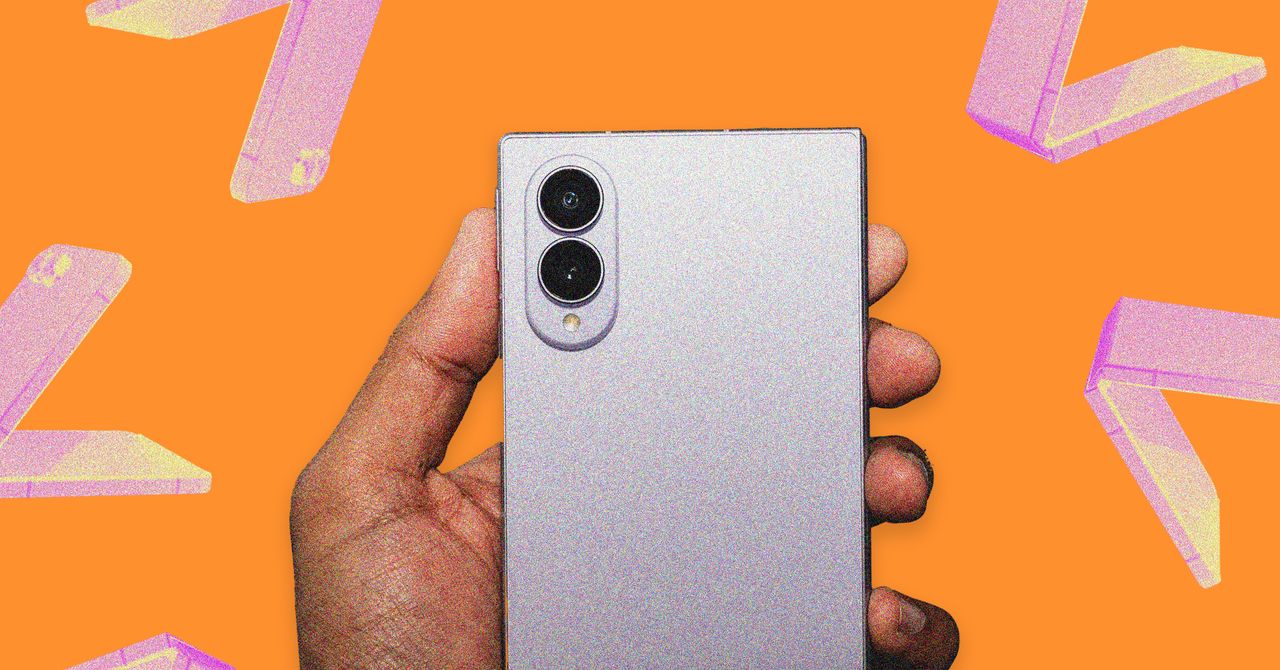
Samsung used its second Galaxy Unpacked event of the year to split its foldable phone line into more shapes, adding a new Galaxy Z Fold8 with a wider, passport-like design. The move gives buyers another expensive way to avoid a normal slab phone, and gives Samsung a hedge before Apple is expected to enter the category.
The new Fold8 sits between the larger Galaxy Z Fold8 Ultra and the compact Galaxy Z Flip8. Drew Blackard, Samsung’s senior vice president of mobile product management, told WIRED the lineup is meant to serve different uses: the Ultra for productivity, the Flip8 for portability and the new Fold8 for watching and reading.
Samsung’s argument is basically geometry. Blackard said mobile video viewing has grown sharply, with consumers now watching 80 percent of their video on phones rather than TVs or tablets. He also said video formats have shifted from horizontal streaming video to vertical social clips.
To match that, Samsung gave the Fold8 a 10:16 cover display and a 4:3 inner panel. Opened up, the phone has a 7.6-inch inside screen that Samsung is pitching as better suited to websites, ebooks, YouTube and vertical social video than the taller, narrower Fold8 Ultra.
A familiar shape, with familiar pressure
The design resembles earlier wide foldables such as Google’s first Pixel Fold and Microsoft’s Surface Duo, according to WIRED. It also looks close to the shape Apple’s first folding device is rumored to use, though Apple has not announced such a product.
Blackard said Samsung reached a turning point with last year’s seventh-generation foldables, when the devices became thinner, lighter and closer in specifications to conventional flagship phones. He cited the Galaxy Z Fold7’s use of the same 200-megapixel camera as the Galaxy S25 Ultra as an example.
Samsung has already tested more exotic hardware. Earlier this year it sold the $2,899 Galaxy Z TriFold, a limited-run device that opened into a tablet-size screen. Blackard told WIRED Samsung made roughly four U.S. drops and that each sold out in minutes. The company has since stopped selling it.
The Fold8 is still not cheap at $1,900. Francisco Jeronimo, vice president for data and analytics at IDC, told WIRED the extra format gives Samsung room to answer customers who do not want the standard book-style foldable. He said Samsung may also be positioning itself for Apple’s expected entry.
The crease gets another engineering pass
Samsung also says the Fold8 and Fold8 Ultra use a titanium display layer it calls Flex Titanium. The company claims the titanium plate and titanium-alloy film improve durability, and WIRED reported that the crease looks less obvious and feels flatter than on earlier models.
The crease still exists because foldable screens bend around a hinge. Samsung has reduced the ridge rather than eliminated the underlying physics, which is usually where phone marketing starts waving its hands.
Blackard said the Fold8 is easier to open and close, but it is not designed around sitting half-open. He expects most owners to use either the outside screen or the fully opened display, while the 90-degree “Flex Mode” use case is more likely on the Fold8 Ultra or Flip8.
Samsung claims the Fold8 is the lightest book-style foldable on the market at 201 grams, 32 grams lighter than Apple’s iPhone 17 Pro Max. Weight matters because early foldables often felt like two phones taped together, which, mechanically speaking, was not far off.
The competitive threat is getting less theoretical. IDC forecasts cited by WIRED say a folding iPhone could take nearly 30 percent of global foldable shipments in 2026 and could make Apple the category leader with one device. Blackard said more competition should make foldables more familiar to buyers, while pointing to Samsung’s eight generations of experience.
Prices are also climbing. Blackard attributed $100 increases for the Flip8 and Fold8 Ultra to memory shortages and component costs. He said Samsung’s $899 Galaxy Z Flip7 FE did not deliver the experience customers wanted, making a sub-$1,000 Samsung foldable unlikely soon.
This story draws on original reporting from WIRED.


