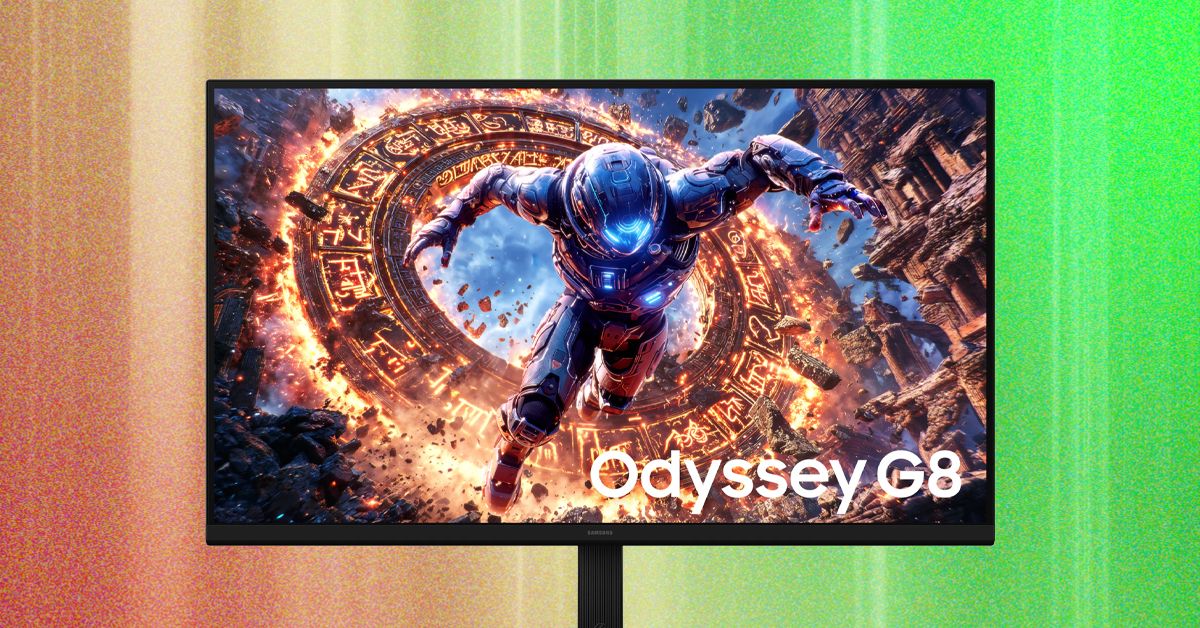
This Samsung Odyssey G8 6K review lands on an awkward conclusion: the 32-inch G80HS produces exceptional detail, yet asks buyers to pay for pixels that most gaming PCs cannot use well. Samsung’s 6,144-by-3,456 IPS monitor can run at 165 Hz at its native resolution, but reviews find its better use case is high-DPI desktop work rather than top-tier gaming.
The panel contains 21,233,664 pixels, roughly 155% more than a conventional 4K display. WIRED found that density made text, photos and small game details visibly cleaner. Monitors Unboxed similarly found the 220-PPI screen immediately sharper than 32-inch 4K displays, particularly for text and high-resolution image work.
That is a meaningful advantage for someone editing large images or keeping a 4K asset at full scale with application controls still visible. It does less for video, since WIRED noted that few sources exceed 4K. In games, extra resolution can clean up thin objects such as fences and power lines, but it does not turn 4K into a blurry mess.
Can a high-end PC run the Odyssey G8 at 6K and 165 Hz?
It can output the signal if it has DisplayPort 2.1 or HDMI 2.1, according to WIRED. Rendering a modern 3D game at that setting is the expensive part. At 6K, the GPU must draw about 2.5 times as many pixels as it does at 4K, which explains why the 165-Hz specification is more capability than practical target in demanding games.
Monitors Unboxed tested Cyberpunk 2077 on an RTX 5080 and needed the High preset, no ray tracing and DLSS Performance mode to consistently clear 60 frames per second at 6K. The same setup exceeded 110 fps at 4K. WIRED also reported that its Radeon RX 9070 XT system could not reach playable performance with acceptable settings in demanding titles at native 6K.
Samsung provides a more realistic gaming fallback: 3,072-by-1,728 at up to 330 Hz. That lower-resolution dual mode trades the monitor’s central selling point, native 6K detail, for frame rates current hardware has a better chance of delivering. Older games may add another wrinkle, as WIRED said some have interfaces that scale poorly at such high resolutions.
The display trade-offs do not stop at performance
The G80HS uses an IPS LCD panel while many competing premium gaming monitors use OLED. WIRED measured about 2,000:1 maximum contrast and judged its color, contrast and motion performance behind current OLED options. It lists a one-millisecond pixel response time, while the review notes that 4K OLED models commonly advertise 240-Hz or 360-Hz refresh rates and response times as low as 0.03 milliseconds.
Connectivity is also oddly thin for a display that has credible productivity ambitions. The monitor has one DisplayPort 2.1 input and two HDMI 2.1 inputs, but no USB-C display input, WIRED reported. A laptop owner may need another cable or an adapter instead of a one-cable desk setup.
Price makes those omissions harder to shrug off. WIRED showed a $1,600 list price with $1,300 offers when it reviewed the display, while Monitors Unboxed cited $1,600 at the time of its video. Those are snapshots, not current pricing.
A separate reviewer, Ruslan Tulupov, reported dead pixels on their unit and perceived dimming around the edges on white screens. That is one unit report, not evidence of a broader defect pattern. The larger point holds: the G80HS suits buyers who prize desktop clarity and want to experiment with 6K. Gamers seeking high frame rates, deep contrast and stronger value have a persuasive reason to choose a 4K OLED instead.
This story draws on original reporting from WIRED.


